
The short answer
Find studs on 16-in. or 24-in. centers, add a wood stringer if the maker requires one, then lag-bolt the brackets through studs or expansion-bolt into concrete. Check ceiling height (PRx recommends 99 to 113 inches depending on rack height) and folded and unfolded depth before you drill, then check every bolt with the rack empty before adding weight.
On this page 12 sections
- The short answer
- Step by step
- How much space does a wall-mounted squat rack need?
- How do I find studs and mark spacing before mounting?
- Do I need a stringer or backing board?
- What hardware do wall-mount racks use?
- How much ceiling height do I need?
- What about garage doors and folding clearance?
- How do you install a wall-mounted squat rack step by step?
- Bottom line
- Questions
- Sources
Step by step
Check ceiling height and pull-up clearance
Force USA lists 8'4" as the minimum ceiling for a full pull-up with your head above the bar on the G4, 8'3" on the G1, and 8'2" on the G20. PRx recommends 99" (about 8.25 ft, our calculation) for its 81-in. Profile PRO upright, 107" for the 89-in. upright, and 113" for the 95-in. upright, with minimums of 86", 94", and 100" respectively. Measure your actual ceiling before you order a bar height, not after.
Find studs and mark 16-in. or 24-in. spacing
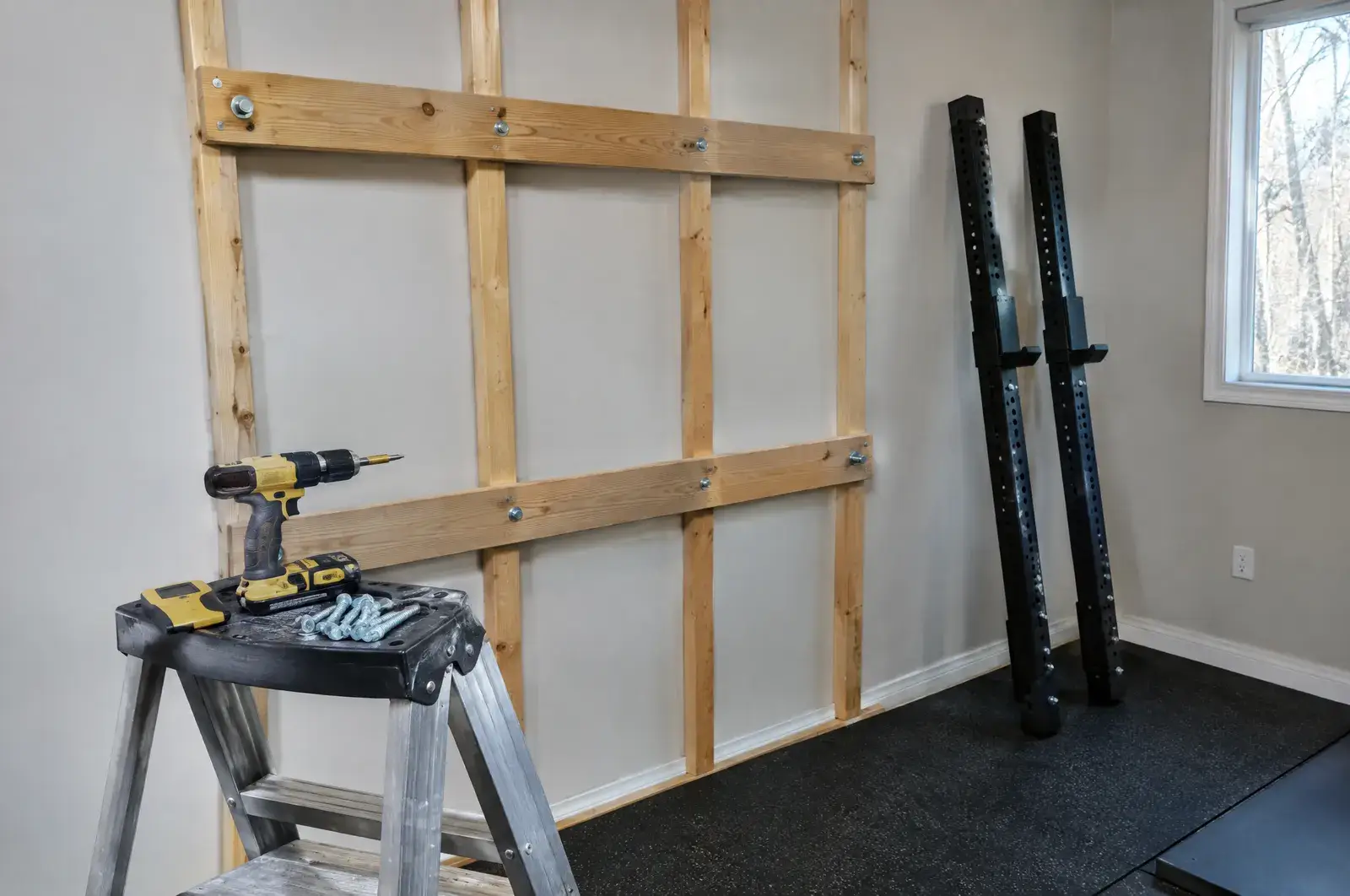
PRx brackets for the Profile PRO and Profile CORE mount to studs on 16-in. or 24-in. centers, and the company includes wood-stud hardware in the box. Use a stud finder and a level to mark every stud the bracket will cross, not just the two end points, since a rack that's off level will bind when it folds.
Decide stud-mount vs. concrete or masonry
Mikolo's QJ power cage and Cheetah folding rack both mount to wall studs or to concrete/brick/masonry. Concrete and masonry need different hardware than wood studs; REP's PR-4100 spec sheet calls for M10x90 expansion bolts on concrete walls versus M10x75 lag bolts into wood stringers.
Install a stringer or backing board if the maker requires one
REP's PR-4100 manual calls for two 2x10x56-in. wood stringers as backing. Mikolo's Cheetah page is blunt about it: "It is never recommended to install the Fold Back Rack on a drywall, wood, or metal stud wall without a stringer or additional support," and the stringer must be level and secured to four studs. If your wall has a concrete footer, Mikolo notes stringer height may need adjusting to clear it.
Mark and drill pilot holes for the brackets
Hold the bracket or stringer in place, mark bolt centers through every stud, and drill pilot holes sized for your lag or expansion bolts. Vacuum out drywall or masonry dust before you bolt anything so the bracket sits flush.
Bolt the rack to the wall
REP's PR-4100 uses eight M10x75 lag bolts plus M16x80 bolts per its hardware list. Titan's T3 and X3 folding racks ship without wall-mounting hardware at all, so you'll need to buy lag bolts or concrete anchors separately sized to your wall. Torque bolts snug against the stringer or stud face; don't leave gaps that let the bracket rock.
Check folded and unfolded clearance
PRx's Profile PRO stores 4 in. from the wall folded. REP's PR-4100 folds to 6 in. if it folds in on itself, or takes up 24 in. of side space if it folds left/right, and sits 21.5 in. or 41 in. deep unfolded depending on which fold style you choose. Titan's T3 folds to 5 in. from the wall (22.5 in. unfolded) and the X3 also folds to 5 in. (23.5 in. unfolded, 48 in. wide overall). Measure garage door travel and any side obstructions against these numbers before you commit to a wall.
Fold and unfold the rack empty first
Cycle the rack through a full fold and unfold with no bar or plates loaded. PRx's hydraulic-shock design is built for this: the company markets it as "no disassembly, no dragging equipment around." Confirm nothing binds on a light switch, shelf, or door track before you load weight.
Add optional attachments or a floor stabilizer
REP's folding rack collection supports 4000-series attachments like spotter arms ($159.99) and a dip station ($129.99) if you want extra capacity beyond the bare rack. These bolt to the upright, not the wall, so add them after the wall mount is fully tightened.
Call a licensed pro when you're not sure
Hire a contractor or structural pro for concrete anchoring, load-bearing wall questions, or any wall you can't confirm is framed with studs on standard spacing. A rack that pulls out of the wall under load is a safety issue, not a DIY learning moment.
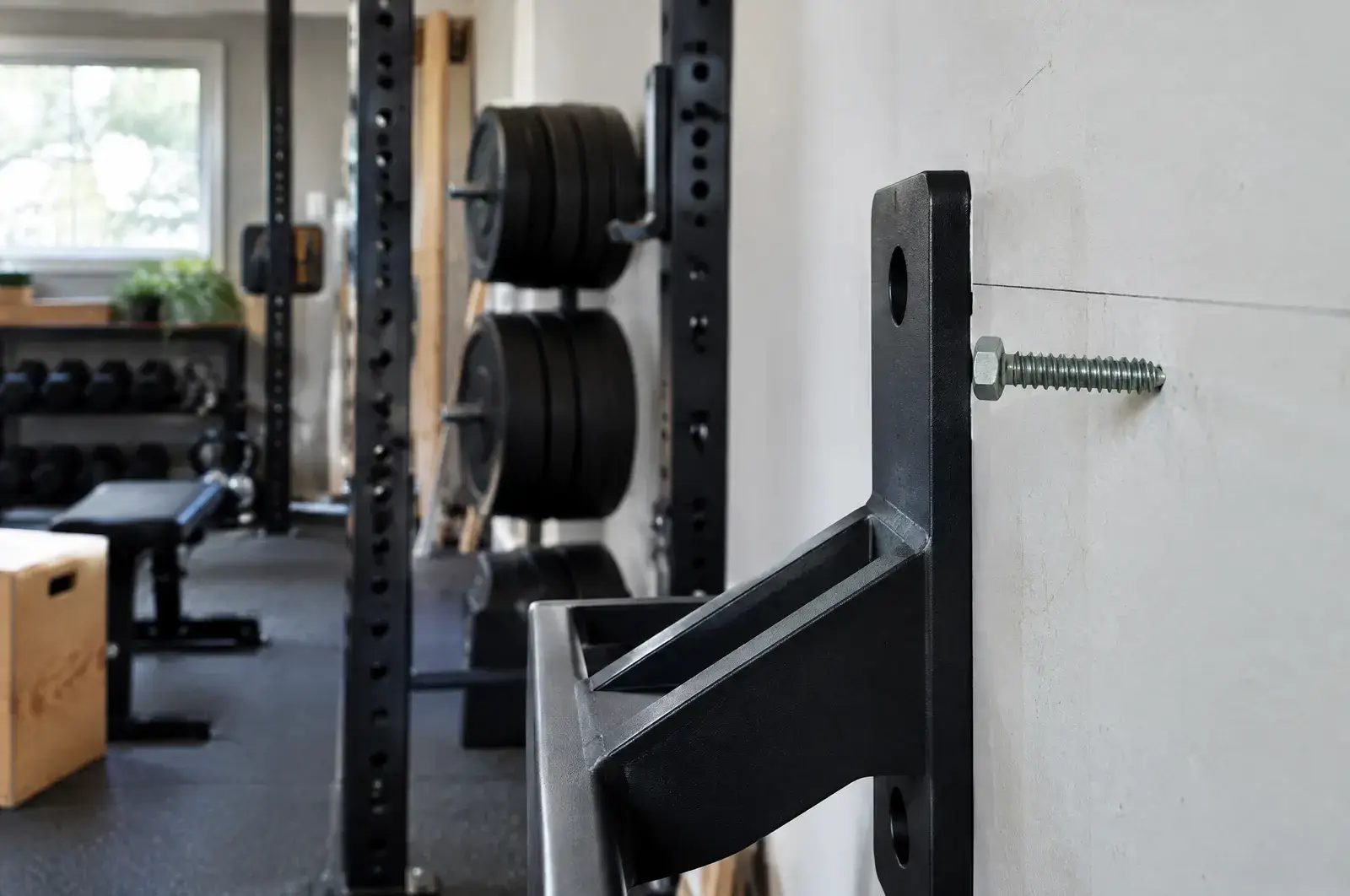
Installing a wall-mounted squat rack comes down to three checks before you touch a drill: what’s inside the wall, how much the rack folds out, and how tall your ceiling is. Get those three right and the rest is bolts and a level. Get them wrong and you’re either drilling into empty drywall or buying a rack that can’t fold past your garage door track.
This guide walks through a full install using specs published by PRx, REP Fitness, Titan Fitness, Mikolo, and Force USA. It’s based on maker specs, prices, and published installation instructions, not a hands-on install — treat torque values and hardware sizes as a starting point and confirm against your specific rack’s manual before drilling.
How much space does a wall-mounted squat rack need?
Folded depth ranges from about 4 in. to 6 in. on most name-brand racks, with unfolded depth landing between roughly 21 in. and 41 in. depending on fold style. PRx’s Profile PRO stores just 4 in. from the wall using a hydraulic-shock fold system the company describes as “no disassembly, no dragging equipment around.”
REP’s PR-4100 gives you two fold options: fold in on itself for a 6-in. wall profile at 21.5 in. deep unfolded, or fold left/right for a 24-in. side profile at 41 in. deep unfolded. Titan’s T3 folds to 5 in. from the wall and measures 22.5 in. deep unfolded at 46 in. wide; the X3 also folds to 5 in. and measures 23.5 in. deep unfolded at 48 in. wide with a 42-in. inside width. Mikolo’s Cheetah folds down to a 3-sq.-ft footprint, and its QJ power cage lists a 5-in. wall profile in its spec sheet (marketing copy elsewhere on the same page says 4 in., so the page lists both figures).
| Rack | Folded depth from wall | Unfolded depth | Wall mount type |
|---|---|---|---|
| PRx Profile PRO | 4 in. | not listed separately from clearance specs | Studs, 16 in. or 24 in. OC |
| REP PR-4100 | 6 in. (fold-in) or 24 in. (fold left/right) | 21.5 in. or 41 in. | Stringer + lag bolts; expansion bolts for concrete |
| Titan T3 folding | 5 in. | 22.5 in. | Studs (hardware not included) |
| Titan X3 folding | 5 in. | 23.5 in. | Studs (hardware not included) |
| Mikolo QJ | 4–5 in. (page lists both) | not listed | Studs or concrete/brick |
| Mikolo Cheetah | not listed (folded footprint ~3 sq ft) | not listed | 16 mount points, studs or concrete/masonry |
Measure your garage door track, any side shelving, and the walkway behind the rack against these numbers before you order. A rack that folds to 24 in. of side clearance needs a very different wall than one that folds flat to 4 in.
How do I find studs and mark spacing before mounting?
Use a stud finder to locate every stud the bracket will cross, then confirm spacing with a tape measure — PRx brackets for the Profile PRO and Profile CORE are built for studs on 16-in. or 24-in. centers, which covers most US residential framing. Mark each stud center with a level line, not just two end points, so the bracket sits flat instead of twisting under load.
If your framing doesn’t land on standard spacing, you’ll need a stringer (see below) to bridge the gap rather than trying to force a bracket to match odd stud centers.
Do I need a stringer or backing board?
If you’re mounting to wood or metal studs, most makers say yes. REP’s PR-4100 manual specifies two wood stringers cut to 2x10x56 in. as backing before the brackets go on. Mikolo’s Cheetah page is direct about the risk: “It is never recommended to install the Fold Back Rack on a drywall, wood, or metal stud wall without a stringer or additional support,” and adds that “stringer must be level and secured to four studs.”
A stringer spreads the load across four studs instead of two, which matters more as the rack folds out and adds leverage to the top brackets. If your wall has a concrete footer near the floor, Mikolo notes stringer height may need adjusting to clear it — measure before you cut lumber. If you’re mounting to concrete or masonry instead of wood, the stringer requirement doesn’t apply in the same way, but Mikolo puts the responsibility on the buyer for using correct hardware on non-wood wall construction.
What hardware do wall-mount racks use?
Hardware varies by brand and by wall type, so check your specific rack’s manual rather than assuming one bolt size fits all.
| Rack | Hardware specified | Included with rack? |
|---|---|---|
| PRx Profile PRO / CORE | Wood-stud brackets and hardware | Yes, included for wood-stud installs |
| REP PR-4100 | Eight M10x75 lag bolts, M16x80 bolts; M10x90 expansion bolts for concrete | Not stated as included/excluded in our product research |
| Titan T3 folding | Buyer-supplied wall hardware | No — “Wall Mounting Hardware NOT included” |
| Titan X3 folding | Buyer-supplied wall hardware | No — hardware not included |
| Mikolo QJ / Cheetah | Studs or concrete/masonry hardware; buyer responsible for correct hardware on non-wood walls | Not stated |
REP’s PR-4100 spec calls for eight M10x75 lag bolts alongside M16x80 bolts per its published hardware list, and M10x90 expansion bolts if you’re anchoring into concrete instead of wood. Titan is explicit that both its T3 and X3 folding racks ship without wall-mounting hardware, so factor a hardware-store trip into your budget and timeline — pick bolts rated for the wall material you actually have, not just the rack’s weight rating.
How much ceiling height do I need?
Minimum ceiling height depends on whether you want a full pull-up with your head above the bar, and on which rack height you buy. Force USA lists 8’4” as the minimum for a full pull-up on its G4, 8’3” on the G1, and 8’2” on the G20 — a full foot of variance across three racks from the same brand.
PRx ties its ceiling recommendation to upright height: the 81-in. Profile PRO wants a 99-in. (about 8.25 ft, our calculation) ceiling recommended, with an 86-in. absolute minimum. The 89-in. upright wants 107 in. (about 8.92 ft) recommended, 94 in. minimum. The 95-in. upright wants 113 in. (about 9.42 ft) recommended, 100 in. minimum. The Profile CORE, at 89 in. tall, matches the mid-tier figures: 107 in. recommended, down to 94 in. with what PRx calls a modified install.
| Model / source | Recommended ceiling | Stated minimum |
|---|---|---|
| Force USA G4 | — | 8’4” (full pull-up) |
| Force USA G1 | — | 8’3” (full pull-up) |
| Force USA G20 | — | 8’2” (full pull-up) |
| PRx Profile PRO 81-in. upright | 99 in. (~8.25 ft, our calculation) | 86 in. |
| PRx Profile PRO 89-in. upright | 107 in. (~8.92 ft, our calculation) | 94 in. |
| PRx Profile PRO 95-in. upright | 113 in. (~9.42 ft, our calculation) | 100 in. |
| PRx Profile CORE (89-in. upright) | 107 in. | 94 in. |
If your garage has an 8-ft ceiling and you want a pull-up bar, look for the shortest upright option and confirm the minimum figure, not the recommended one, still clears your actual ceiling height plus any door tracks or light fixtures in the swing path.
What about garage doors and folding clearance?
The whole point of a folding wall rack is reclaiming floor space, so check the folded footprint against your garage door track before you mount anything. REP’s PR-4100 gives you a choice: fold in on itself for a 6-in. wall profile, or fold left/right for a 24-in. side profile — the second option needs open wall space beside the rack, not just in front of it.
Mikolo’s Cheetah folds to roughly 3 sq. ft. of floor footprint, useful if you’re parking a car in the same bay. PRx’s Profile PRO folds to 4 in. using a hydraulic-shock mechanism, which the company markets as letting the rack “move with the help of hydraulic shocks” rather than requiring you to unbolt anything to fold it. Titan’s T3 and X3 both fold to 5 in. from the wall. None of these figures account for a garage door track that hangs lower than the ceiling, so measure your actual door hardware, not just wall-to-wall distance.
How do you install a wall-mounted squat rack step by step?
The full sequence — checking ceiling height, finding and marking studs, choosing stud vs. concrete hardware, adding a stringer if required, drilling, bolting, checking fold clearance, cycling the rack empty, adding attachments, and knowing when to call a pro — is laid out in the numbered steps above. Follow them in order; skipping the stringer step or the empty fold-test step is where most installs go wrong.
Bottom line
A wall-mounted rack install lives or dies on wall prep: stud spacing on 16-in. or 24-in. centers, a wood stringer if your maker calls for one, and bolts matched to wood, drywall, or concrete. Confirm folded and unfolded depth against your actual garage layout, check ceiling height against both the maker’s recommended and minimum figures, then cycle the rack empty before you load a bar. If you’re not sure the wall can take it — especially on concrete or an unfamiliar wall assembly — bring in a licensed pro rather than guessing. For general power rack background before you shop, see what is a power rack and squat rack vs. power cage; for model picks, see best folding wall-mounted power rack and best power racks. See how we research for how this guide was put together.
Questions
Do wall-mounted squat racks need studs on 16-inch or 24-inch centers?
Most do. PRx's Profile PRO and Profile CORE brackets are built for studs on 16-in. or 24-in. centers, which covers standard US residential framing. Measure your actual stud spacing before ordering brackets, since off-standard framing can leave gaps the bracket wasn't designed to span.
Can I mount a wall rack to concrete instead of studs?
Yes, on some models. Mikolo's QJ cage and Cheetah folding rack both list studs or concrete/brick/masonry as mounting options, and REP's PR-4100 spec sheet calls for M10x90 expansion bolts specifically for concrete walls. Concrete mounting needs different hardware than wood-stud mounting, so match the bolt type to the wall material.
Do I need a wood stringer behind the rack?
Many folding racks require one. REP's PR-4100 manual specs two 2x10x56-in. wood stringers, and Mikolo's Cheetah page says it's never recommended to install on drywall, wood, or metal studs without a stringer or added support. A stringer spreads the load across four studs instead of two.
How far does a wall-mounted rack stick out when folded?
It depends on the model. PRx's Profile PRO stores 4 in. from the wall, REP's PR-4100 folds to 6 in. (folding in on itself) or 24 in. (folding left/right), and Titan's T3 and X3 folding racks both fold to 5 in. from the wall. Measure your garage door track and walkway against these numbers before buying.
What ceiling height do I need for a wall-mounted rack with a pull-up bar?
Force USA lists minimums of 8'2" to 8'4" for a full pull-up with your head above the bar, depending on the rack. PRx recommends 99 in. (about 8.25 ft) for its shortest upright and up to 113 in. (about 9.42 ft) for its tallest, with stated minimums 13 in. shorter than the recommended figures for each model.
Does wall-mounting hardware come included?
It varies by brand. PRx says all wall-mounting brackets and hardware for wood-stud installation are included with the Profile PRO. Titan's T3 and X3 folding racks explicitly state wall-mounting hardware is not included, so budget for lag bolts or concrete anchors separately.
How much weight can a wall-mounted rack hold?
REP's folding rack collection page notes the PR-4100 is rated up to about 1,000 lb, and PRx lists 1,000 lb capacity on both the Profile PRO and Profile CORE. Capacity depends on correct wall anchoring, not just the rack's own steel rating, so a poor stud or bolt choice can undercut the stated number.
Should I hire a professional to install a wall-mounted rack?
Hire a licensed pro for concrete anchoring, load-bearing wall questions, or any framing you can't confirm. A rack pulling loose from the wall under a loaded bar is a fall and crush hazard, so don't guess on structural questions.
Sources
Every fact on this page comes from the sources below. We did not test these products by hand.
- Profile PRO folding rack — PRx Performance, accessed
- Profile CORE squat rack — PRx Performance, accessed
- PR-4100 folding wall mount squat power rack — REP Fitness, accessed
- Folding rack collection — REP Fitness, accessed
- T3 Series folding power rack — Titan Fitness, accessed
- X3 Series folding power rack — Titan Fitness, accessed
- Mikolo QJ power cage — Mikolo, accessed
- Cheetah folding power rack — Mikolo, accessed
- G4 power rack — Force USA, accessed
- G1 power rack — Force USA, accessed
- G20 power rack — Force USA, accessed