
The short answer
An air bike (also called a fan bike) is a stationary bike with a large fan wheel instead of a magnetic flywheel. Pedaling and pushing the handlebars spin the fan, and air resistance rises the harder you push — there's no dial to set. Models run roughly $270 to $1,300 depending on frame, console, and warranty.
On this page 12 sections
- The short answer
- What is an air bike?
- How does an air bike actually work?
- Do any air bikes have adjustable resistance levels?
- Air bike model comparison
- What do the dimensions and weight tell you?
- How is an air bike different from an elliptical?
- What features should you check before buying an air bike?
- Where does an air bike fit in a home gym?
- Bottom line
- Questions
- Sources
What is an air bike?
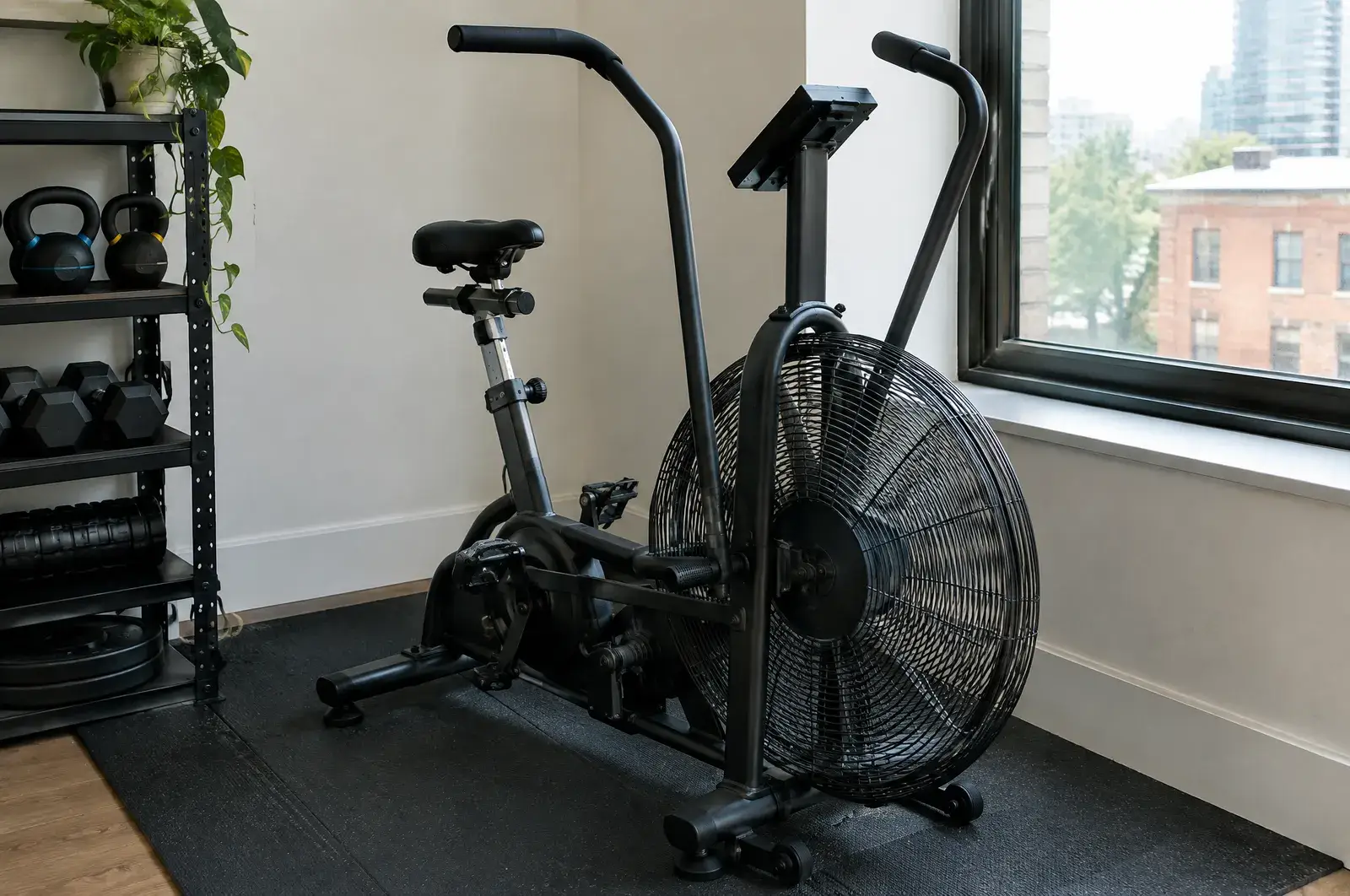
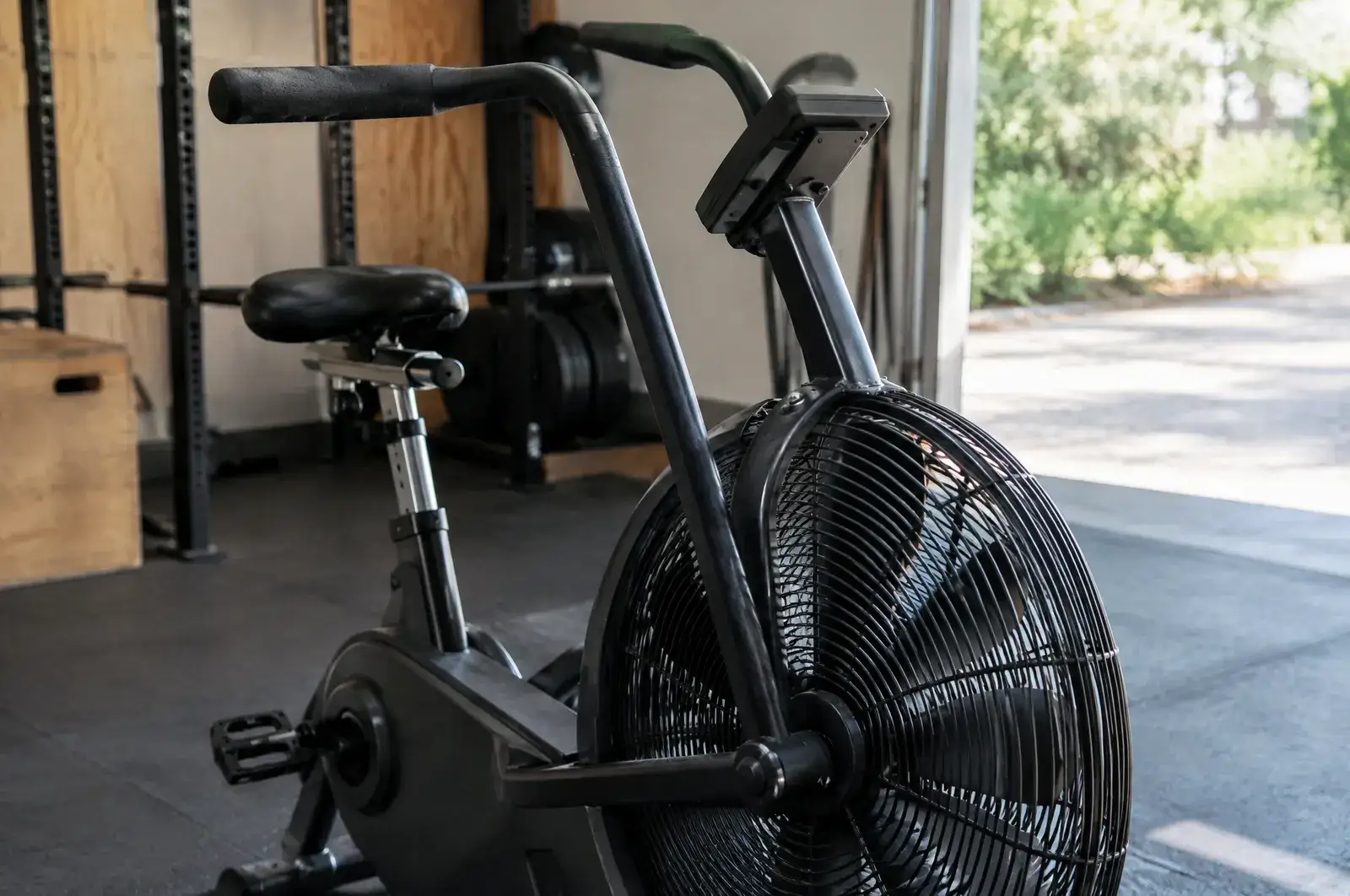
An air bike is a stationary bike where a fan wheel, not a magnetic flywheel, makes the resistance. Pedal harder and push the handlebars harder, and the fan spins faster, so the air resistance climbs with your own effort instead of a preset dial. People also call it a fan bike — same machine, different name — and you’ll see both terms on maker sites like Titan Fitness, Xebex, REP Fitness, XMark, and Marcy.
Most air bikes work both your arms and legs at once because the handlebars move back and forth as you pedal, driven by connecting arms linked to the crank. That’s different from a standard upright exercise bike, where only your legs drive the flywheel. The trade-off is a machine that can feel brutal fast, since the harder you go, the harder it pushes back.
How does an air bike actually work?
A large exposed fan blade set sits where a flywheel would be on a normal exercise bike. Spinning that fan pushes air, and pushing more air takes more force, so the resistance is self-regulating — there’s usually no knob to turn up or down.
The Xebex Air Bike, for example, uses a 27-inch resistance fan and lets the “user” control resistance simply by changing pedal speed and push force, per the maker’s product page. Compare that to a magnetic bike, where you twist a knob or tap a button to raise resistance, and the wheel resists the same amount whether you’re sprinting or coasting. On an air bike, coasting means almost no resistance, and sprinting means a wall of air.
Do any air bikes have adjustable resistance levels?
Yes, at least one model in our product research breaks from the “you control it with effort only” design. The Xebex AirPlus Performance Bike lists 8 resistance levels, described on the maker’s page:
- Levels 1-2: lighter than standard air bike resistance, for warm-up, cool-down, and younger or older athletes
- Level 3: standard air bike resistance
- Levels 4-5: heavier than standard, for novice hill-climb and power/cardio work
- Levels 6-8: heaviest, for expert hill climbs, power training, and higher calorie burn per hour
The maker also states you can burn “an average of 57% more calories/hour” using level 8 over level 1, with wattage output rising “by nearly 76% on average” — both figures assume a 60 kg (about 132 lb) user, per the product page. Treat those numbers as the maker’s own claim, not an independent lab result.
Air bike model comparison
Prices and specs pull directly from each maker’s product page and change over time, so confirm current pricing before buying.
| Model | Price | Fan/resistance | Weight capacity | Warranty |
|---|---|---|---|---|
| Marcy NS-1000 | $269.99 | Fan bike, 14-gauge steel tubing | 250 lb | Not listed |
| Marcy AIR-1 | $449.99 | Fan bike | 300 lb | 2-year limited |
| Titan Fitness Fan Bike | $759.97 | Fan bike | Not listed | Not listed |
| CAT 3 Hurricane (XMark) | $899.00 | Wind/fan resistance | Not listed | Not listed |
| Raptor AirBike (Fringe Sport) | $995.00 | Full-steel welded fan, +20 lb reinforced vs. standard | Not listed | 3-year |
| Xebex Air Bike | $949.00 | 27-inch resistance fan | Not listed | Not listed |
| Xebex AirPlus Performance Bike | $999.00 | 8 resistance levels, tilt-and-roll wheels | Not listed | Not listed |
| REP Strive Air Bike (VPR) | $1,299.99 | Fan resistance | Not listed | Not listed |
(our calculation: price range across these 8 models is $269.99 to $1,299.99, a spread of $1,030.00.)
What do the dimensions and weight tell you?
Size and shipped weight matter more for small spaces than horsepower claims. A heavier bike usually sits more stable during hard intervals but is harder to move or store.
| Spec | Marcy AIR-1 | Marcy NS-1000 | Xebex Air Bike 1000 Eco | Raptor AirBike |
|---|---|---|---|---|
| Assembled dimensions | 46 in L x 24 in W x 48.5 in H | 45.5 in L x 27.5 in W x 49.5 in H | Not listed | Not listed |
| Net/product weight | Not listed | Not listed | 98.16 lb | 130 lb |
| Max user weight | 300 lb | 250 lb | Not listed | Not listed |
If you’re tight on garage or spare-room space, measure your footprint against these numbers before ordering — return shipping on a 100+ lb bike is expensive and our product research doesn’t list any free-return policy for these models.
How is an air bike different from an elliptical?
An elliptical moves your feet through a smooth, looping path and typically uses a flywheel (often magnetic) for resistance you set with a dial or console button. An air bike keeps a normal circular pedal stroke like a regular bike, adds moving handlebars, and lets a fan generate resistance that scales with your effort rather than a fixed setting.
The practical difference shows up in workout style. Air bikes are common for short, all-out interval efforts — because resistance rises instantly when you sprint — while ellipticals are more often used for steady, lower-impact sessions. If you’re deciding between bike styles for a home setup, it also helps to compare against a recumbent design; see /what-is-a-recumbent-bike/ for how that layout differs from both.
What features should you check before buying an air bike?
Start with three things our product research actually covers across models: price, weight capacity, and warranty length. Beyond that, check fan size (bigger fans like the 27-inch on the Xebex Air Bike generally move more air per stroke) and whether the model gives you adjustable resistance levels like the Xebex AirPlus, or pure effort-based resistance like most other air bikes.
Warranty coverage varies a lot in this category based on our product research. The Marcy AIR-1 carries a 2-year limited warranty, while the Raptor AirBike from Fringe Sport carries 3 years. Titan, XMark, Xebex, and REP Fitness product pages in our product research don’t list a warranty term, so ask the retailer directly if that matters to you.
Where does an air bike fit in a home gym?
Air bikes are compact compared to full cardio machines like a stair climber (the REP STEPR line runs $3,999.99 to $9,999.00 depending on trim), which makes them a common pick for a garage or spare-room setup alongside strength equipment. If you’re planning a full room, start with a broader parts list at /best-home-gym-equipment/ or a complete setup guide at /best-home-gyms/.
Flooring matters more with an air bike than with a quiet magnetic bike, since the fan and moving handlebars can transmit vibration and noise into a hard floor. See /best-gym-flooring/ for mat options if you’re placing one over concrete or a shared-wall room. And if the rest of your gym is centered on a rack, /best-power-racks/ covers that side of the build separately, since air bikes and racks solve different training goals.
For a closer look at one specific budget option in our product research, the /titan-fitness-fan-bike/ page covers that $759.97 model directly. This page is built from maker specs, prices, and published product listings — see /how-we-research/ for how Home Gym Journal sources and checks facts before publishing.
Bottom line
An air bike is a fan-resistance stationary bike that works arms and legs together, with resistance that rises automatically the harder you push — no dial required on most models. Prices in our product research span $269.99 to $1,299.99, weight capacities range from 250 lb to 300 lb where listed, and warranty terms differ by brand, so match the model to your budget, space, and how hard you plan to train before buying.
Questions
Is an air bike the same as a fan bike?
Yes. Air bike and fan bike are the same machine — the names both point to the exposed fan wheel that creates wind resistance. Brands use the terms interchangeably; Titan Fitness, XMark, and Marcy all call theirs a fan bike, while Xebex, REP, and Fringe Sport use air bike.
How does an air bike create resistance?
A fan blade set replaces the flywheel found on spin bikes. Both your legs (pedals) and arms (moving handlebars) spin the fan, and the faster it spins, the more air it has to push, so resistance scales with your own effort instead of a preset dial.
Do air bikes have resistance levels you can set?
Most true air bikes don't have a resistance dial — you control intensity by how hard and fast you pedal and push. The Xebex AirPlus is an exception, listing 8 resistance levels from light warm-up (1-2) to expert hill climbs and power training (6-8).
How much does an air bike cost?
Prices in our product research range from $269.99 for the Marcy NS-1000 up to $1,299.99 for the REP Strive Air Bike featuring VPR. Mid-range options like the Titan Fitness Fan Bike ($759.97) and Xebex Air Bike ($949.00) sit between those.
What's the weight capacity on a typical air bike?
It varies by model. The Marcy AIR-1 lists a 300 lb maximum user weight, while the Marcy NS-1000 lists 250 lb. Check the specific model's listing before buying if you're near either limit.
Is an air bike good for a small home gym?
It depends on the model's footprint and weight, not just bike type. The Marcy AIR-1 measures 46 in L x 24 in W x 48.5 in H, and the Raptor AirBike weighs 130 lb, so check both dimensions and shipped weight against your space before ordering.
What is an elliptical, and how is it different from an air bike?
An elliptical uses foot pedals moving in a looping, low-impact path with a flywheel (often magnetic) for resistance, and it doesn't require you to push handlebars for propulsion the way an air bike does. Air bikes tend to be simpler mechanically and are commonly used for high-intensity interval work rather than steady low-impact cardio.
Do air bikes need maintenance?
Our product research doesn't list a maintenance schedule for any model, but sealed-bearing designs like the Xebex Air Bike's 20 sealed bearings are built to cut down on upkeep. Check your specific owner's manual for bearing, chain, or belt care.
Sources
Every fact on this page comes from the sources below. We did not test these products by hand.
- Xebex Air Bike — RXD (Get RX'd), accessed
- Xebex AirPlus Performance Bike — RXD (Get RX'd), accessed
- Titan Fitness Fan Bike — Titan Fitness, accessed
- Marcy Deluxe Fan Bike | AIR-1 — Marcy, accessed
- Marcy Fan Bike | NS-1000 — Marcy, accessed
- CAT 3 Hurricane Commercial Air Bike — XMark Fitness, accessed
- Raptor AirBike — Fringe Sport, accessed
- Strive Air Bike featuring VPR — REP Fitness, accessed