
The short answer
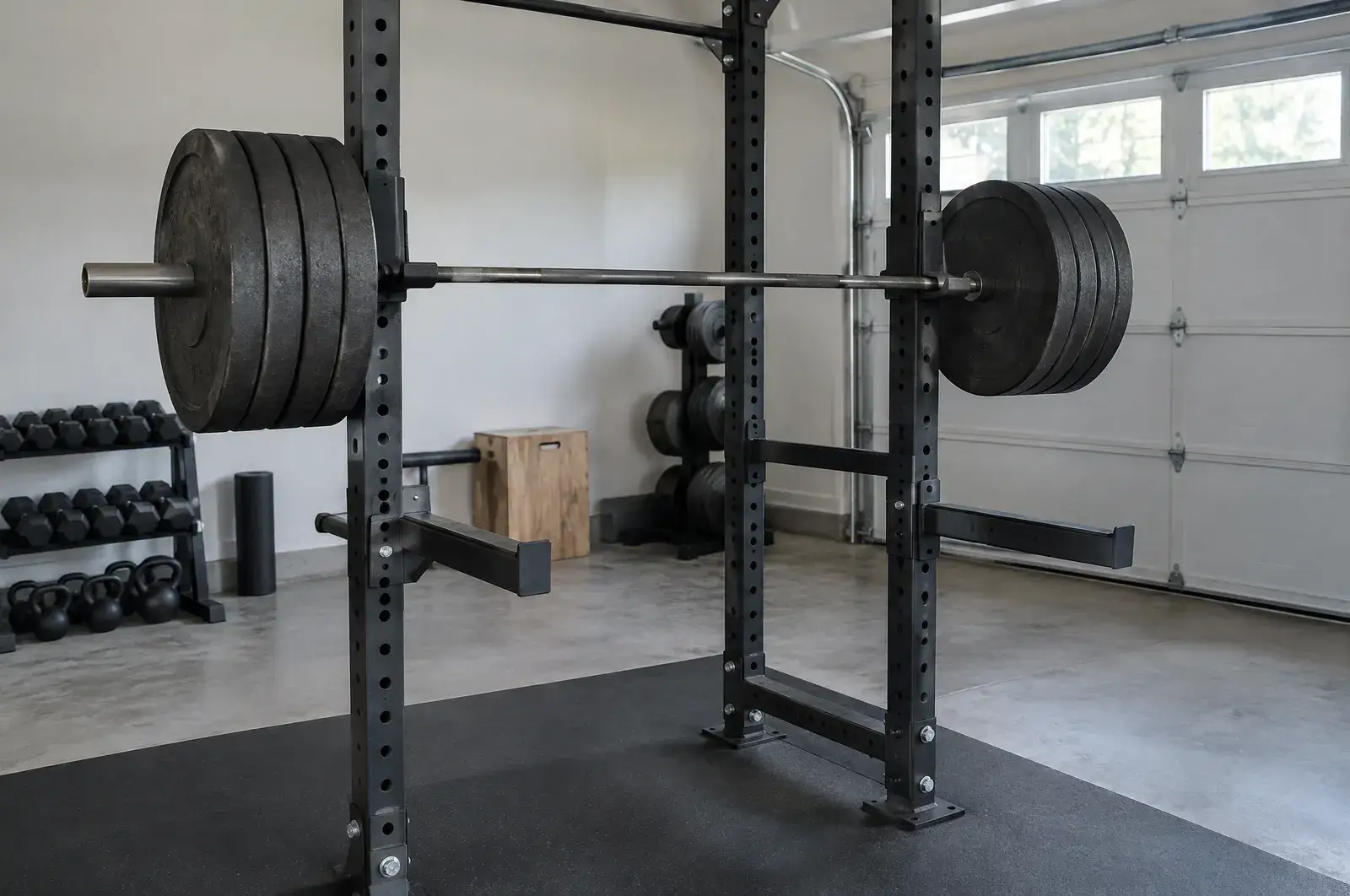
Four 45-lb plates per side means eight plates total: 4 × 45 lb × 2 sides = 360 lb of plates (our calculation). Add a 45-lb bar and the loaded total is 405 lb. This math scales the same way for any plate count and any bar weight — just multiply plates per side by plate weight by two, then add the bar.
On this page 15 sections
- The short answer
- How much weight is four 45-lb plates a side?
- How is that total calculated?
- How much weight for other common plate counts?
- How wide does a stack of 45s get?
- Is a 45-lb plate always exactly 45 lb?
- What other specs come with a 45-lb plate?
- Does bar weight change the total?
- Does a Smith machine’s pulley system change the felt weight?
- What does 405 lb loaded mean for your rack and floor?
- How do you store four 45s a side when not in use?
- Safety notes for loading this heavy
- Bottom line
- Questions
- Sources
How much weight is four 45-lb plates a side?
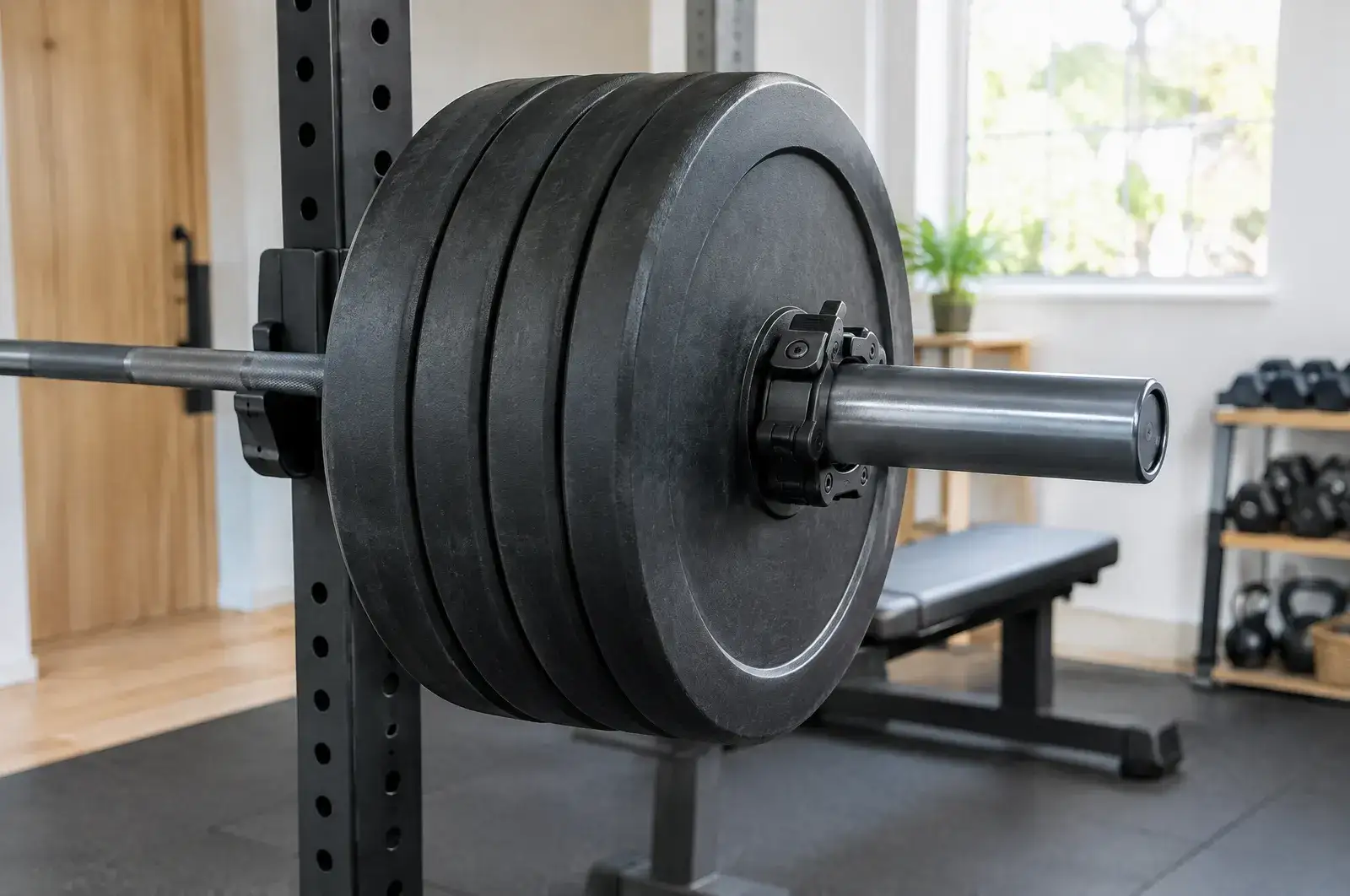
Four 45-lb plates per side is eight plates total on the bar. That’s 4 × 45 lb × 2 sides = 360 lb of plates (our calculation), plus the bar itself.
If you’re loading a standard 45-lb Olympic bar, the loaded total is 405 lb. This article is a plate-math reference built from published specs and prices — not a hands-on test — so check your own bar’s weight and rated capacity before loading heavy.
How is that total calculated?
The formula is simple: plates per side × plate weight × 2 sides, then add bar weight.
For four 45s a side: 4 × 45 = 180 lb on one side. Double it for both sides: 360 lb of plates. Add a 45-lb bar and you get 405 lb loaded (our calculation).
This same formula works for any plate count, any plate weight, and any bar. Swap in 35s, 25s, or a mixed stack and just redo the multiplication.
How much weight for other common plate counts?
Here’s the same math applied to the plate counts people search for most, using a 45-lb bar as the reference point (our calculation, based on our product research figures).
| Plates per side | Plates total | Plate weight (lb) | Bar (lb) | Loaded total (lb) |
|---|---|---|---|---|
| 1 | 2 | 90 | 45 | 135 |
| 4 | 8 | 360 | 45 | 405 |
| 5 | 10 | 450 | 45 | 495 |
| 6 | 12 | 540 | 45 | 585 |
| 8 | 16 | 720 | 45 | 765 |
Note on “8 plates”: if the count means 8 plates total on the bar (4 per side), that’s the same 405-lb load as four 45s a side. If it means 8 plates per side (16 total), the loaded total jumps to 765 lb — a very different lift. Always confirm which side of that ambiguity you’re loading for.
How wide does a stack of 45s get?
The IWF-standard 45-lb bumper plate in our product research has a width of 2.40 inches. Stack four of them on one sleeve and you get about 9.6 inches of plate width per side, before collars (our calculation).
Check your bar’s usable sleeve length before buying a full set of 45s — a standard Olympic sleeve that’s too short will run out of room before you hit four plates a side. This matters more with bumper plates than thin cast iron, since bumpers are built thicker for a consistent 17.72-inch diameter.
Is a 45-lb plate always exactly 45 lb?
Not perfectly — plates carry a manufacturing tolerance. The IWF-spec 45-lb bumper plate in our product research lists a weight tolerance of plus or minus 1% of claimed weight, which works out to about plus or minus 0.45 lb per plate (our calculation).
Across eight plates (four a side), that tolerance could theoretically stack up to roughly plus or minus 3.6 lb total — small compared to a 405-lb load, but worth knowing if you’re chasing a specific number for a meet or a calibrated log. For lifts where exact loading matters, look at calibrated weight plates instead of standard gym stock.
What other specs come with a 45-lb plate?
Beyond weight, our product research’s IWF-standard 45-lb bumper plate lists these specs:
| Spec | Value |
|---|---|
| Diameter | 17.72 in (450 mm ± 3 mm) |
| Width | 2.40 in |
| Weight tolerance | ± 1% of claimed weight |
| Durometer (hardness) | 88 |
| Insert type | Stainless steel |
The stainless insert is what the bar sleeve actually rotates against, so its condition affects how smoothly the plate spins during a lift. A durometer of 88 puts the rubber on the firmer end, which affects bounce if you’re dropping bumpers from the top of a lift. For a full breakdown of bumper materials and pricing, see crumb rubber bumper plates.
Does bar weight change the total?
Yes — and not every bar is a flat 45 lb. Our product research shows real variation depending on the bar type.
| Bar type | Listed weight | Source |
|---|---|---|
| Hoist CF-3754 Smith machine Olympic bar | 45 lb (20 kg) | Hoist Fitness |
| Major Fitness B52 Smith machine bar | 31 lb (14.2 kg), no counterbalance | Major Fitness |
| Typical Smith machine bar range (Major Fitness estimate) | 6–45 lb | Major Fitness |
| Most standard gym bars (Major Fitness estimate) | 15–25 lb | Major Fitness |
If you’re loading four 45s on a straight Olympic barbell, 45 lb is the common reference bar weight in our product research. But if you’re loading a Smith machine, check the bar’s actual starting weight first — REP’s Smith machine attachment notes a 15 kg (about 33 lb) start weight on its own bar, which is different again from Hoist’s 45-lb figure. For general barbell shopping guidance, see barbell for weight training and Olympic barbell.
Does a Smith machine’s pulley system change the felt weight?
Yes, on some machines. Force USA’s G3, G4, and G20 racks all use a 2:1 pulley ratio, meaning 100 lb loaded on the bar feels like 50 lb of resistance to the lifter.
That means the plate-math table above — plates × weight × 2 sides — only tells you what’s physically loaded, not what you feel moving the bar on a counterbalanced or pulley-reduced Smith machine. REP’s Smith machine attachment, by contrast, states plainly that “there is no counterbalance,” so loaded weight and felt weight match on that unit. Always check whether your specific machine has a pulley ratio or counterbalance before assuming plate math equals felt resistance.
What does 405 lb loaded mean for your rack and floor?
A 405-lb barbell is a serious load for both your rack’s weight rating and your floor. REP’s Smith machine attachment lists a 450-lb max loading capacity and states its safeties are drop-tested to 450 lb — a useful benchmark for how close 405 lb sits to a rated ceiling on some home units.
Before loading four 45s a side, confirm your rack’s or Smith attachment’s rated max in writing from the maker, not just from what “looks strong enough.” If you’re setting up a rack for this kind of load, compare options in best power racks, and check flooring built for heavy static and dropped loads in best gym flooring.
How do you store four 45s a side when not in use?
Plate storage needs to handle the horn length and mount spacing for heavier plates, not just count. REP’s wall-mounted plate storage lists an 8.25-inch weight horn and 16-inch stud mount spacing, priced at $45.99 (REP Fitness, checked 2026-09-23) — prices change, so confirm current pricing before buying.
Eight 45-lb plates (four a side) is 360 lb of storage weight alone, before any other plates on the same rack. Check a storage rack’s total rated capacity, not just per-horn length, if you’re keeping a full set of 45s mounted. For more storage options and capacity comparisons, see best storage for weight plates.
Safety notes for loading this heavy
Loading 400+ lb onto a barbell is not casual gym math — it changes how you rack, spot, and unrack the bar. A few points worth flagging before you load four 45s a side:
- Confirm your bar’s rated max load from the manufacturer, not an assumption based on diameter.
- Confirm your rack’s or Smith attachment’s rated max loading — REP’s unit lists 450 lb as a hard ceiling with safeties drop-tested to that number.
- Use collars on every plate stack this heavy; a shifting 360-lb plate stack is a real injury risk.
- If you’re setting up a home rig for structural mounting (wall-mounted storage, rack anchoring), get a licensed contractor to check stud spacing and wall load ratings before drilling.
This article draws only on maker specs, prices, and published info in our product research — no hands-on testing was involved. Confirm any weight-critical number against your own equipment’s listed specs before you load it.
Bottom line
Four 45-lb plates a side is 360 lb of plates, 405 lb loaded with a standard 45-lb bar (our calculation from our product research figures). The same multiplication — plates per side × plate weight × 2, then add the bar — works for any count from one plate to eight plates a side. The only variables worth double-checking are your actual bar weight (not every bar is 45 lb), your rack’s rated max load, and whether your machine uses a pulley ratio that changes felt resistance. See how we research for how our product research like this one get built.
Questions
How much weight is 1 plate on each side?
One 45-lb plate per side is 90 lb of plates (2 × 45 lb, our calculation). Add a 45-lb bar and the loaded total is 135 lb.
How much weight is 8 plates?
If ‘8 plates’ means 4 per side (8 total on the bar), that's the same load as four 45s a side: 360 lb of plates plus the bar. If it means 8 plates per side (16 total), that's 720 lb of plates plus the bar (our calculation).
How much weight is 5 plates on each side?
Five 45-lb plates per side is 450 lb of plates (5 × 45 lb × 2, our calculation). With a 45-lb bar, the loaded total is 495 lb.
How much weight is 6 plates on each side?
Six 45-lb plates per side is 540 lb of plates (our calculation). Add a 45-lb bar and the total is 585 lb — check your bar's rated capacity before loading this heavy.
Does the plate math change with bumper plates instead of iron?
No. Bumper and iron 45s are both sold at a nominal 45 lb, so the multiplication is the same. Our product research's IWF-spec bumper plate has a weight tolerance of plus or minus 1%, so an individual plate can run about 0.45 lb light or heavy.
How wide is a stack of four 45s on one sleeve?
The IWF-spec 45-lb bumper plate in our product research is 2.40 inches wide. Four of them stack to about 9.6 inches per side (our calculation), before collars — check your bar's usable sleeve length.
Is every 45-lb barbell actually 45 lb?
Not always labeled the same way. Hoist's CF-3754 Smith machine lists its Olympic bar starting weight as 45 lb (20 kg), while Major Fitness notes some Smith bars run as light as 6 lb or as heavy as 45 lb depending on the machine, and most gym bars fall in the 15–25 lb range.
Why does a Smith machine feel lighter than the plates loaded?
Some Smith machines use a counterbalance or pulley ratio that reduces felt resistance. Force USA's G3, G4, and G20 racks use a 2:1 pulley ratio, meaning 100 lb loaded feels like 50 lb of resistance — check your machine's specs before assuming plate math applies directly.
Sources
Every fact on this page comes from the sources below. We did not test these products by hand.
- CF-3754 Dual Action Smith — Hoist Fitness, accessed
- How much does the average Smith machine bar weigh? — Major Fitness, accessed
- Smith Machine Rack Attachment — REP Fitness, accessed
- Smith Machine Attachment Guide — REP Fitness, accessed
- Wall Mounted Plate Storage — REP Fitness, accessed