
The short answer
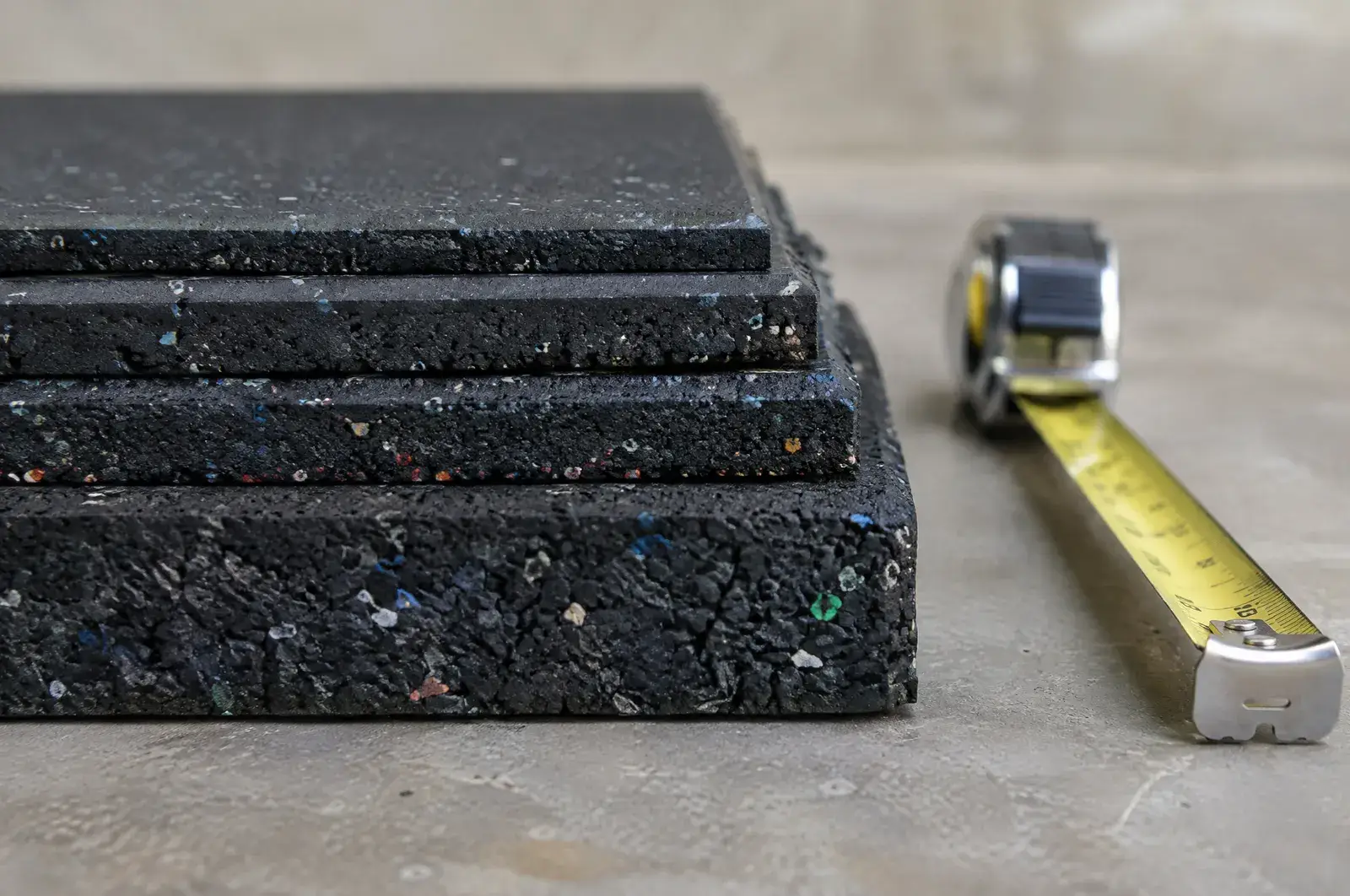
For light cardio and bodyweight work, 1/4 to 5/16 inch (6 to 8mm) rubber flooring is enough. For dumbbells and controlled barbell lifts, use 5/16 to 1/2 inch (8 to 12mm). For dropped bumper plates or Olympic lifting, go 3/4 inch (19mm) minimum, or 1 inch-plus over a lifting platform for heavy drops.
On this page 12 sections
- The short answer
- How thick should gym flooring be?
- Gym flooring thickness by activity
- How thick should rubber gym flooring be for dropping weights?
- How thick should gym mats be for dumbbells and bodyweight work?
- How thick should gym flooring be in an apartment or upstairs room?
- Do you need a lifting platform on top of thick flooring?
- Thick mats vs thin flooring: cost per square foot
- How to cut gym flooring mats to fit
- How we researched this
- Questions
- Sources
How thick should gym flooring be?
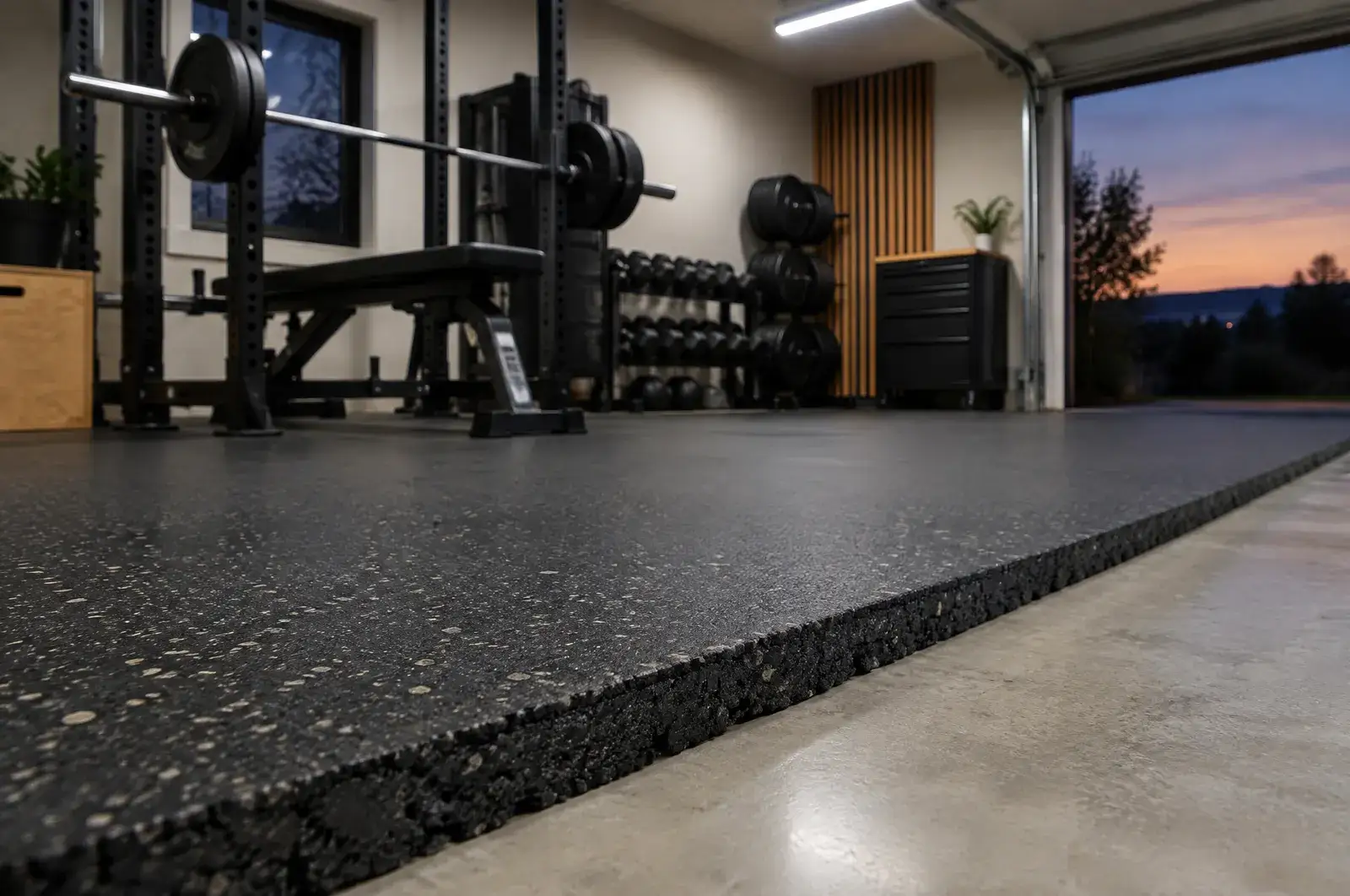
The right thickness depends on what lands on it, not just what room it’s in. Greatmats’ flooring guide puts it plainly: 3/4 inch rubber is “generally regarded as the bare minimum for proper floor protection for olympic lifting,” and the guide points moderate-to-advanced weightlifters toward that same 3/4 inch tile once free weights enter the picture (Greatmats). Cardio and bodyweight work barely stress a floor by comparison. A dropped 45 lb bumper plate hits it like a hammer. Match the flooring to the heaviest thing that’s likely to land on it, not to the average workout you do.
That’s also why “how thick should gym flooring be” doesn’t have one number. A home gym with a treadmill and a yoga mat is a different sizing problem than a garage with a power rack and a barbell. The table below breaks it out by activity, in both inches and millimeters, with real products at each thickness so you can see what the number actually looks like on a shelf.
Gym flooring thickness by activity
This table merges guidance from Norsk’s weightlifting flooring breakdown, Greatmats’ thickness guide, and REP Fitness’s own product tiers, cross-checked against each other. Where sources disagreed slightly, we used the more conservative (thicker) figure.
| Activity | Minimum thickness | Recommended thickness | Example product |
|---|---|---|---|
| Cardio machines, stretching | 1/4 in (6mm) | 5/16 in (8mm) | REP Fitness 8mm commercial roll |
| Bodyweight training, yoga | 1/4 in (6mm) | 5/16 in (8mm) | Rogue Individual Mat, 5/8 in |
| Dumbbells (up to ~50 lb drops) | 1/4 in (6mm) | 5/16 in (8mm) | REP Fitness 8mm commercial roll |
| Light barbell training (135–225 lb) | 5/16 in (8mm) | 3/8 in (10mm) | REP Fitness 9mm commercial roll |
| Powerlifting, controlled drops (315–405 lb) | 3/8 in (10mm) | 3/4 in (19mm) | Rogue Gym Mat stall mats, 3/4 in |
| Heavy powerlifting (405–700+ lb) | 3/4 in (19mm) | 3/4 in + platform | Power Systems drop pad, 6 in |
| Olympic lifting, light (200–275 lb) | ~3/4 in (20mm) | 1 3/16 in (30mm) | Platform + drop pad combo |
| Olympic lifting, serious (300+ lb) | 1 3/16 in (30mm) or platform | Platform + 3/4 in mats | Purpose-built lifting platform |
Sources: activity tiers and max drop weights from Norsk’s weightlifting flooring guide, which states 6mm as a minimum for bodyweight and dumbbell work, 8mm minimum with 10mm recommended for light barbell training, 10mm minimum with 19mm recommended for controlled powerlifting drops, and 19mm minimum for heavy powerlifting drops of 405 lb or more (Norsk). Norsk’s own summary line: “Three-fourths of an inch is better, and 1 inch is best” for serious weightlifting. Product examples verified on maker/retailer pages listed in Sources below.
How thick should rubber gym flooring be for dropping weights?
Sources don’t converge on one clean number for “how thick for dropping weights” — it depends on what’s actually being dropped. REP Fitness sells its commercial flooring rolls in three thicknesses specifically tuned to drop risk: the 8mm roll is “a good option for people who do not plan on dropping any weights,” the 9mm roll is “a great option for people who may just be dropping bumper plates,” and the 12mm roll “can withstand both bumpers and iron plates, making it perfect for an Olympic weightlifting/HIIT facility” (REP Fitness). Greatmats sets a firmer floor for serious lifting: it calls 3/4 inch (19mm) rubber “generally regarded as the bare minimum for proper floor protection for olympic lifting” (Greatmats). Even REP’s thickest standard roll, at 12mm (roughly 1/2 inch), falls short of that 19mm bar — a sign that “thickness” alone doesn’t tell the whole story. Density and rubber type matter too, and a roll built for occasional bumper-plate drops isn’t necessarily rated for max-effort Olympic lifts from overhead.
For repeated heavy drops, thickness stops being enough on its own. Greatmats’ guide lists 2 inches or thicker as the range for “sound-dampening athletic tiles” under heavy dropping (Greatmats), and that’s usually a purpose-built crash tile, not standard rubber roll or stall mat. A cheaper, more common approach: keep a 3/4 inch rubber floor everywhere, then add a dedicated drop pad only where plates actually land. Power Systems’ drop pad pairs are 6 inches thick, filled with “6-inch thick rebound foam” under a vinyl shell, sized 20 x 30 inches, and sold for $175 a pair, checked 2026-09-23 (Power Systems). That’s a small footprint of serious cushioning instead of a whole room of it.
How thick should gym mats be for dumbbells and bodyweight work?
This is the range most home gym owners overbuy for. Norsk’s guidance puts bodyweight and floor exercises at a 6mm (1/4 in) minimum with 8mm (5/16 in) recommended, and dumbbell work in the same 6–8mm band, with an informal drop-weight ceiling around 50 lb (Norsk). Greatmats’ guide points the same direction: light, no-drop use doesn’t need anywhere near the 3/4 inch (19mm) tile the guide recommends once you’re lifting at a moderate-to-advanced level (Greatmats).
Rogue’s Individual Mat is a useful reference point at the upper end of this tier: 5/8 inch thick (built from closed-cell, cross-linked foam under an anti-microbial vinyl top), sized 36 x 72 inches, priced at $95, checked 2026-09-23 (Rogue Fitness). It’s foam rather than solid rubber, which is why it can hit 5/8 inch and still stay light at 4 lb — a difference worth knowing if you’re comparing thickness numbers across rubber and foam products, since they don’t compress or protect a subfloor the same way at the same thickness.
If your dumbbells top out around 50–75 lb and you’re not doing overhead work that could drop them from height, 3/8 inch flooring is a reasonable stopping point. Push past that weight, or add a barbell to the mix, and it’s worth moving up a tier.
How thick should gym flooring be in an apartment or upstairs room?
Weight and drop force are only half the equation upstairs — the other half is what your downstairs neighbor hears. Norsk’s apartment flooring guide recommends a minimum of 0.47 inch (12mm) rubber tiles for a second-floor gym, or double-layered 0.5 inch foam mats as a cheaper alternative, moving up to 0.70 inch (18mm) rubber tiles on a third floor or higher when heavier weights are involved (Norsk). Norsk sells its own Rubber-Tec tiles in exactly those two thicknesses — 0.47 inch and 0.70 inch — which lines up with that guidance.
The reason thickness matters so much here is impact noise, measured as Impact Insulation Class (IIC). Norsk’s guide states that a typical bare floor sits around IIC 45–50, that adding the right flooring can raise that by roughly 20 to 25 points, and that “IIC 65-70” is “good for apartments—most activities inaudible” (Norsk). For a floating installation over a hard floor, their recommended stack is a rosin paper or RAM board underlayment, then 0.47 inch or thicker interlocking rubber tiles laid loose (not glued), with a 1/4 inch gap left around the room’s perimeter for expansion. Over carpet, they instead recommend a rigid base of 1/2 inch plywood or OSB under the tiles, with 3/4 inch plywood spreaders placed under anything heavy like a rack or bench, to spread the load instead of letting legs sink into carpet padding.
One caveat: no rubber floor thickness fully solves a structural noise problem on its own. If you’re setting up a serious lifting area above an occupied unit, treat these numbers as a meaningful improvement, not a guarantee, and keep drop weight and timing (avoid late-night max-effort sets) part of the plan too.
Do you need a lifting platform on top of thick flooring?
Once you’re regularly dropping loaded barbells from the hip or overhead, flooring thickness alone tends to reach its practical limit, and a dedicated platform starts to make more sense. A typical DIY Olympic lifting platform pairs a wood base (commonly two layers of 3/4 inch plywood, so roughly 1.5 inches combined) with a rubber drop zone on each side that should be “at least three-quarters of an inch thick,” for a finished platform height in the 2.5 to 3.5 inch range (Katamu Co). The wood center gives you a stable, non-compressing surface to stand and lift from — something even very thick rubber can’t fully match — while the rubber sides absorb the plates.
For lifters who don’t want to build or buy a full platform, drop pads fill a similar role in a smaller footprint: a firm rubber floor everywhere, with a thick foam pad (commonly around 6 inches, as in the Power Systems example above) placed only under the bar path where plates actually contact the ground.
If you’re not doing Olympic lifts or max-effort deadlifts, you likely don’t need a platform — a 3/4 inch floor under a rack, per the table above, covers controlled powerlifting drops.
Thick mats vs thin flooring: cost per square foot
Thicker flooring costs more, and not by a small margin. Using prices read directly from each maker’s site today, here’s what that spread looks like per square foot (our calculation from the sourced price and coverage on each page):
| Product | Thickness | Price (checked 2026-09-23) | Coverage | Cost per sq ft (our calculation) |
|---|---|---|---|---|
| REP Fitness commercial roll, 9mm | 9mm (~3/8 in) | $824.99 | 100 sq ft (4 x 25 ft roll) | ~$8.25/sq ft |
| Rogue Individual Mat | 5/8 in (foam) | $95.00 | 18 sq ft (3 x 6 ft) | ~$5.28/sq ft |
| Rogue Gym Mat, 25-piece bundle | 3/4 in | $1,495.00 (bundle, on sale from $1,750.00) | ~600 sq ft | ~$2.49/sq ft |
Coverage and pricing per Rogue Fitness (Individual Mat, 25-piece bundle) and REP Fitness (Commercial Flooring Rolls), all checked 2026-09-23. Prices change — recheck before buying. Note the stall mat bundle actually comes out cheapest per square foot despite being the thickest option here, because buying in bulk from a horse-stall-mat-style product typically beats small-format rolls and foam mats on a per-square-foot basis. Rubber roll pricing generally climbs with thickness within the same product line, so expect an 8mm roll to undercut a 12mm roll from the same maker.
How to cut gym flooring mats to fit
Thicker mats aren’t necessarily harder to cut, but the method matters more as thickness goes up. Greatmats’ guide describes a four-step process that needs no power tools: mark your cut line with a pen, brace the mat over a 2x4 board placed under the line, hold a straightedge firmly along the mark, then make “a series of shallow scores to cut all the way through the mat, allowing the cut to open as the mat folds over the board” (Greatmats). The same method works for tiles and rolled flooring.
A few practical notes that follow from that method: use a fresh, sharp utility knife blade — a dull one needs more force and is more likely to slip. Multiple light passes along the same line cut cleaner and safer than trying to push through in one stroke, especially past 1/2 inch thick. And support the mat right at the cut line (the 2x4 board’s job) so the material folds open as you score, instead of just denting under the blade.
How we researched this
Every thickness figure, price, and product spec on this page came from a maker or retailer page we read on the date shown, not from hands-on testing. We compared thickness guidance across Greatmats, Norsk, REP Fitness, and Rogue Fitness, along with a lifting-platform build guide and a drop pad product listing, and used the more conservative number where sources gave a range. Cost-per-square-foot figures are our own calculation from sourced prices and coverage areas, not a number any maker published directly. We could not independently verify IIC (Impact Insulation Class) test data behind Norsk’s noise-reduction claims — those figures are cited to Norsk’s own published guide, not a third-party acoustic test we reviewed.
If you’re shopping for flooring, start with your heaviest realistic drop weight, check that product’s thickness against the table above, and confirm the maker’s own page still lists it in stock before you buy — see our flooring hub for the full range of guides, or jump straight to our best gym flooring and best garage gym flooring picks for currently sold options at each thickness tier. For general room setup, how to level a garage floor for a gym and gym flooring installation cost cover what comes before and after you pick a thickness. Full method notes: how we research.
Questions
How thick should gym flooring be for dropping bumper plates?
REP Fitness lists 9mm rubber rolls as "a great option for people who may just be dropping bumper plates." Greatmats sets a stricter bar, calling 3/4 inch (19mm) rubber "the bare minimum for proper floor protection for olympic lifting." Treat 9mm as workable for occasional, light bumper drops and 3/4 inch as the safer floor for repeated or heavier drops. For frequent heavy drops (300+ lb), pair either floor with a dedicated lifting platform or drop pads rather than relying on flooring thickness alone.
Can gym flooring be too thick?
Yes, in a practical sense. Very thick flooring (1.5 to 2 inches) can feel unstable under a loaded squat rack or barbell, since the base flexes slightly. Most makers reserve that thickness for crash mats and drop pads placed only where plates land, not as wall-to-wall flooring under racks.
What thickness rubber flooring is best for a home gym in a garage?
REP Fitness recommends 8mm rolls for gyms with no weight drops, 9mm for occasional bumper plate drops, and 12mm where both bumper and iron plates get dropped. A garage with a rack, bench and free weights typically lands in the 8mm to 12mm range depending on how heavy the lifts get.
How thick should gym mats be under a squat rack or power rack?
Use at least 3/4 inch stall mats or interlocking tiles under a power rack. Greatmats calls that same 3/4 inch (19mm) thickness "the bare minimum for proper floor protection for olympic lifting," and rack feet concentrate weight in small spots much like a dropped plate does. Many lifters double-layer 3/4 inch mats under the rack footprint specifically, then use a thinner floor for the rest of the room.
How thick should gym flooring be in an apartment or a room above a living space?
Norsk recommends at least 0.47 inch (12mm) rubber tiles on a second floor and 0.70 inch (18mm) tiles on a third floor or higher for heavier training, since upper floors transmit impact noise to the space below. Adding rubber flooring over a bare floor can raise the Impact Insulation Class (IIC) rating by roughly 20 to 25 points.
Is 1/4 inch gym flooring thick enough?
Only for light use. Greatmats and Norsk both list 1/4 inch (6mm) as the minimum for machines-only rooms, bodyweight training, stretching and cardio equipment. It is not rated for dropped barbells or dumbbells over about 50 lb.
What tools do I need to cut thick gym mats to fit?
A sharp utility knife, a straightedge, and something to support the mat while you cut, such as a 2x4 board. Greatmats' method is to mark the line, brace the mat over the board, then make several shallow scoring passes with the knife rather than one deep cut, letting the mat fold open along the score line.
Do I need a thicker floor if I only use dumbbells, not a barbell?
Not necessarily. Norsk's activity guidance puts dumbbell work at the same 1/4 to 5/16 inch (6 to 8mm) range as bodyweight training, with an informal ceiling around 50 lb for controlled drops. Heavier dumbbell drops call for the light barbell range (5/16 to 3/8 inch, or 8 to 10mm) or a dedicated drop pad.
Sources
Every fact on this page comes from the sources below. We did not test these products by hand.
- What Is The Best Thickness For Weight Gym Flooring Mats? — Greatmats, accessed
- Weightlifting Flooring (2026) — Home Gym, Garage, Competition Platforms — Norsk, accessed
- Best Apartment Gym Flooring: Quiet Solutions for Renters (2026 Guide) — Norsk, accessed
- Rogue Individual Mat — Rogue Fitness, accessed
- Rogue Gym Mats - 25 Piece Bundle — Rogue Fitness, accessed
- Commercial Flooring Rolls — REP Fitness, accessed
- Olympic Lifting Platforms: Complete Guide for 2026 — Katamu Co, accessed
- Drop Pad Pairs — Power Systems, accessed
- How To Cut Rubber Gym Mats & Tiles Without Power Tools — Greatmats, accessed