
The short answer
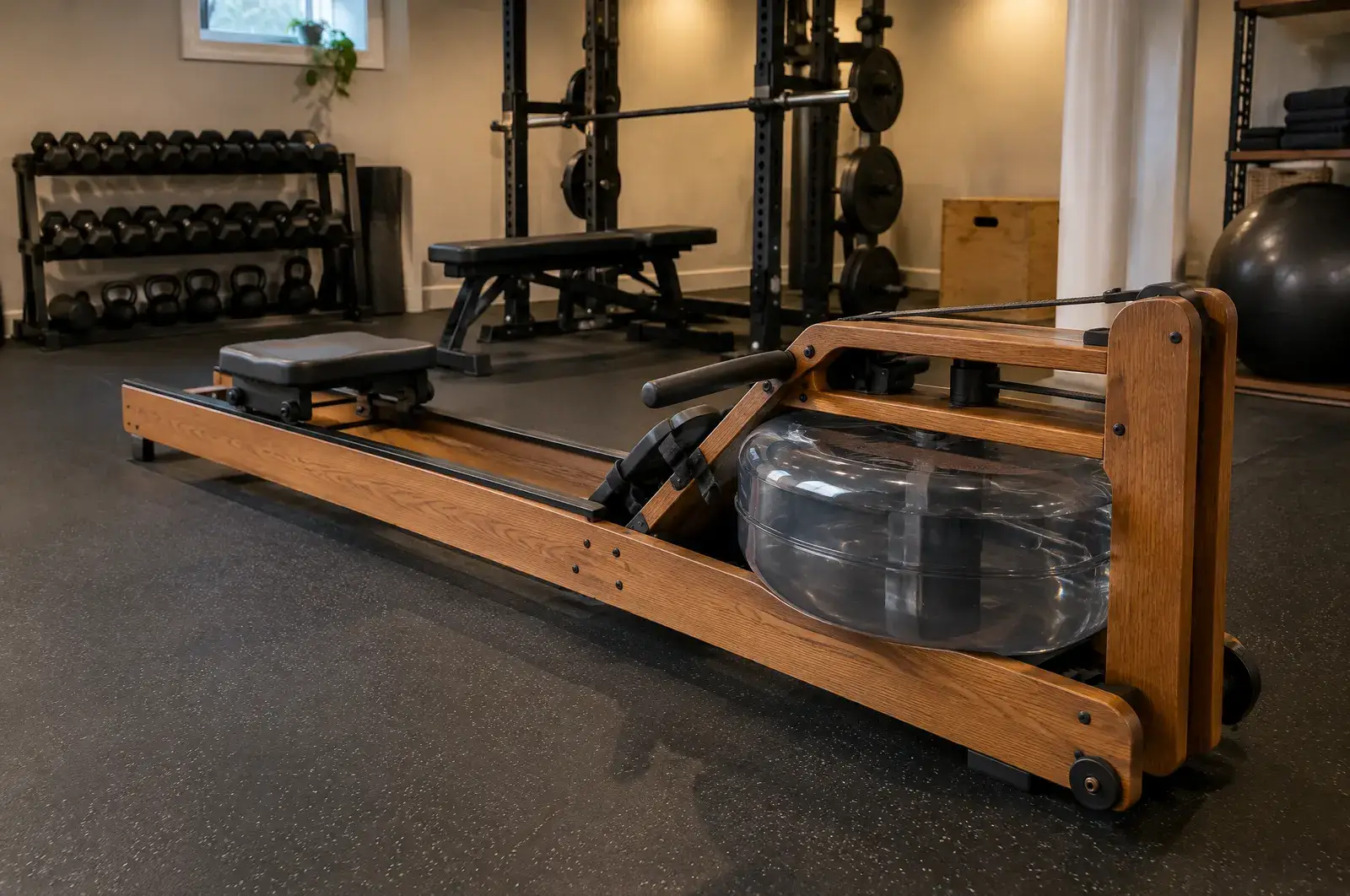
A water rower is a rowing machine that creates resistance with a paddle spinning inside a water-filled tank instead of a fan, magnet, or hydraulic piston. Pulling the handle spins the paddle through water, and resistance scales with how hard you pull, similar to real rowing. Home gym makers pair this tank design with a wood or steel frame and a monitor that reads stroke rate and distance.
On this page 13 sections
- The short answer
- What is a water rower?
- How does a water rower compare to other rowing machine types?
- What specs and prices do air-resistance rowers list, for comparison?
- What does the display or monitor typically track?
- How big is a rowing machine, and does it fold?
- What weight capacity should a rowing machine have?
- How much assembly does a home rower need?
- Are there parts and maintenance considerations?
- Is a water rower a good fit for a home gym?
- Bottom line
- Questions
- Sources
What is a water rower?
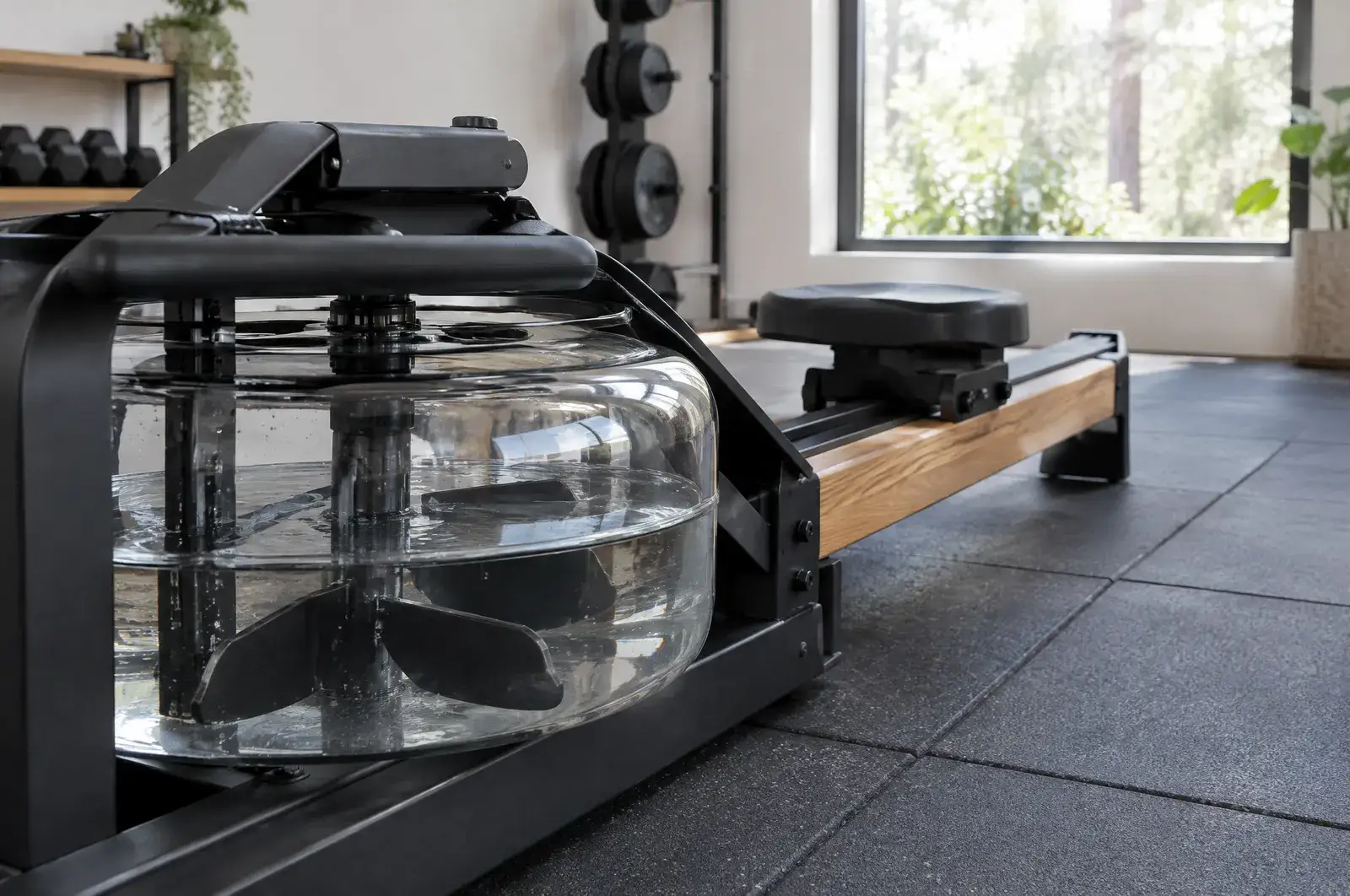
A water rower is a rowing machine that builds resistance with a spinning paddle inside a sealed, water-filled tank instead of a fan wheel, magnetic brake, or hydraulic piston. Pull the handle, the chain or strap spins the paddle through the water, and the harder you pull, the more resistance the water pushes back. This mechanism is meant to mimic the feel of rowing an actual boat, since resistance scales with your effort rather than a fixed setting.
The tank sits at the front of the machine, usually behind a clear housing so you can see the water move as you row. A monitor mounted near the tank typically reads out stroke rate, time, and distance, though the exact data fields depend on the model. This article’s our product research does not include a specific water rower product, so treat the mechanical description above as general explanation of the category, not a tested claim about any one machine.
How does a water rower compare to other rowing machine types?
Water rowers are one of several resistance types; the other common designs are air, magnetic, and hydraulic. The comparison below uses two air-resistance rowers pulled straight from maker catalogs, since those are the models with confirmed specs on our product research.
| Resistance type | How it works | Example from our product research |
|---|---|---|
| Water | Paddle spins inside a water tank; resistance rises with pull effort | Not in our product research |
| Air | Fan wheel spins in open air; faster pull = more air resistance | Xebex Air Rower 2.0, Xebex AirPlus Rower 4.0 Smart Connect |
| Air (damper-adjustable) | Fan wheel with a manual damper to set resistance level | Marcy NS-7874RW California Fitness Deluxe Rowing Machine, 10 damping levels |
Air rowers and water rowers share one trait: both scale resistance with effort instead of locking to a fixed number like a magnetic rower does. The difference is mostly noise and feel — a fan wheel produces a whoosh, while a water paddle produces a wash sound closer to an actual oar stroke. Neither trait is measured on our product research, so treat it as a general mechanical distinction, not a lab comparison.
What specs and prices do air-resistance rowers list, for comparison?
Air-resistance rowers give a useful price and spec reference point since water rower data isn’t on our product research. Here’s what three catalog listings show.
| Model | Maker | Price | Resistance control | Weight capacity |
|---|---|---|---|---|
| Xebex Air Rower 2.0 | Get RX’d | $849.00 | Fan wheel, tracks watts/calories/pace always-on | Not listed |
| Xebex AirPlus Rower 4.0 Smart Connect | Get RX’d | $1,249.00 | Fan wheel, tracks metrics on one display | Not listed |
| Marcy NS-7874RW Deluxe Rowing Machine | Marcy | $699.99 | Fan wheel with 10 damping levels | 300 lbs |
The price gap between the cheapest and most expensive listed model is $549.01 (our calculation: $1,249.00 minus $699.99). That gap tracks with added display features — the AirPlus 4.0 Smart Connect adds heart-rate pairing and a Smart Connect console layer that the base Air Rower 2.0 doesn’t list.
What does the display or monitor typically track?
Displays on rowing machines generally track stroke rate, distance, and time, with higher-tier models adding power and heart-rate data. On the Xebex AirPlus Rower 4.0 Smart Connect, the single display tracks time rowed, meters, strokes per minute, calories, watts, 500m pace per stroke, total strokes, and heart rate when a monitor is paired. The Xebex Air Rower 2.0 tracks the same core list at all times, plus nine additional readouts in its larger middle window: total time, average 500m pace, average meters per stroke, max heart rate, calories per hour, force curve, max watt, watt chart per stroke, and average watt.
A water rower’s monitor generally covers similar basics — stroke rate, distance, time — but the specific field list depends on the model and isn’t part of our product research. If workout data matters to your training, check the exact display list on the product page before buying rather than assuming it matches an air rower’s readout.
How big is a rowing machine, and does it fold?
Rowing machines run long because the rail needs to accommodate a full stroke, and folding designs cut that footprint for storage. The Marcy NS-7874RW measures 96 in L x 24.5 in W x 45 in H assembled, and separates into two pieces for storage, dropping to 44 in L x 30 in W x 54 in H folded. That’s a length reduction of 52 inches (our calculation: 96 in minus 44 in) once separated.
Water rowers commonly stand upright for storage because of their tank shape, but our product research doesn’t include folded or stored dimensions for a water rower model. If floor space is tight, measure your available footprint against both the assembled and stored dimensions listed on any specific rower’s product page before ordering. Pairing a rower with proper flooring also matters — check a guide like /best-gym-flooring/ if you’re setting up a dedicated cardio corner.
What weight capacity should a rowing machine have?
Weight capacity depends on the frame and components, and only one model on our product research lists a number: the Marcy NS-7874RW at 300 lbs maximum user weight. Marcy’s product page also notes the frame uses a sturdy build and powder coating meant to resist rusting, which the maker ties to that capacity claim. Neither Xebex listing on our product research states a weight capacity, so check that spec directly on the product page if it matters to your household.
How much assembly does a home rower need?
Assembly time varies by brand, and only Xebex’s listings state a specific window on our product research. Both the Xebex Air Rower 2.0 and Xebex AirPlus Rower 4.0 Smart Connect list minimal assembly, with all tools and hardware included and an estimated 30 to 45 minutes to complete setup, per Get RX’d’s product pages. Marcy’s NS-7874RW listing does not state an assembly time window in our product research, and notes the unit ships through FedEx in one box with 1 to 7 business days processing before shipment.
Are there parts and maintenance considerations?
Rowing machines with chain-driven handles need occasional part replacement, and Get RX’d’s parts page for the Xebex Fitness Rower 2.0 gives a look at what that involves. Listed parts include an updated seat bracket (fitted on rowers with serial number XK-1618 and later), a metal hook handle holder (updated on serial XK-1975 and later), a rower chain set, and an elastic rope measuring 3600mm. Get RX’d’s page also recommends owners with a serial number of XK-1857 or lower upgrade their chain and handle to the newer AR-2-PT-CHAINSET and AR-2-PT-A25 Handle set for better durability.
Water rowers don’t use a chain in the same way, so this specific parts list applies to air rowers, not water rowers. Still, it’s a reminder that any rowing machine with moving mechanical parts — chain, paddle, pedal straps — will eventually need a replacement part, and checking whether the maker sells spare parts directly is worth doing before you buy.
Is a water rower a good fit for a home gym?
A water rower can work well in a home gym if quieter operation and a boat-like stroke feel matter more to you than built-in wattage and calorie tracking. Since our product research has no direct water rower model, the practical decision rule is this: if you want confirmed pricing, weight capacity, and console specs today, an air-resistance rower like the ones above gives you real numbers to compare. If a water rower’s feel is the priority, look up a specific model’s own spec sheet and price before ordering, since none of that data appears here.
Either resistance type still needs a stable, level floor and enough clearance for a full stroke — generally more than the tank or fan housing alone suggests, since your arms and legs extend well past the frame. If you’re building out a broader setup, /best-home-gym-equipment/ and /best-home-gyms/ cover space planning beyond just the rower, and /best-power-racks/ is useful if strength equipment is going in the same room. For general rowing machine buying advice beyond this single question, see /best-rowing-machines/ and the broader /rowing-machines/ hub. This article is based on maker specs, prices, and published product pages; see /how-we-research/ for how Home Gym Journal sources facts.
Bottom line
A water rower creates resistance with a paddle spinning through a water tank, giving a stroke feel that scales with effort, similar to air resistance but generally quieter. Our product research doesn’t include a specific water rower’s price or specs, but air-resistance rowers from Xebex ($849.00 and $1,249.00) and Marcy ($699.99) show the kind of price, weight capacity, and display features to expect in this equipment category. Before buying any rower — water or air — confirm the exact price, weight capacity, and stored dimensions on the maker’s own product page, since those figures change and vary by model.
Questions
Is a water rower better than an air rower?
Neither is flat-out better. Air rowers, like the Xebex models in this guide, use a fan wheel and let you read watts, calories, and stroke data directly off a console. Water rowers aim for a quieter, more natural stroke feel. The right pick depends on whether you want detailed workout metrics or a quieter, rowing-boat-style feel.
Do water rowers need maintenance?
Any tank-and-paddle design needs occasional care, such as checking water clarity and treating the tank per the maker's instructions. Our product research does not list a specific water rower model, so always check the maker's manual for that unit's maintenance schedule.
How much does a water rower cost compared to an air rower?
This article's source data does not include a water rower price. For comparison, the Marcy NS-7874RW air-resistance rower lists at $699.99 and the Xebex Air Rower 2.0 lists at $849.00, both at Marcy Pro and Get RX'd respectively. Prices change, so confirm current pricing before buying.
Can a water rower fold for storage?
Some rowers fold, but that depends on the specific model and frame design. The Marcy NS-7874RW in our product research separates into two pieces, going from 96 in L x 24.5 in W x 45 in H assembled down to 44 in L x 30 in W x 54 in H folded, per Marcy's listing.
What does the resistance feel like on a water rower?
Water resistance is generally described as smooth and self-regulating: pull harder and the paddle pushes more water, similar to rowing a boat. This article's our product research does not include lab or user-tested feel data for a specific water rower, so treat feel descriptions as general mechanical explanation, not a tested claim.
Do water rowers have workout tracking like air rowers?
Many water rowers include a basic monitor for stroke rate, time, and distance, but the exact display depends on the model. For contrast, the Xebex AirPlus Rower 4.0 Smart Connect tracks time rowed, meters, strokes per minute, calories, watts, 500m pace per stroke, total strokes, and heart rate when paired with a monitor, per Get RX'd's product page.
What weight capacity should I look for?
Weight capacity varies by model and frame material, so check the specific listing. The Marcy NS-7874RW air-resistance rower in our product research lists a 300 lb maximum user weight capacity, which gives a sense of typical home-rower capacity ranges.
Sources
Every fact on this page comes from the sources below. We did not test these products by hand.
- Xebex Fitness Rower 2.0 Parts — Get RX'd, accessed
- Xebex AirPlus Rower 4.0 Smart Connect — Get RX'd, accessed
- Xebex Air Rower 2.0 — Get RX'd, accessed
- Deluxe Rowing Machine with Adjustable Air Resistance NS-7874RW — Marcy, accessed