
The short answer
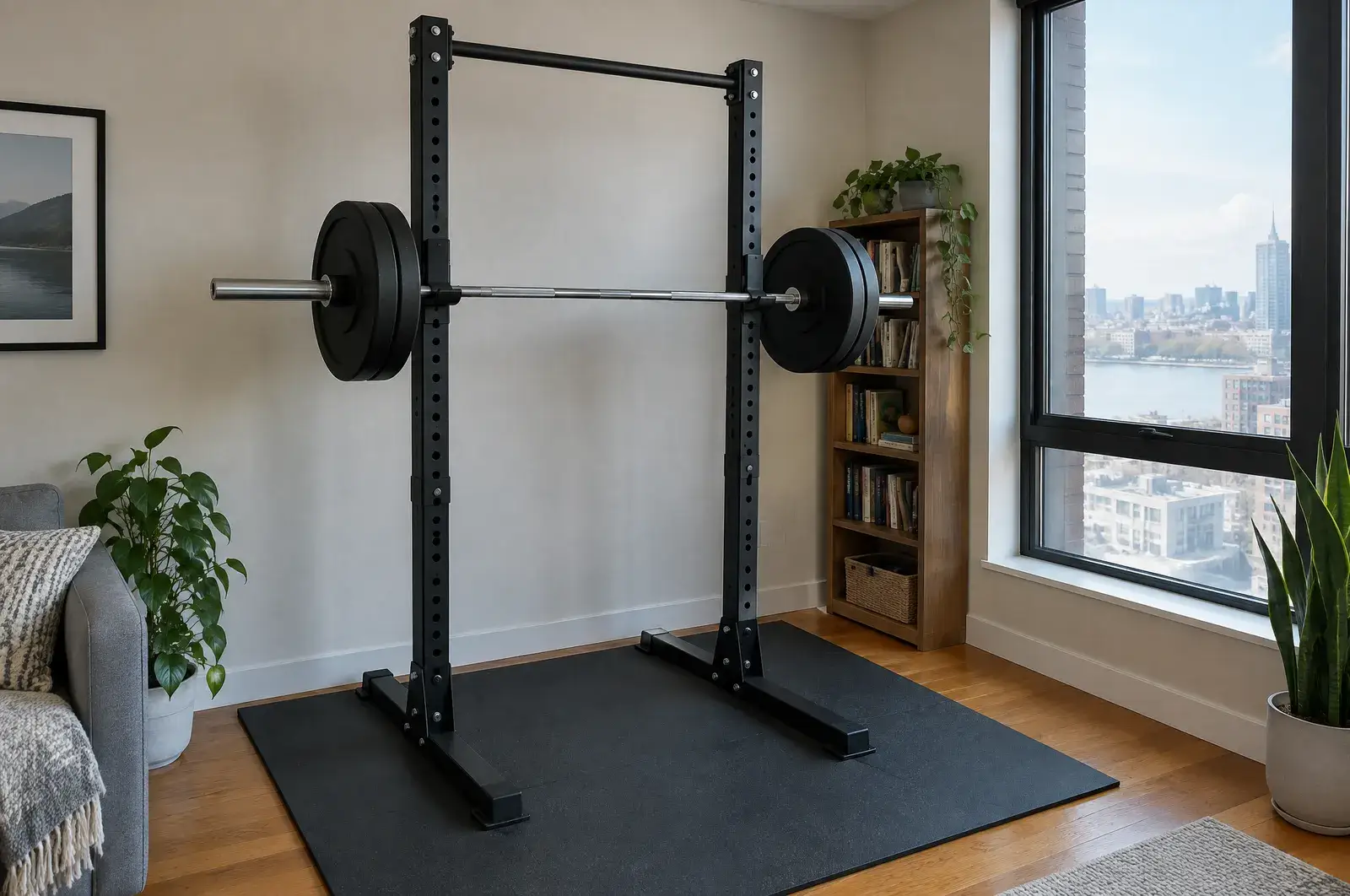
The Titan T-3 Short Squat Stand is the best pick for most apartments: 73.5 inches tall, no floor bolting, 1,000-lb rated, and $300.97. Renters who want more rack around the bar can step up to the Titan X-3 Flat Foot or REP Omni, both flat-foot designs that don't require anchors.
On this page 20 sections
- The short answer
- Our picks at a glance
- T-3 Series Short Squat Stand
- T-3 Series Independent Squat Stand
- X-3 Series Flat Foot Power Rack
- HR-2 Half Rack
- Omni Rack Builder
- SML-2 Rogue 90 Monster Lite Squat Stand
- What’s the best freestanding squat stand for an apartment?
- How we ranked these picks
- Compare the top picks
- Will a freestanding rack fit under an 8-foot ceiling?
- How much floor space do these stands need?
- How do I keep it quiet and protect my rented floor?
- What should renters check before buying?
- Freestanding vs. wall-mounted vs. folding — which is safer for renters?
- Setting up in a small apartment room
- Bottom line
- Questions
- Sources
Our picks at a glance
| Pick | Best for | Price |
|---|---|---|
| T-3 Series Short Squat Stand | Best overall apartment pick | $300.97 at Titan Fitness (20% off $379.99) |
| T-3 Series Independent Squat Stand | Tightest corners and narrow rooms | $303.97 at Titan Fitness (regular $379.99) |
| X-3 Series Flat Foot Power Rack | More rack strength without bolts | $719.97 at Titan Fitness (regular $899.99) |
| HR-2 Half Rack | Adjustable height without floor bolts | $765.00 at Rogue Fitness |
| Omni Rack Builder | Configurable height including a low open-rack option | Starting at $1,069.96 at REP Fitness |
| SML-2 Rogue 90 Monster Lite Squat Stand | Lifetime-warranty steel if your ceiling clears 92 in | $525.00 at Rogue Fitness |
Prices checked on the dates shown with each pick. They change often; confirm before you buy.
1Best overall apartment pick
T-3 Series Short Squat Stand
A two-post squat stand built on 2x3-inch 11-gauge steel with a flat-foot base. Titan states it holds “rock-solid stability without requiring floor bolting,” making it a straightforward no-drill option for a rental.
Why it ranks here: Shortest listed height (73.5 in), flat 2x3-in. base rated 1,000 lb, and the maker states it does not require floor bolting, all at the lowest price in this list.
| Overall height | 73.5 in |
|---|---|
| Base footprint | 47 in x 48 in |
| Steel | 2x3-in. 11-gauge |
| Capacity | 1,000 lb |
| Weight | 144 lb |
| Warranty | 1 year |
Keep it if
- No floor bolting needed
- Lowest price here
- In stock
Skip it if
- No pull-up bar included
- Spotter arms sold separately
$300.97 at Titan Fitness (20% off $379.99) · checked See it at Titan Fitness
2Tightest corners and narrow rooms
T-3 Series Independent Squat Stand
Two independent posts instead of one welded frame. Titan lists a 72.5-inch overall height, 2x3-inch 11-gauge steel, and a 1,000-lb rating, with an adjustable pull-up bar sold separately.
Why it ranks here: Each post has its own small 24 in x 25 in base, so the pair can be spread only as wide as your bar needs — useful in a small apartment room where a 47-inch-wide frame won't fit.
| Overall height | 72.5 in |
|---|---|
| Base footprint (each post) | 24 in x 25 in |
| Steel | 2x3-in. 11-gauge |
| Capacity | 1,000 lb |
| Pair weight | 119 lb |
| Warranty | 1 year |
Keep it if
- Smallest single-post footprint on this list
- Flexible width placement
Skip it if
- Backordered per the maker's page
- Pull-up bar is an add-on, not included
$303.97 at Titan Fitness (regular $379.99) · checked See it at Titan Fitness
3More rack strength without bolts
X-3 Series Flat Foot Power Rack
Titan's flat-foot version of its X-3 cage swaps floor anchors for a wide flat-foot base, keeping the enclosed 4-post design without drilling into a rental's slab.
Why it ranks here: A full flat-foot cage rated for 1,650 lb rackable weight and 6,170 lb for the whole rack, with the maker confirming it needs no floor anchoring — well past a stand for renters who lift heavier.
| Overall height | 82 in or 91 in |
|---|---|
| Base footprint | 50 in x 48 in |
| Steel | 3x3-in. 11-gauge |
| Rackable capacity | 1,650 lb |
| Whole-rack capacity | 6,170 lb |
| Weight | 280 lb |
Keep it if
- No bolting required per Titan
- High rated capacity
- Westside spacing in the bench zone
Skip it if
- 280 lb — plan for two people to move it
- 91-in. option leaves little ceiling clearance at 8 ft
$719.97 at Titan Fitness (regular $899.99) · checked See it at Titan Fitness
4Adjustable height without floor bolts
HR-2 Half Rack
A 3x3-inch 11-gauge half rack that Rogue states does not need to be bolted to the floor. Height is configurable per side, and it ships with Monster Lite J-cups and a 43-inch single pull-up bar.
Why it ranks here: Front and back uprights can be ordered at different heights (90 or 108 in front; 70 or 90 in back), letting a renter pick a shorter back set to clear a low apartment ceiling while keeping full front-post height for pull-ups.
| Front upright height | 90 in or 108 in |
|---|---|
| Back upright height | 70 in or 90 in |
| Footprint | 48 in x 49 in |
| Steel | 3x3-in. 11-gauge uprights |
| Weight | 225–255 lb |
Keep it if
- Explicitly no floor bolting
- Mixed front/back heights for low ceilings
- Westside spacing
Skip it if
- No rated capacity published
- Pricier than the two-post stands here
$765.00 at Rogue Fitness · checked See it at Rogue Fitness
5Configurable height including a low open-rack option
Omni Rack Builder
A build-to-order flat-foot rack. REP states the flat foot base “stabilizes the rack ... so you don't need to bolt it down to the floor,” and it ships within 24–48 hours.
Why it ranks here: REP's rack guide lists a 60-inch open-rack build alongside the 80- and 93-inch options, giving apartment lifters a shorter no-bolt configuration most competitors don't offer.
| Height options | 60 in (open), 80 in, or 93 in |
|---|---|
| Steel | 3x3-in. 11-gauge |
| Capacity | 1,000 lb rackable |
| Crossmember depth options | 16, 30, or 41 in |
| Hole spacing | 2 in |
Keep it if
- Flat foot, no bolting
- 60-in. option for very low ceilings
- Fast ship time
Skip it if
- Highest starting price on this list
- Configurator pricing can climb fast
Starting at $1,069.96 at REP Fitness · checked See it at REP Fitness
6Lifetime-warranty steel if your ceiling clears 92 in
SML-2 Rogue 90 Monster Lite Squat Stand
A 3x3-inch 11-gauge Monster Lite stand with Westside hole spacing and a choice of fat/skinny or single pull-up bar. J-cups with UHMW inserts are included; spotter arms are a $195 add-on pair.
Why it ranks here: Rogue backs this two-post stand with its lifetime warranty and a 1,000+ lb capacity, but its 92.25-inch height leaves only a few inches of clearance under a standard 96-inch apartment ceiling.
| Overall height | 92.25 in |
|---|---|
| Footprint | 49 in x 48 in |
| Steel | 3x3-in. 11-gauge uprights |
| Capacity | 1,000+ lb |
| Weight | 157 lb |
| Warranty | Lifetime |
Keep it if
- Lifetime warranty
- Made in the USA
- 1,000+ lb rated
Skip it if
- Tight fit under an 8-ft ceiling
- No floor-mount option built in (optional S-Base feet sold separately)
$525.00 at Rogue Fitness · checked See it at Rogue Fitness
What’s the best freestanding squat stand for an apartment?
The Titan T-3 Series Short Squat Stand is the strongest all-around pick. It stands 73.5 inches tall, uses a flat 2x3-inch 11-gauge steel base that Titan says needs no floor bolting, carries a 1,000-lb rating, and costs $300.97 at Titan Fitness (regular $379.99, checked 2026-09-23).
If you want more rack around the bar — safety bars closer to the cage, more mounting points — the Titan X-3 Flat Foot Power Rack and REP Omni both scale up without adding floor anchors. All picks below share one trait: the maker states they stand on their own weight and base geometry, not lag bolts into concrete.
How we ranked these picks
Every pick had to be freestanding — no wall studs, no floor anchors — since that’s what apartment leases usually require. From there, five factors decided the order: stated no-bolt stability (25%), base footprint (25%), fit under an 8-foot ceiling (20%), price (15%), and rated capacity (15%). This article is built from maker specs, prices and published product pages, not hands-on testing; see how we research for the method.
Products that require wall-stud bolting to fold or stay upright — like PRx’s wall-mounted Profile line — were left off this list even though they save floor space, because they still involve drilling into a wall. If your lease allows a wall mount, our best folding wall-mounted power rack guide covers that category separately.
Compare the top picks
| Pick | Height (in) | Footprint (in) | Capacity (lb) | Price |
|---|---|---|---|---|
| Titan T-3 Short Squat Stand | 73.5 | 47 x 48 | 1,000 | $300.97 |
| Titan T-3 Independent Squat Stand | 72.5 | 24 x 25 (each post) | 1,000 | $303.97 |
| Titan X-3 Flat Foot Power Rack | 82 or 91 | 50 x 48 | 1,650 rackable | $719.97 |
| Rogue HR-2 Half Rack | 70–108 (adjustable) | 48 x 49 | not published | $765.00 |
| REP Omni Rack Builder | 60, 80, or 93 | varies by build | 1,000 rackable | From $1,069.96 |
| Rogue SML-2 Squat Stand | 92.25 | 49 x 48 | 1,000+ | $525.00 |
Prices are current as of the checked date for each source and change without notice — confirm on the maker’s page before buying.
Will a freestanding rack fit under an 8-foot ceiling?
Most apartment ceilings run close to 8 feet (96 inches), and every pick here fits under that with room left over — the tightest is the Rogue SML-2 at 92.25 inches, leaving under 4 inches of clearance (our calculation). RitFit’s dimension guide recommends 8.5 to 9 feet of ceiling if you want pull-ups, overhead pressing, and easy bar handling, and tells buyers to measure the lowest point in the room, including beams, lights, fans, and garage door tracks.
| Pick | Overall height (in) | Clearance under a 96-in. ceiling (our calculation) |
|---|---|---|
| Titan T-3 Independent | 72.5 | 23.5 in |
| Titan T-3 Short | 73.5 | 22.5 in |
| REP Omni (60-in. open build) | 60 | 36 in |
| Titan X-3 Flat Foot (short) | 82 | 14 in |
| REP Omni (80-in. build) | 80 | 16 in |
| Rogue HR-2 (70-in. back upright) | 70 | 26 in |
| Titan X-3 Flat Foot (tall) | 91 | 5 in |
| REP Omni (93-in. build) | 93 | 3 in |
| Rogue SML-2 | 92.25 | 3.75 in |
If a pull-up bar matters, add more margin. A shop page for a different rack line warns that “you need to have 9’ ceilings to install any of the Profiles that have pull-up bars; 8’ ceilings just won’t do” — the same logic applies to any stand with a bar mounted near the top: measure grip-to-ceiling clearance, not just frame height.
How much floor space do these stands need?
Base footprints in this list range from 24 in x 25 in per post (Titan T-3 Independent, since each side stands alone) up to 50 in x 48 in for the Titan X-3 Flat Foot. A footprint number only covers the frame itself — leave working space around it for stepping back with a loaded bar and for loading plates on each side.
Bells of Steel’s general space guidance for a powerlifting-style setup calls for 8–10 feet wide by 8–10 feet deep minimum, which is a useful ceiling for a dedicated lifting corner even if your stand’s own footprint is much smaller. In a studio or one-bedroom apartment, the two-post Titan T-3 models fit best against a wall with a bar loaded on only one side at a time, since you won’t have room to walk fully around the frame.
How do I keep it quiet and protect my rented floor?
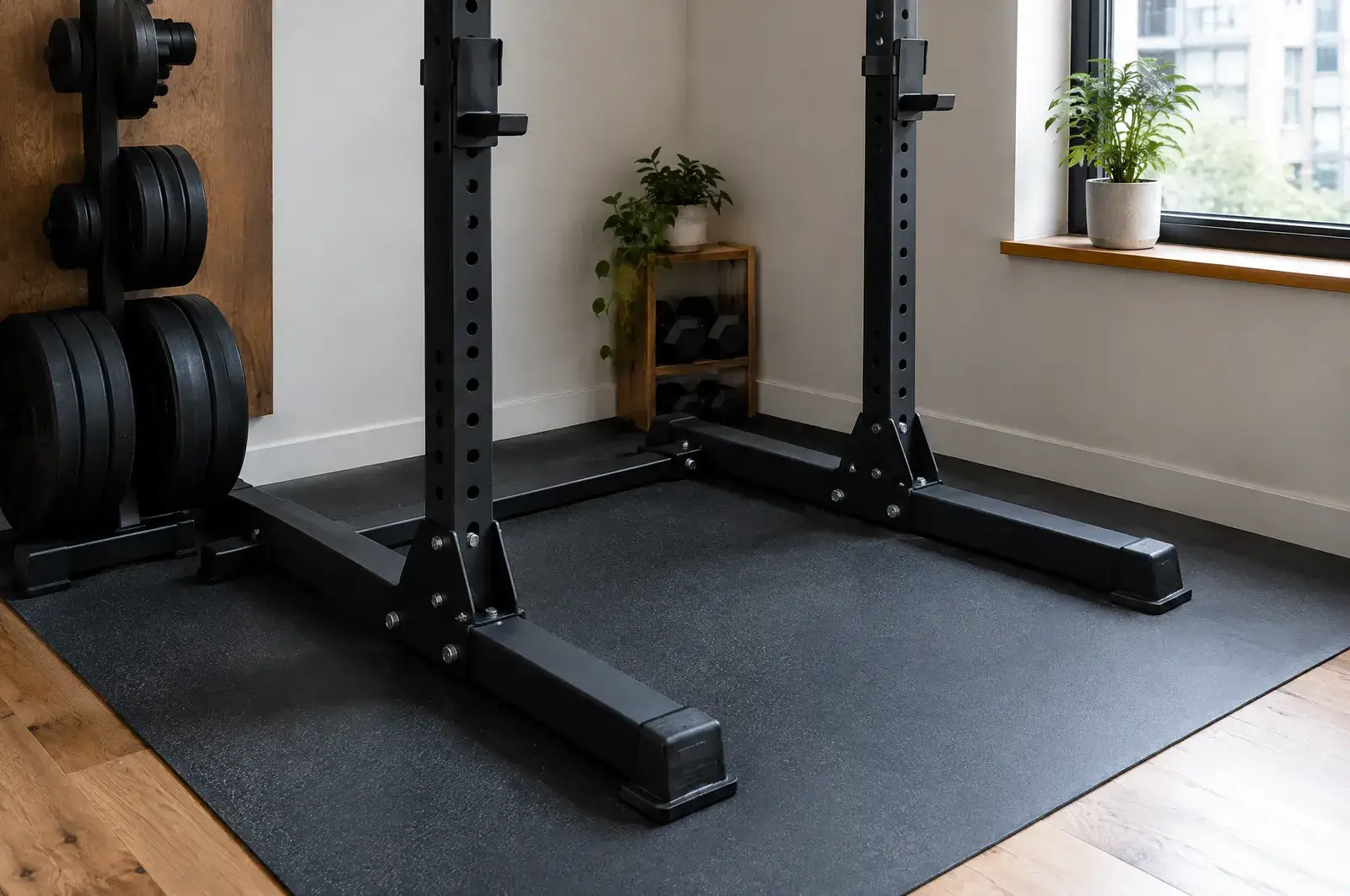
Rubber flooring under the rack absorbs impact from dropped plates and cuts vibration through the floor to neighbors below — a real concern in multi-unit buildings. Owner feedback on one rubber tile product notes “minimal to zero rubber smell” but also that the tiles “show footprints horribly,” so plan on sweeping or a runner if you care about appearance. A different rubber flooring product drew praise from an owner who said “dirt, dust, and footprints are completely hidden” on a gray-flecked pattern — pattern and color affect how much daily wear shows, not just the rubber itself.
Cover the full footprint of your stand plus a few extra feet where plates land, not just the frame outline. See our guides to gym flooring and garage gym flooring for thickness and material options; both apply just as well to an apartment room as a garage.
What should renters check before buying?
Check your lease for any equipment weight limits or noise clauses before ordering — a no-bolt stand avoids structural changes, but a lease can still restrict heavy gear regardless of hardware. Building or floor load limits are a structural question specific to your unit; if you’re unsure whether your floor can handle a loaded rack plus plates, that’s a conversation for your landlord or a licensed structural professional, not a guess based on a product page.
Confirm delivery and assembly space too. Several picks here ship backordered (Titan T-3 Independent) or take a few weeks (Titan X-3 Half Rack, mentioned for comparison, ships around mid-October per its product page), so check current stock status before you commit to a moving date.
Freestanding vs. wall-mounted vs. folding — which is safer for renters?
Freestanding stands like the ones above rely on base width and steel gauge for stability — no fasteners into the building at all. Folding racks that mount to a wall, like the Titan X-3 Series Folding Power Rack, fold to just 5 inches from the wall when stored but need wall mounting hardware to work, which brings drilling back into the picture.
For a side-by-side on frame types generally, read squat rack vs. power cage and what is a power rack. If your apartment allows wall anchors into studs, a folding design saves more floor space day-to-day than any freestanding stand — but check with your landlord first, since that’s a permanent hole pattern in a wall you don’t own.
Setting up in a small apartment room
Start by measuring your actual ceiling height at the lowest point in the room, not just the room’s stated height — lighting fixtures and sloped ceilings eat into your number fast. Next, measure the clear floor width where the stand will sit, leaving at least loading space on both ends of the bar.
Place the stand against the sturdiest wall in the room, ideally an exterior or load-bearing wall, even though you’re not bolting to it — this reduces how much the whole setup can shift under load. For general apartment layout ideas beyond the rack itself, see how to set up a home gym and half-garage gym ideas, both of which cover space-constrained rooms.
Bottom line
For most apartment lifters, the Titan T-3 Short Squat Stand covers the basics — no bolting, 1,000-lb rating, low price, and a height that clears any standard ceiling with room to spare. Step up to the Titan X-3 Flat Foot or REP Omni if you want more rack around the bar or higher rated capacity, and check your lease and ceiling height before ordering anything with a pull-up bar mounted near the top.
Questions
Do freestanding squat stands actually need no floor anchors?
The models in this list use a flat-foot or wide-base design that the maker states does not need floor bolting — Titan says this directly for the T-3 Short and X-3 Flat Foot, and Rogue says it for the HR-2. Some brands, like REP, still recommend bolting racks down for extra safety even when anchors aren't strictly required, so check the specific product page before you decide.
How much floor space does a freestanding squat stand need in an apartment?
Footprints in this list range from about 24 in x 25 in per post (Titan T-3 Independent) up to 50 in x 48 in (Titan X-3 Flat Foot). Leave extra room around the base for loading plates and stepping back from the bar; a cramped footprint number alone doesn't account for working space.
Will a squat stand fit under a standard 8-foot apartment ceiling?
An 8-foot ceiling is 96 inches. The shortest stands here — the Titan T-3 Short (73.5 in) and T-3 Independent (72.5 in) — leave over 20 inches of clearance (our calculation). Taller options like the Rogue SML-2 (92.25 in) leave under 4 inches, which is tight once you add a pull-up bar's swing clearance.
Can I still do pull-ups with a short apartment squat stand?
Only if the stand includes or supports a pull-up bar and your ceiling has enough headroom above it. RitFit recommends 8.5 to 9 feet of ceiling for pull-ups and overhead work, and one flooring maker's page warns that 8-foot ceilings 'just won't do' for rack models with pull-up bars — so measure your actual lowest point, including light fixtures, before buying that feature.
Do I need permission from my landlord to use a freestanding rack?
No drilling means no permanent modification to walls or floors, which is the main appeal for renters. Still check your lease for weight or noise clauses, since a lease can restrict heavy equipment even without any hardware involved.
What's the cheapest no-bolt option in this list?
The Titan T-3 Series Short Squat Stand at $300.97 (regular $379.99, Titan Fitness) is the lowest price here and is rated for 1,000 lb without floor bolting.
Should I put a squat stand on rubber flooring in an apartment?
Rubber tiles or mats help absorb impact noise and protect a rented floor from dropped plates or scuffing. See our flooring guide for options and thicknesses that fit under a squat stand's footprint.
Sources
Every fact on this page comes from the sources below. We did not test these products by hand.
- T-3 Series Short Squat Stand — Titan Fitness, accessed
- T-3 Series Independent Squat Stand — Titan Fitness, accessed
- X-3 Series Flat Foot Power Rack — Titan Fitness, accessed
- Rogue HR-2 Half Rack — Rogue Fitness, accessed
- Omni Rack Builder — REP Fitness, accessed
- SML-2 Rogue 90 Monster Lite Squat Stand — Rogue Fitness, accessed
- Squat rack dimensions guide — RitFit Sports, accessed
- Rack guide — REP Fitness, accessed
- Cheetah Folding Power Rack — Gym Mikolo, accessed