
The short answer
A half garage gym works when the rack folds flat, the flooring stays down without blocking the car, and you leave real clearance for the garage door's track and springs and for ceiling height. A folding wall-mounted rack, 3/4-inch stall mats over the workout side only, and mobile storage let a common 24-by-24-foot two-car garage hold both a car and a real lifting setup.
On this page 14 sections
- The short answer
- What is a half garage gym, exactly?
- How much garage width does your car actually need?
- The rack that makes a half garage gym possible
- Flooring that can stay down when you park
- Storage that keeps the car side clear
- Garage doors, tracks and ceiling height: what to check before you mount anything
- Definitions: sideroom, headroom, backroom
- An example half-garage layout
- One-car garage: splitting front to back instead of side to side
- Safety notes for a shared space
- How we researched this guide
- Questions
- Sources
What is a half garage gym, exactly?
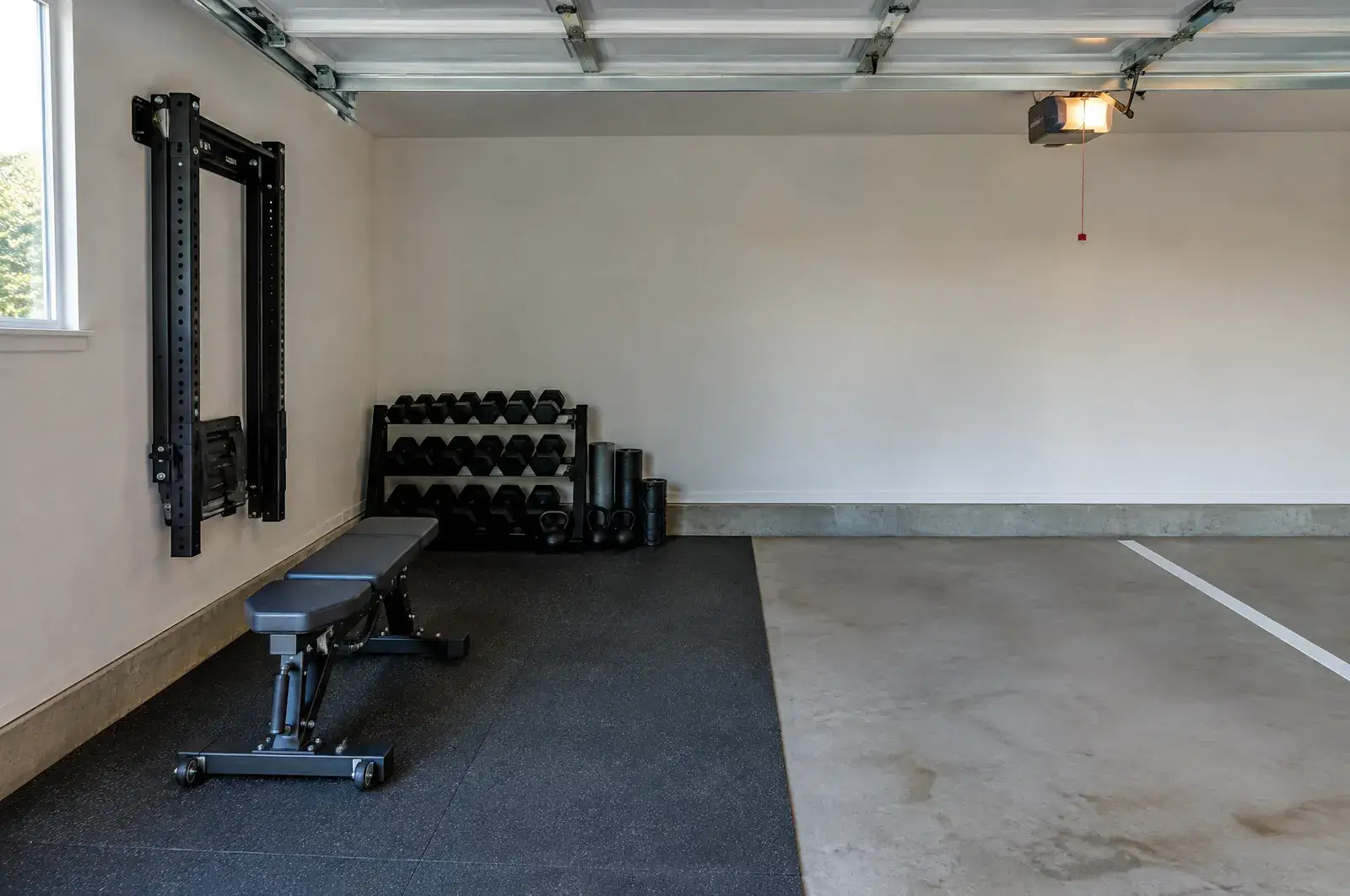
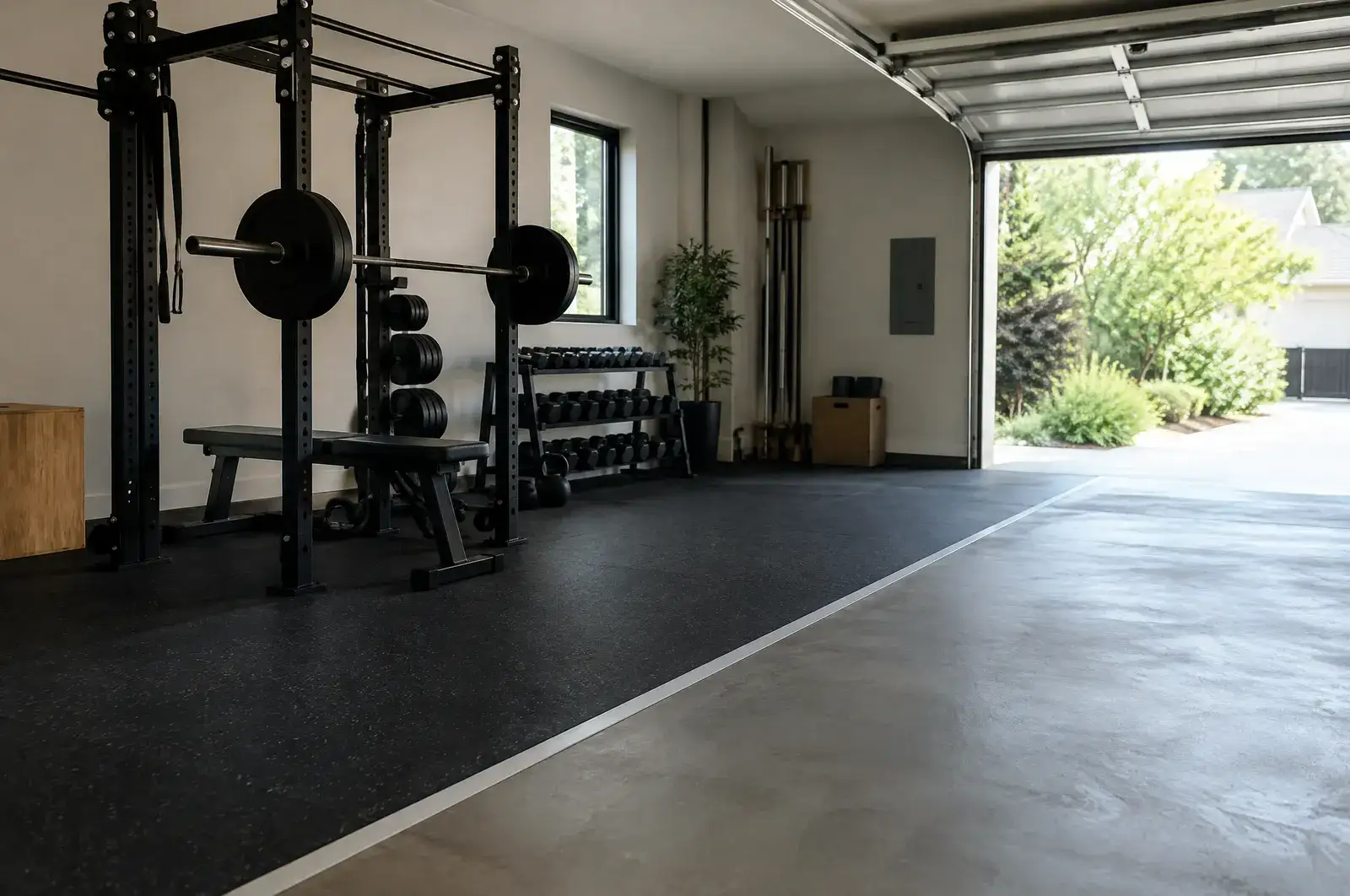
A half garage gym is a workout setup built into one side of a garage while the other side keeps parking a car. The car doesn’t move out permanently. A folding wall-mounted rack, flooring that stays down only on the gym side, and storage on wheels are what make that split work day to day.
Most two-car garages are around 24 feet wide, the most common size according to a guide from home-services site Angi, with a range from 20x20 feet up to 30x30 feet for larger builds. Split down the middle, a 24-foot garage gives you roughly 10 to 12 feet of width for the gym side and leaves the rest for the car. That’s enough for a folding rack, flooring, a bench, and a rack of plates, but not enough to also leave the rack standing open.
The rest of this guide covers the four things that actually decide whether a half garage gym works: how much room your specific car needs, which rack folds flat enough to give that room back, flooring you don’t have to pull up to park, and the garage door hardware and ceiling height that limit where you can mount anything. If you’re starting the whole garage from scratch rather than sharing it, our general guide to how to set up a home gym covers the broader planning steps.
How much garage width does your car actually need?
Before buying a rack or flooring, measure your own car, not an average one, because the spread between vehicle classes is wide. Extra Space Storage’s guide to average car dimensions gives the ranges below.
| Vehicle class | Length | Width |
|---|---|---|
| Mid-size sedan | 14-16.3 ft (168-196 in) | 5.8-6.3 ft (70-75 in) |
| Mid-size SUV | 15-16.3 ft (180-195 in) | 6-6.6 ft (72-79 in) |
| Full-size SUV | 16-18.4 ft (192-221 in) | 6.3-7 ft (76-84 in) |
Mirrors add a few more inches on each side beyond the body width above, so if you’re working with a tight margin, fold the mirrors in when measuring your actual parked footprint.
Add your car’s width to whatever clearance you want for opening doors and walking past, and that’s the minimum width the “car side” of the garage needs. Whatever is left over is your gym side. In a 24-foot garage with a 6.5-foot-wide SUV and generous walk-around room, that commonly leaves 10 to 12 feet for the gym, which is enough for a folded rack against the wall plus a flooring strip in front of it, but not enough to also swing the rack fully open and squat in front of the car.
Single-car garages are tighter. Angi’s guide notes that single garage doors themselves run 12 to 20 feet wide, and a one-car garage bay is typically sized close to the low end of that. If you’re converting a one-car garage instead of a two-car garage, see the front-to-back layout further down, since splitting a narrow one-car bay side to side usually doesn’t leave enough width for both the car and a rack.
The rack that makes a half garage gym possible
A standard power rack that stays open all the time doesn’t work in a shared garage, because its footprint permanently blocks the space a car needs. The fix is a folding wall-mounted rack: the uprights bolt to studs and the whole thing swings flat against the wall in seconds when you’re done training.
Two current models illustrate the range, both fetched directly from the maker’s site on 2026-09-23.
| Spec | REP PR-4100 | Rogue RML-3W |
|---|---|---|
| Price | $499.99 (21.5 in) / $579.99 (41 in) | $605.00 |
| Depth options | 21.5 in or 41 in | 21.5 in or 41.5 in |
| Folded footprint | 6 in (21.5 in model) / 24 in (41 in model) | Under 5 in, either depth |
| Upright height | 92.3 in | 90.375 in |
| Weight capacity | 1,000 lb, properly mounted | Not published |
| Pull-up bar | 1.25 in diameter, built in | Included, quick-attach |
| Steel | 3x3 in, 11-gauge | 3x3 in, 11-gauge |
| Warranty | Not published on the product page | Guaranteed for life |
The 21.5-inch depth option on either rack is the one that actually matters for a half garage gym: the PR-4100 folds down to just 6 inches from the wall, and the RML-3W folds to under 5 inches, both close enough to a bare wall’s footprint that a parked car regains almost the full width of the garage the moment you fold the rack up. The 41 or 41.5-inch depth versions give more working room inside the rack while it’s open, but they also fold out to roughly 24 inches from the wall, which eats into the width you’re trying to save.
Rogue backs the RML-3W with a lifetime guarantee; REP’s PR-4100 product page doesn’t list warranty terms, so check that directly with REP before buying if it matters to you. Neither company’s page states a weight capacity for the Rogue rack, so that’s a gap worth asking about if you plan to load it heavy.
For more folding and wall-mounted options beyond these two, see our guide to the best folding and wall-mounted power racks.
Flooring that can stay down when you park
The flooring strategy for a half garage gym is different from flooring a full garage: you only need to cover the gym side, and it has to survive being walked past by a car on the other side without curling up or sliding.
Horse stall mats are the default choice for exactly this reason. They’re heavy, dense rubber, usually 3/4 inch thick, and don’t need adhesive to stay flat; Greatmats calls 3/4 inch “generally regarded as the bare minimum for proper floor protection for olympic lifting.” A poster on the Garage Journal forum, in a thread specifically about converting half a garage into a workout space, put it plainly: “go to tsc and get the 4x6 horse stall mats… they are heavy and won’t move around.” TSC is Tractor Supply Co., a common source for stall mats outside of flooring specialists.
Pricing varies by thickness and where you buy. Here’s what a 3/4-inch stall or gym mat costs per square foot from two sourced retailers, checked 2026-09-23. For a broader rundown of flooring types beyond stall mats, see our guide to the best garage gym flooring.
| Product | Thickness | Price | Price per sq ft |
|---|---|---|---|
| Greatmats horse stall mat, 4x6 ft | 3/4 in | About $3/sq ft (retailer’s stated rate) | ~$3.00 |
| Flooringinc.com Traxxon Extreme gym mat, 4x6 ft | 3/4 in | $74.99/mat | ~$3.12 (our calculation) |
| Flooringinc.com Diamond Top stall mat, 4x6 ft | 3/4 in | $103.49/mat | ~$4.31 (our calculation) |
| Flooringinc.com Premium stall-mat tiles, 24x24 in | 1 in | $8.81/sq ft | $8.81 |
For a 220-square-foot gym strip (the example layout below), that price range works out to roughly $660 at the stall-mat end and up to about $1,938 for the thicker premium tile, before tax, shipping or a subfloor. Stall mats are heavy and often ship freight, so get a shipping quote before comparing final totals; neither retailer’s page listed a flat shipping rate we could verify today. Prices change, so treat these as a starting point and re-check before you order.
Whichever mat you choose, keep the seam between “gym flooring” and “bare garage floor” in a straight line the car’s tires won’t cross, and butt the mats tight so there’s no lip a car tire or a foot can catch. If the slab underneath isn’t flat, deal with that first; see our guide on how to level a garage floor for a gym.
Storage that keeps the car side clear
A folded rack and flat flooring solve the big footprint problems, but plates, dumbbells, bands and a bench still need somewhere to live that isn’t the middle of the car’s path. Mobile storage is the standard answer: a rolling plate tree, a wheeled dumbbell rack, or a rolling utility bench that tucks against the gym-side wall when you’re done.
The goal is that nothing on the gym side has to be picked up and carried out of the way before the car pulls in. If it has wheels and lives against the wall, it stays there. If it’s small enough to hang, wall-mounted hooks or a slat wall on the gym-side studs keep bands, straps and smaller items off the floor entirely.
Garage doors, tracks and ceiling height: what to check before you mount anything
Before you bolt a rack to a wall, check what’s already using that wall space. The garage door’s track, springs and cables need dedicated clearance, and mounting hardware too close to them can interfere with the door’s operation.
Door manufacturer Clopay’s buying guide gives three clearance zones to check:
- Sideroom — at least 4.5 inches of clear wall space next to the door opening for the track, springs and mounting brackets.
- Headroom — at least 12 inches above the door opening for a 12-inch-radius track, or 14.25 inches for a 15-inch-radius track, measured to the ceiling or the lowest obstruction.
- Backroom — door height plus 16 inches of depth so the door can retract fully and lie flat against the ceiling.
A separate guide from Garage Door Guide adds that leaving 18 inches of headroom is the safer target if you have the ceiling for it, especially once an automatic opener’s rail is factored in. Practically, that means the header wall directly above the garage door, and the first several inches of side wall next to the opening, aren’t good places to bolt a rack. Mount on a side wall further from the door track instead.
Ceiling height is the other constraint. Fitness retailer RitFit recommends aiming for 8.5 to 9 feet of clear ceiling if you want pull-ups, overhead pressing or comfortable bar handling, and its guide stresses measuring the lowest point in the space, including garage door tracks, openers, ductwork and light fixtures, rather than trusting the nominal ceiling height. An 8-foot garage ceiling can still work for a compact wall-mounted rack, but it will likely rule out full-range pull-ups.
Definitions: sideroom, headroom, backroom
These three terms come from the garage door industry, not fitness, but they matter for where you can safely drill into a shared garage wall. Sideroom is the flat wall space beside the door opening that the track hardware needs. Headroom is the vertical space above the door opening the track needs to curve back. Backroom is the depth behind the door needed for it to lie flat against the ceiling once fully open.
An example half-garage layout
Here’s one way the numbers above come together in a real two-car garage, using the common 24x24-foot interior size cited by Angi’s guide.
| Zone | Approx. width | What goes there |
|---|---|---|
| Car side | 14 ft | Mid-size SUV (up to ~7 ft wide) plus walk-around room on both sides |
| Gym side | 10 ft | Folded rack against back wall, flooring strip in front, mobile storage along a side wall |
| Total interior | 24 ft | Matches Angi’s “most common” two-car garage size |
In this layout, the gym side’s flooring might run roughly 10 ft wide by 22 ft deep (about 220 sq ft, leaving a couple of feet of bare concrete near the door for backroom clearance), which is the area used in the flooring cost math above. The rack mounts on the back wall or a side wall away from the garage door’s header, at least 4.5 inches clear of any door-track hardware on that wall. When it’s folded, the gym side reads as an empty strip of flooring the car could technically park across if you ever needed the whole garage back.
This is one configuration, not a universal template. Garage width, door type, ceiling obstructions and your specific vehicle will all shift these numbers, so treat it as a starting point to measure against, not a plan to copy exactly. For more layout options once you’ve measured your own garage, see our roundup of garage gym ideas and our garage gym conversion cost breakdown, or start from our planning hub.
One-car garage: splitting front to back instead of side to side
A one-car garage bay usually isn’t wide enough to fit a car and a rack side by side, since a single-car bay is built close to the width of its door, and Angi’s guide puts single garage doors at 12 to 20 feet wide, most of which is taken by the car itself plus door-swing room. Front-to-back splits work better here: park the car as far forward (or back) as the garage allows, and use the remaining depth, often just a few feet, for flooring and a folded wall rack.
That shallow zone won’t fit an open rack or floor space for barbell movements that need to travel, but it’s enough for a folded rack, a flooring strip, and accessory work like pull-ups, banded movements or a rolling bench pulled out only while it’s in use. The 21.5-inch depth version of either rack in the comparison table above is the better fit here, since the 41-inch/41.5-inch versions need more open floor depth than a one-car bay’s leftover space usually has.
Safety notes for a shared space
Working out a few feet from where a car pulls in raises a few practical safety points worth building into the layout, not just the equipment list.
Keep a clear sightline and a few feet of buffer between the flooring’s edge and the car’s parking line, so nobody backs a bumper into a loaded rack or a stack of plates. Store loose plates and dumbbells on the rack or a storage cart rather than the floor near the car path, since a tripping hazard next to a moving vehicle is a bigger risk than the same hazard in an open room. If the garage door opener is on the same electrical circuit as any gym equipment you add (a treadmill, a fan, lighting), have a licensed electrician confirm the circuit can handle the added load rather than guessing from the breaker panel. And if you’re planning any structural changes, like reinforcing a wall for a heavier rack, work with a licensed contractor and check local building code rather than relying on general advice from a website.
How we researched this guide
Every spec, price and clearance figure in this guide came from a page fetched directly from the source on 2026-09-23: the REP Fitness and Rogue Fitness product pages, Greatmats’ and Flooringinc.com’s pricing pages, garage-dimension guides from Angi and Extra Space Storage, garage door clearance specs from Clopay and Garage Door Guide, a ceiling-height guide from RitFit, and one attributed forum post from the Garage Journal. None of this equipment was physically tested for this guide; every figure above was compared from maker specs, prices, warranty terms and the one forum thread cited. Where a number couldn’t be confirmed on a maker’s page, such as the Rogue RML-3W’s weight capacity or the REP PR-4100’s warranty terms, we said so rather than estimating it. Prices and stock change; re-check before you buy. See how we research for the full method behind every guide on this site.
Questions
Can I still open my car doors if the rack is on the shared wall?
Yes, if you fold it first. The REP PR-4100 in its 21.5-inch depth option folds to just 6 inches from the wall when stowed, and the Rogue RML-3W folds to under 5 inches, so a parked car keeps close to the same door-swing room it would have against a bare wall. Measure your actual door-swing arc before buying, since wide pickup doors need more room than a sedan's.
Do I need to pull the flooring up every time I park?
No. The point of a half garage gym is that the flooring only covers the workout side, so the car parks on bare concrete or the existing driveway apron and never touches the mats. Interlocking or glue-free mats on the gym side can stay down permanently; you just sweep them off.
What size folding rack fits in a one-car garage?
Both racks in this guide come in a shallower depth option built for exactly this: the REP PR-4100 folds to 6 inches from the wall in its 21.5-inch depth version, and the Rogue RML-3W folds to under 5 inches in either depth option. In a one-car garage, the 21.5-inch depth (not the 41-inch) leaves the most floor width for the car.
Will dropping weights damage the concrete under stall mats?
Horse stall mats and dedicated rubber gym mats exist mainly to protect the slab from repeated impact and dropped plates, and Greatmats calls 3/4 inch "generally regarded as the bare minimum for proper floor protection for olympic lifting." A Garage Journal forum poster who converted half a garage into a workout space recommended 4x6-foot stall mats specifically because they're heavy enough to stay in place under use.
How much clearance do I need above a wall-mounted rack?
Aim for 8.5 to 9 feet of ceiling height if you want pull-ups and overhead pressing, and measure the lowest point in that space, not the nominal ceiling height. Garage door tracks, openers, ductwork and light fixtures can all cut into that number before you ever touch a bar.
Can I mount a rack near the garage door track?
Give the track hardware room first: door manufacturers spec at least 4.5 inches of clear wall space (sideroom) next to the opening for the track, springs and brackets, plus headroom above the door of roughly 12 to 18 inches depending on the track radius and whether there's an opener. Mount uprights outside that zone, on the side wall rather than the header wall.
What's the cheapest way to floor a half garage gym?
Among the sourced options here, 3/4-inch horse stall mats are the budget route at roughly $3 per square foot from Greatmats or a comparable price per mat from a flooring retailer, versus $4.31 to $8.81 per square foot for thicker or tile-style gym mats. A 220-square-foot gym strip works out to roughly $660 in stall mats by that math.
Do folding wall racks work for bench press, not just squats?
Yes. Both the REP PR-4100 and Rogue RML-3W have 1-inch (REP) or Westside (Rogue) hole spacing through the bench and pull-up zone specifically so you can rack a bench inside the uprights, and both include a pull-up bar: a fixed 1.25-inch bar on the PR-4100, a quick-attach bar on the RML-3W.
Sources
Every fact on this page comes from the sources below. We did not test these products by hand.
- PR-4100 Folding Squat Rack — REP Fitness, accessed
- Rogue RML-3W Fold Back Wall Mount Rack — Rogue Fitness, accessed
- Pricing and Costs of Horse Stall Mats — Greatmats, accessed
- What Is The Best Thickness For Gym Flooring — Greatmats, accessed
- Horse Stall Mats: Rubber Mats for Stables, Barns, Trailers & Gyms — Flooringinc.com (Rubber Flooring Inc), accessed
- 2-Car Garage Dimensions: A Complete Guide to Standard Sizes — Angi, accessed
- Average Car Dimensions: A Guide to Length, Width, & Height — Extra Space Storage, accessed
- Garage Door Tracks | Options, Headroom and Specs — Clopay, accessed
- Garage Door Headroom Requirements - Standard vs Low Clearance Track — Garage Door Guide, accessed
- What Are Standard Squat Rack Dimensions? Space Guide for Home Gyms — RitFit, accessed
- anyone turn half garage into workout space? — The Garage Journal (forum), accessed