
The short answer
Set up a home gym by picking a room, measuring floor space and ceiling height, setting a budget, then laying flooring before installing one anchor piece — usually a power rack. A rack-based setup needs about 8 to 10 feet wide by 8 to 10 feet deep, per equipment maker Bells of Steel, plus roughly 8 ft 9 in of ceiling height for a full-height rack. Plan clearances before buying the rest.
On this page 13 sections
- The short answer
- Step by step
- How do you set up a home gym?
- How much room do you actually need?
- How much clearance does each piece of equipment need?
- What ceiling height do you need?
- How thick should your flooring be?
- How much does it cost to set up a home gym?
- Does a home gym need a dedicated electrical circuit?
- How do you keep a garage gym comfortable year-round?
- How we researched this
- Questions
- Sources
Step by step
Pick the room
A garage, spare bedroom, basement, or a corner of a larger room can all work. Garages give you the most ceiling height and a washable concrete floor but usually need climate control; finished rooms are more comfortable but often have lower ceilings and carpet to work around. Walk the space with a tape measure before you decide anything else — floor dimensions and ceiling height set the limit on what equipment fits.
Set a budget before you shop
Decide what you're spending on equipment, flooring, and any electrical or climate-control work separately, since it's easy to blow the whole budget on a rack and have nothing left for flooring. A bodyweight-and-dumbbell setup can start in a space as small as 4 ft x 6 ft, according to equipment maker Bells of Steel, so you don't have to buy everything on day one.
Choose your anchor equipment
Most home gyms are built around one large piece — a power rack, an all-in-one cable machine, or a treadmill — with everything else added later. Picking this first tells you the minimum room size and ceiling height you need, since a rack or cardio machine has a fixed footprint that the rest of your layout has to work around.
Measure ceiling height for that equipment
Add the equipment's height to its overhead clearance requirement and compare that total to your actual ceiling height, not just the room's stated height (garage door tracks and light fixtures can eat into it). A full-height power rack plus recommended headroom can need close to 9 feet; a short rack or a treadmill needs less. See the clearance table below for the numbers behind this.
Lay the flooring first
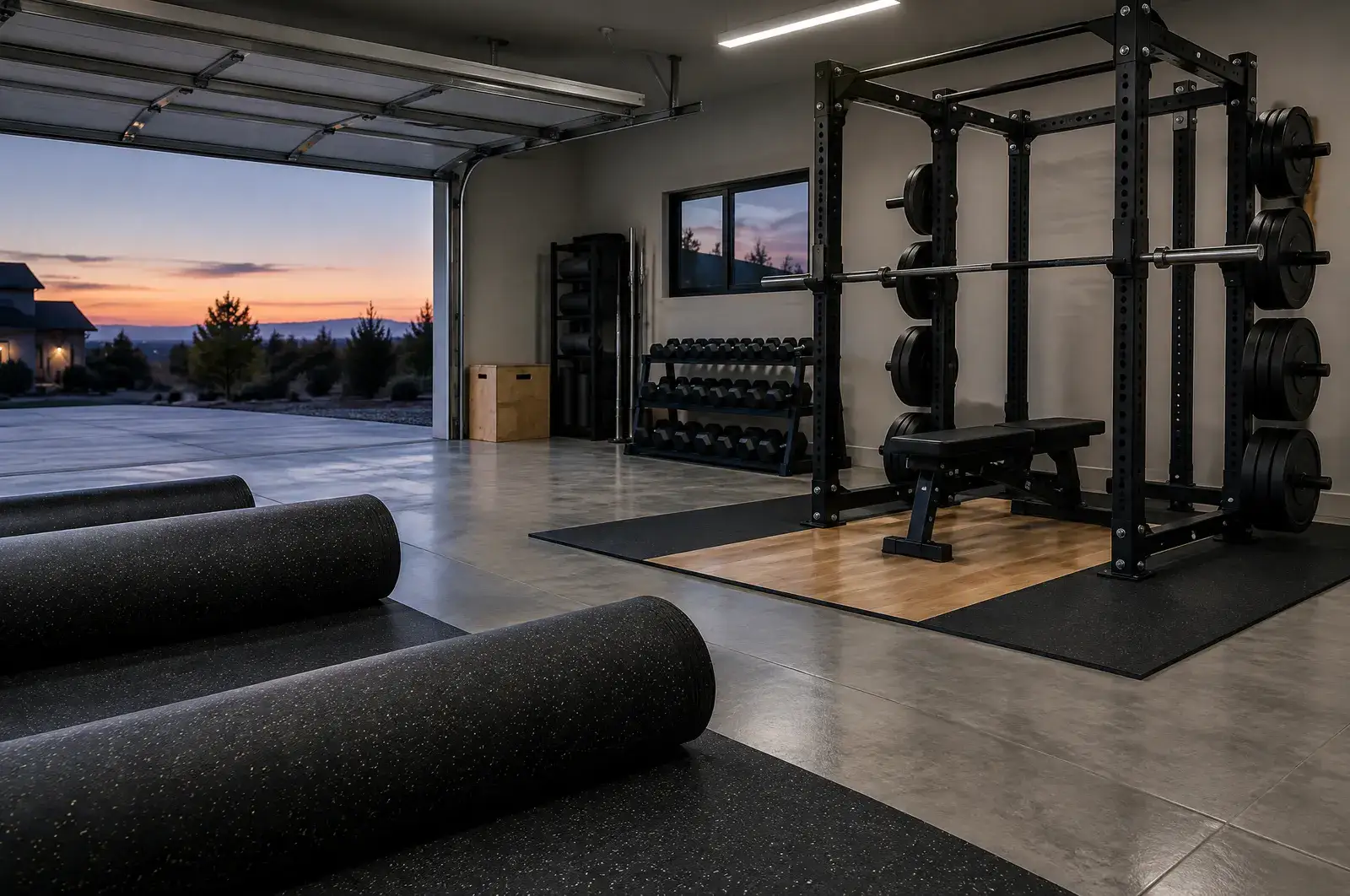
Install flooring before any equipment arrives — it's far easier to roll out tiles or mats in an empty room than to work around a loaded rack. Flooring also protects a concrete slab from dropped plates and makes the room more comfortable to stand and train on. Pick thickness by what you'll actually do on it; see the flooring table below.
Map clearances for every piece
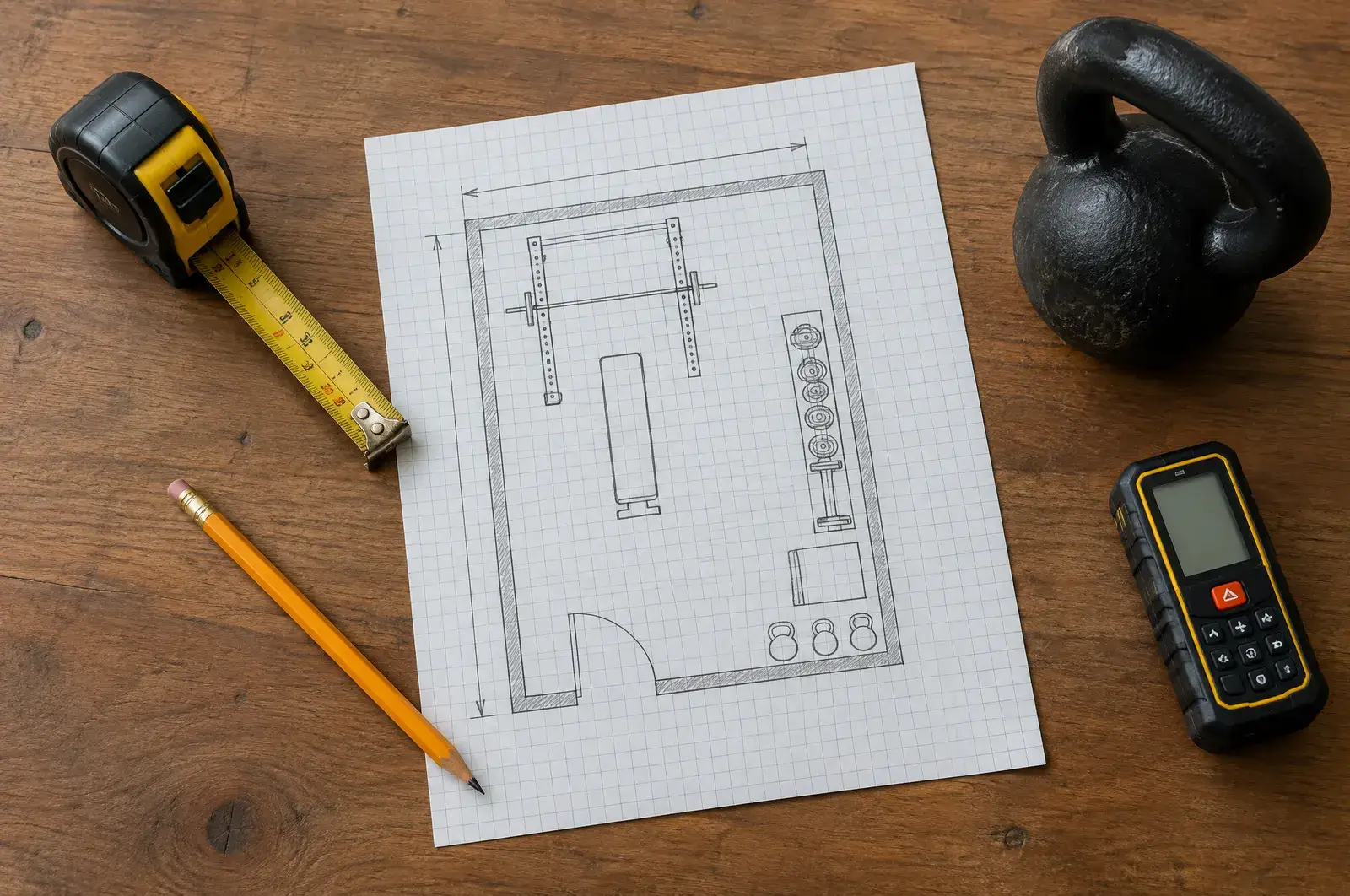
Sketch your layout to scale (graph paper or a free floor-planning app both work) and mark real clearance zones around each piece, not just its footprint. A power rack needs meaningfully more space in front for bench work and to the sides for loading plates than its frame alone suggests — skipping this step is the most common reason home gyms feel cramped.
Sort out power before you plug anything in
Motorized equipment like treadmills draws enough current that manufacturers commonly specify a dedicated circuit — many treadmills call for a dedicated 20-amp, 120-volt circuit, and some commercial-grade units need 240 volts at 30 amps, according to electrical guidance site Ask the Electrician. Never plug a treadmill into a shared circuit or upsize a breaker without a licensed electrician confirming the wiring can handle it; this is not a DIY judgment call.
Control temperature and humidity
Garages run hotter, colder, and more humid than the rest of the house, which is uncomfortable to train in and speeds up rust on steel equipment. A dehumidifier rated for 50 to 70 pints a day is a common recommendation for keeping relative humidity under 50%, the rough threshold where rust and mold slow down, per garage-gym ventilation guide GarageGymBuilders. Fans, an open door, or a small window unit can handle temperature.
Add storage and organization
Wall-mounted plate posts, a small shelving unit for bands and collars, and hooks for jump ropes keep the floor clear and reduce trip hazards. Add storage once you know what you actually own — buying racking before your equipment list is final usually means buying it twice.
Run a safety walkthrough before the first session
Check that the rack (or any wall-mounted equipment) is level and, where the maker specifies it, anchored to the floor or wall studs. Confirm safety arms or straps are set at the right height for your lifts, clear the walking path to any exit, and make sure a phone is reachable from the training area before you lift alone.
How do you set up a home gym?
Set up a home gym in this order: pick the room, measure it (floor space and real ceiling height), set a budget, choose one anchor piece of equipment, lay flooring, then plan clearances around everything before you buy the rest. Skipping flooring or clearances until after equipment arrives is the most common reason a home gym ends up too cramped to use safely. Working backward from your ceiling height and one anchor piece — usually a power rack — keeps you from buying something that doesn’t fit.
This guide covers the whole process, whether you’re converting a garage, a spare bedroom, or a corner of a basement. The steps above walk through the order to do things in; the sections below go deeper on the two decisions that make or break a home gym — space and clearances — with sourced numbers instead of guesses. For more on the planning side of a build, see our planning hub.
How much room do you actually need?
It depends entirely on what you’re training with. A bodyweight-and-dumbbell setup can fit in a space as small as 4 ft by 6 ft, according to equipment maker Bells of Steel — smaller than a queen mattress. A barbell changes the math: a standard Olympic bar is about 7 ft long, so Bells of Steel puts the minimum clear width for loading and using one at 8 ft, and recommends 8 to 10 ft wide by 8 to 10 ft deep as a minimum footprint for a full powerlifting-style setup (rack, bar, plates, bench).
Between those two ends, a single power rack with a bench is the most common home gym build, and it’s the one to plan clearances around most carefully, since a rack’s frame is smaller than the space you actually need to use it.
How much clearance does each piece of equipment need?
This is the number most people get wrong — they measure the equipment’s footprint and stop there, without leaving room to actually move around it. The table below uses figures from equipment retailers and gym-flooring specialists, not the manufacturer spec sheets alone, since spec sheets rarely mention working clearance.
| Equipment | Clearance needed | Where |
|---|---|---|
| Power rack, all sides | At least 2 ft minimum | Major Fitness |
| Power rack, sides/front (squats, overhead press) | 3–4 ft | Major Fitness |
| Power rack, overhead | At least 15 in above the rack’s highest point | Major Fitness |
| Power rack, behind (for a lat pulldown or low-row attachment) | Add 1–2 ft | Major Fitness |
| Barbell, clear width to load and use | At least 8 ft | Bells of Steel |
| Powerlifting-style footprint (rack + bar + bench) | 8–10 ft wide x 8–10 ft deep, minimum | Bells of Steel |
| Treadmill, behind the deck | 6 ft | BarBend |
| Treadmill, each side | 2 ft | BarBend |
| Treadmill, overhead | Roughly 1 ft (12 in) | BarBend |
| Rowing machine, total footprint with clearance | 10 ft x 4 ft | Fitness Review Pros |
| Rowing machine, behind | 18–24 in | Fitness Review Pros |
| Rowing machine, in front | 12 in | Fitness Review Pros |
| Rowing machine, overhead (seated) | 6–12 in above your head | Fitness Review Pros |
A few things stand out here. Treadmills need surprisingly deep clearance behind them — 6 ft, more than most other single machines — because a fall at running speed needs somewhere to go. Power racks actually need a bit more overhead clearance than a treadmill or rower (15 in, versus roughly 12 in and 6–12 in), but it’s the side and front clearance that adds up fastest if you’re actually lifting rather than just storing a bar. If a criterion isn’t in this table for a piece of equipment you own, it’s because no fetched source gave a sourced figure for it — check the maker’s own product page before finalizing your layout.
What ceiling height do you need?
Ceiling height is usually the hard limit in a garage or basement, and it’s worth checking against your actual equipment, not a rule of thumb. Two real examples show the range:
| Rack | Height | Footprint | Where |
|---|---|---|---|
| Rogue R-3 (Bolt-Together Power Rack) | 90 3/8 in | 53 in x 34 in (24 in depth option) or 53 in x 40 in (30 in depth option) | Rogue Fitness |
| REP PR-1050 (Short Power Rack) | 72 in (6 ft) | 48 in x 58 in | REP Fitness |
Add the equipment height to the overhead clearance figure from the clearance table above and you get your real ceiling requirement. For the Rogue R-3, that’s 90 3/8 in plus roughly 15 in of headroom — about 105 in, or 8 ft 9 in (our calculation) — before you’d be tight on a pull-up bar mounted at the rack’s stated 7 ft 6 in height. REP’s short rack is built specifically to avoid that math: at 72 in tall, it fits rooms that a full-height rack never would, which is why REP markets it for “small spaces and low ceilings,” per REP Fitness’s own rack-dimensions guide. If your garage has a lower track for the garage door itself, measure to that, not to the highest point of the ceiling — it’s usually the real obstruction.
How thick should your flooring be?
Thickness should match what’s happening on that section of floor, not the room as a whole — a lot of home gyms use one thickness under cardio equipment and a thicker section where weights get dropped.
| Use | Recommended thickness | Where |
|---|---|---|
| Cardio machines (treadmills, bikes, ellipticals) | 8 mm (5/16 in) | U.S. Rubber |
| Free-weight areas (dumbbells, kettlebells, barbell work) | 9 mm (3/8 in) | U.S. Rubber |
| Heavy lifting / dropped bumper plates | 12 mm (1/2 in) minimum | U.S. Rubber |
| Dumbbells, kettlebells, and racks generally | 15 mm minimum, 20 mm as a “sweet spot” for a growing setup | Gym-Flooring.com |
| Deadlifts and heavy barbell training with drops | 30 mm or thicker | Gym-Flooring.com |
| Repeated Olympic lifting drops | 43–63 mm | Gym-Flooring.com |
The two sources don’t perfectly agree on exact millimeters, which is normal — flooring specialists tend to round to the product lines they sell — but they agree on the shape of the answer: thin flooring is fine under cardio machines, and you need meaningfully more underfoot the moment you’re dropping loaded barbells rather than just standing on the floor. Concrete underneath also matters: thicker flooring puts more impact-absorbing material between a dropped plate and the slab, which protects both the slab and whatever’s below it if your gym isn’t on a ground floor.
How much does it cost to set up a home gym?
Costs vary too much by equipment choice to give one number, but flooring is a good example of how to do the math yourself. REP Fitness’s interlocking floor tiles are listed at $44.99 per 19.7 in x 19.7 in tile (checked 2026-09-23) — that works out to roughly 2.7 sq ft per tile, or about $16.70 per square foot at single-tile pricing (our calculation).
| Room size | Tiles needed (approx.) | Cost at single-tile pricing | Cost per sq ft |
|---|---|---|---|
| 100 sq ft (10 ft x 10 ft) | ~38 tiles | ~$1,710 | ~$17/sq ft |
| 168 sq ft (12 ft x 14 ft) | ~63 tiles | ~$2,835 | ~$17/sq ft |
Both figures are our calculation from REP’s listed single-tile price on 2026-09-23, and prices change — check the current listing before you order a full room’s worth. Beyond flooring, budget separately for the rack or machine itself, any electrical or HVAC work, and storage — trying to cover all of it from one number invites corners getting cut on the part that actually keeps you safe (usually flooring or the electrical circuit).
Does a home gym need a dedicated electrical circuit?
Only if you’re running motorized equipment. A power rack, bench, and free weights don’t draw meaningful current. A treadmill is a different story: many treadmills specify a dedicated 20-amp, 120-volt circuit because the drive motor can pull close to that on startup, and some commercial-grade units call for 240 volts at 30 amps, according to electrical resource Ask the Electrician. Sharing that circuit with other outlets risks a tripped breaker mid-run, and upsizing a breaker without confirming the wire gauge can handle it is a fire risk, not just an inconvenience.
This is one area where a licensed electrician, not a blog post, should have the final say — wire gauge, breaker sizing, and whether your panel has room for a new circuit all depend on your specific house and local code, which we can’t verify from here.
How do you keep a garage gym comfortable year-round?
Garages swing further in temperature and humidity than the rest of the house, and humidity is the bigger long-term problem for steel equipment. A dehumidifier rated for 50 to 70 pints a day is commonly recommended to keep relative humidity under 50% — roughly the point where mold stops growing and rust slows down — per garage-gym ventilation guide GarageGymBuilders. For temperature, that same guide notes that opening a garage door partway and training during cooler hours can make a real difference, and that fans are the cheapest way to keep air moving. Full HVAC is the most effective fix but the most expensive; start with a dehumidifier and fans, and add heating or cooling only if you’re still uncomfortable after that.
How we researched this
This guide was compiled from maker specification pages (Rogue Fitness, REP Fitness), equipment retailer space guides (Major Fitness, Bells of Steel, BarBend, Fitness Review Pros), flooring specialists (U.S. Rubber, Gym-Flooring.com), a garage-gym ventilation guide (GarageGymBuilders), and an electrical resource (Ask the Electrician) — not from hands-on testing of a physical space. Every number above links back to the source it came from; where a source didn’t give a sourced figure for something (permit rules, specific local electrical code, structural load ratings for upper-floor rooms), we said so rather than estimate it. Electrical, structural, and code questions always need a licensed professional and your local building department — treat the numbers here as planning inputs, not a substitute for that.
For the equipment itself, see our picks for the best power racks and what a power rack actually is if you haven’t chosen your anchor piece yet. For flooring, our gym flooring picks and how thick your flooring should be go deeper than the summary table above. If you’re specifically working with a garage, garage gym ideas, what a garage gym conversion costs, and how to heat a garage gym cover ground this guide doesn’t. If you’re not sure whether to buy at all yet, renting gym equipment vs. buying is worth reading before you commit to a room. See how we research for our full method.
Questions
Do I need a permit to set up a home gym?
Equipment alone — a rack, bench, and flooring — typically doesn't require a permit. Adding a dedicated electrical circuit, HVAC, or anything structural (wall-mounted racks into studs, glued-down flooring) can fall under local building code. Use a licensed electrician or contractor and check with your local building department rather than guessing.
What's the minimum ceiling height for a home gym?
It depends on your equipment. A full-height rack like the Rogue R-3, at 90 3/8 in tall, plus the roughly 15 in of overhead clearance that equipment retailer Major Fitness recommends above a rack, works out to about 105 in, or 8 ft 9 in (our calculation). A short rack such as the REP PR-1050, at 72 in tall, needs meaningfully less.
Should flooring go down before or after equipment arrives?
Before. It's much easier to cut and lay tiles or rolls in an empty room, and flooring protects the slab underneath from the first dropped plate. Moving a loaded rack to finish flooring afterward is extra work you can skip.
Do I need a dehumidifier in a garage gym?
It's a common recommendation if your garage runs humid. Garage-gym ventilation guide GarageGymBuilders points to a dehumidifier rated 50 to 70 pints a day as enough to hold relative humidity under 50%, which slows rust on bare steel and stops mold.
What's the cheapest way to start a home gym?
Start with a bodyweight and adjustable-dumbbell setup, which equipment maker Bells of Steel says can fit in a space as small as 4 ft x 6 ft. Add flooring and a rack later once you know your space and training style, instead of buying a full setup on day one.
Can I set up a home gym in an apartment?
Yes, with adjustments. Low-ceiling apartments generally can't fit a full-height rack — a short rack like the REP PR-1050 (72 in tall) is built for exactly this. Rubber flooring at 3/8 in or thicker also cuts noise transfer to the unit below, which matters more in an apartment than a detached garage.
How much clearance does a power rack actually need?
At minimum, about 2 ft of clear space on every side, according to equipment retailer Major Fitness, rising to 3 to 4 ft on the sides or front if you're squatting or pressing. Add another 1 to 2 ft behind the rack if you plan to use a lat pulldown or low-row attachment.
Is a treadmill safe to run on a regular household outlet?
Check the owner's manual first. Many treadmills specify a dedicated 20-amp, 120-volt circuit because the drive motor can draw close to that on startup, per electrical resource Ask the Electrician — sharing a circuit with other loads risks a tripped breaker mid-run. Don't assume a standard outlet is rated for it; confirm with a licensed electrician if you're unsure.
Sources
Every fact on this page comes from the sources below. We did not test these products by hand.
- Rack Dimensions Guide — REP Fitness, accessed
- Rogue R-3 Power Rack — Rogue Fitness, accessed
- How Thick Should Rubber Gym Flooring Be? — U.S. Rubber, accessed
- Gym Flooring Thickness Guide: What Thickness Do You Really Need? — Gym-Flooring.com, accessed
- How Much Space Do I Need Around My Power Rack? — Major Fitness, accessed
- Treadmill Size Guide — BarBend, accessed
- Electric Circuit for a Treadmill — Ask the Electrician, accessed
- Rowing Machine Space Requirements: Ultimate Guide for Home Gyms — Fitness Review Pros, accessed
- Garage Gym Ventilation Guide: Fans, Heating & Cooling — GarageGymBuilders, accessed
- How Much Space Do I Need for a Home Gym — Bells of Steel, accessed
- Interlocking Floor Tiles — REP Fitness, accessed