
The short answer
To heat a garage gym, insulate and seal the garage door first, then add electric heat sized to the space: a 1,500 W plug-in heater for short sessions in a small bay, a hardwired 240 V garage heater installed by a licensed electrician for most two-car garages, or a mini-split heat pump for heat and cooling. Treat propane and kerosene heaters as a last resort because of carbon monoxide.
On this page 15 sections
- The short answer
- Step by step
- What is the best way to heat a garage gym?
- Why should you insulate a garage before buying a heater?
- Which heater types work in a garage gym?
- How much does it cost to run a garage gym heater?
- What size heater does a garage gym need?
- Do you need a 240 V circuit to heat a garage gym?
- Is a propane or kerosene heater safe in a garage gym?
- Is a mini-split worth it for a garage gym?
- How do you cool a garage gym in summer?
- Garage gym heating safety checklist
- How we researched this
- Questions
- Sources
Step by step
Measure the space and how you will use it
Write down the length, width and ceiling height of the area you train in, and multiply them to get cubic feet. Note how often you train and for how long. A 45-minute session three times a week needs a different setup than a garage you keep warm all day.
Seal and insulate the garage door
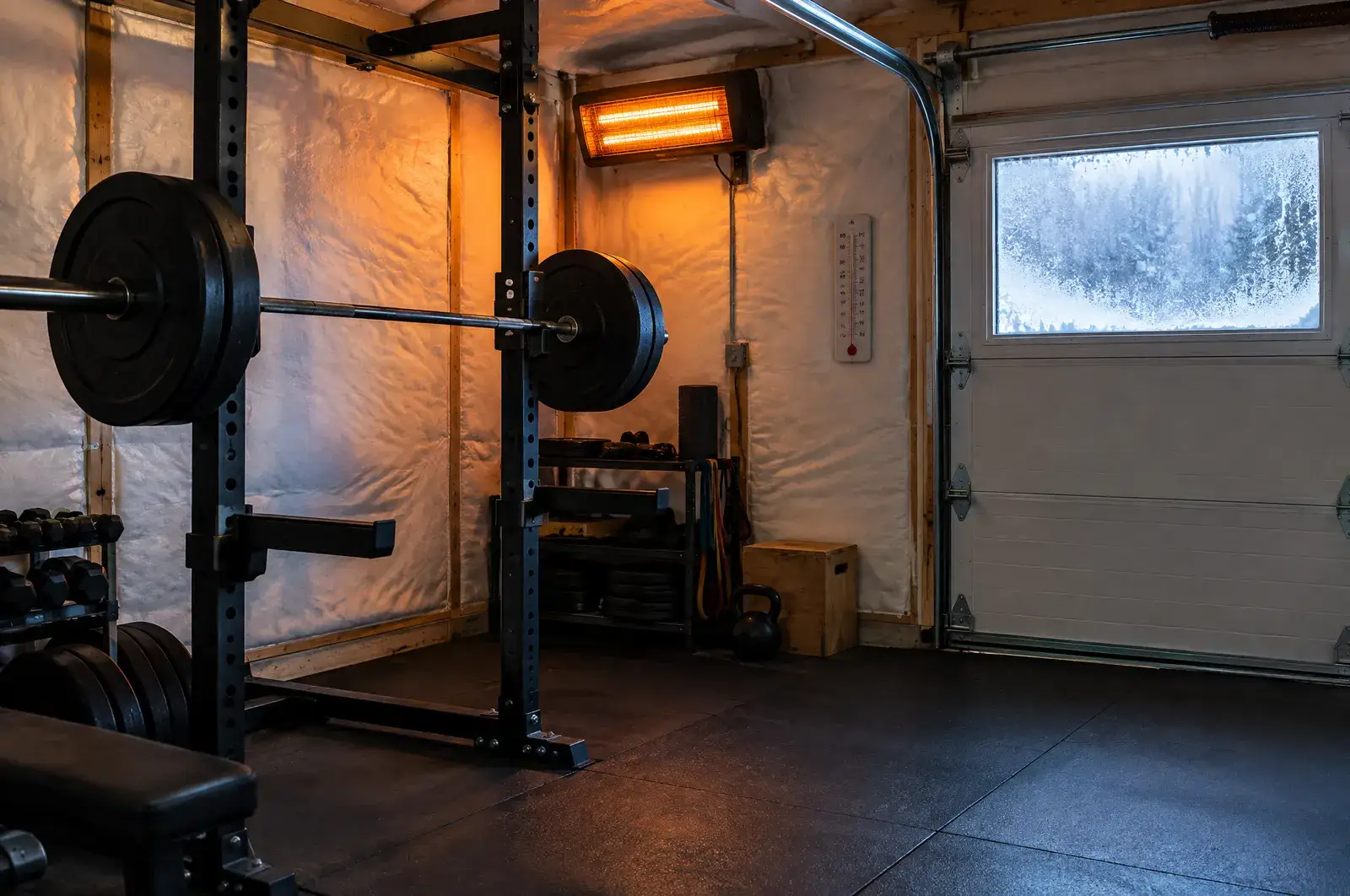
The big door is usually the weakest spot. A non-insulated steel door sits near R-0, while insulated doors run from about R-6 up to R-20 or more. Add or replace the bottom seal and side weatherstrip so cold air cannot pour in at floor level where you lift.
Insulate walls and ceiling, then seal gaps
Open stud walls and an open ceiling lose heat fast. Insulate what you can reach, close gaps around windows and the entry door, and cover the attic hatch. Every gap you close lets a smaller heater do the job.
Clear a no-flammables zone
Heater manuals from Fahrenheat, Dr. Infrared and Mr. Heater all warn against using them where gasoline, paint or flammable liquids are stored. Move the mower, gas cans and paint to a shed or a far corner before you add heat. Keep at least 3 ft of open space in front of any heater.
Choose the heater type
Use the comparison table below. For most garage gyms the choice is between a 120 V plug-in electric heater, a hardwired 240 V garage heater and a mini-split heat pump. Fuel-burning heaters make carbon monoxide and belong at the bottom of the list.
Size the heater to the room
Use the maker's own sizing rule. Dr. Infrared rates its DR-975 at 1.25 watts per cubic foot, so a 20 x 20 x 9 ft space (3,600 cubic feet) works out to about 4,500 W by our calculation. Mini-splits list a coverage area in square feet per BTU size.
Hire a licensed electrician for 240 V work
Hardwired garage heaters and most mini-splits need a dedicated circuit, the right wire gauge and a breaker sized by the maker. The Dr. Infrared manual says its heater must be installed by a certified or licensed electrician in line with local codes. Ask about permits where you live.
Install carbon monoxide and smoke alarms
CPSC says CO alarms belong on every level of the home and outside sleeping areas, with battery backup. If your garage is attached, make sure the rooms next to it are covered. With any fuel-burning heater, a CO alarm is a must, not an extra.
Warm up the space, then train
Turn the heater on a little before you start, or use a thermostat or timer if your heater has one. Stay in the room while it runs, and switch it off when you leave. Never leave a portable heater running unattended or while sleeping.
What is the best way to heat a garage gym?
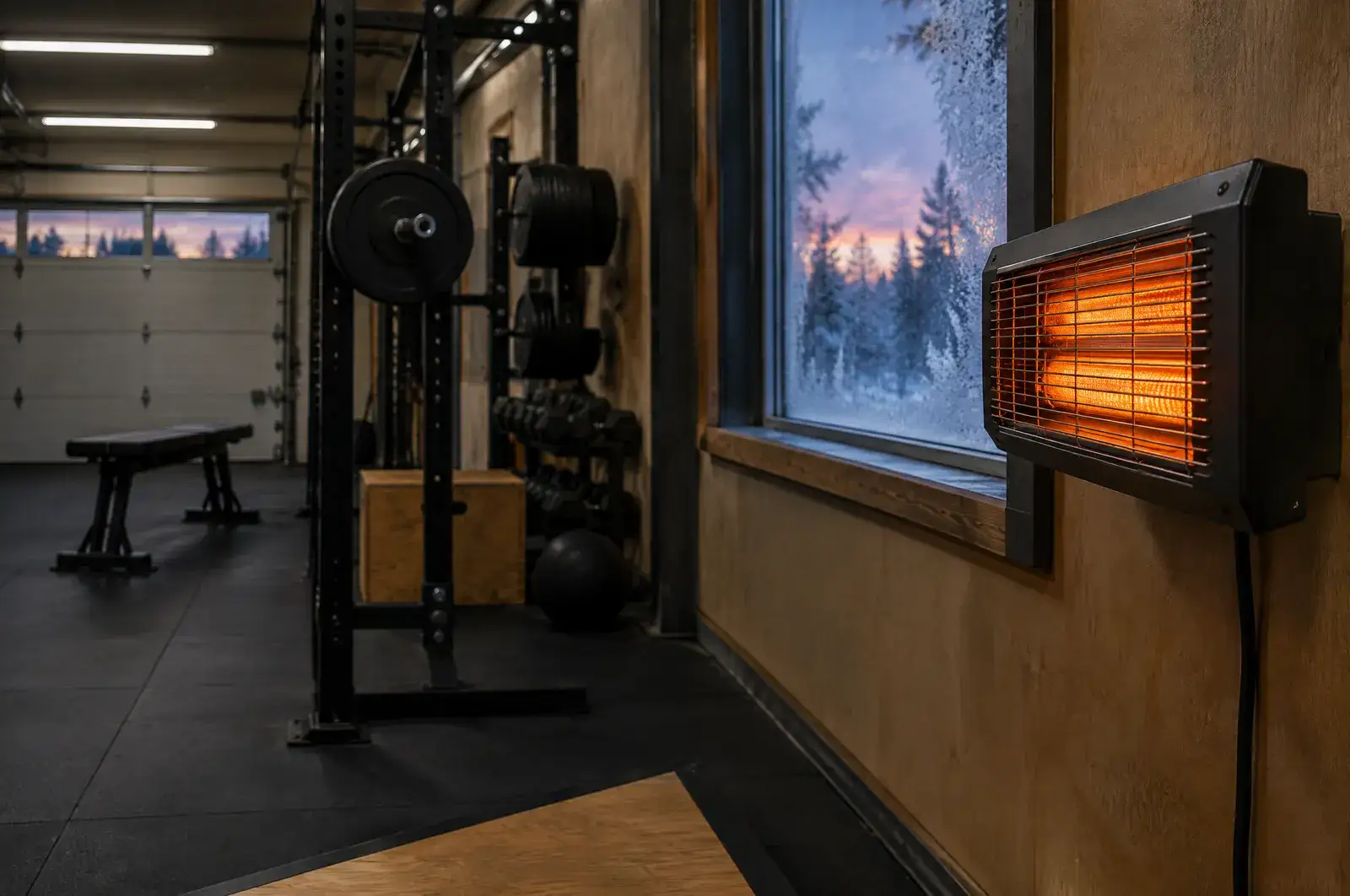
For most garage gyms, the best setup is an insulated, sealed garage door plus an electric heater: a hardwired 240 V unit sized to the space. By one maker’s rule of 1.25 W per cubic foot, a 20 x 20 ft space with a 9 ft ceiling needs about 4,500 W, so a 5,000 W unit fits, while a 24 x 24 ft two-car garage needs about 5,760 W at an 8 ft ceiling or 6,480 W at 9 ft (our calculation). At the June 2026 U.S. average power price, a 5,000 W heater costs about $0.92 per hour at full output (our calculation). Smaller, well-sealed spaces can get by with a 1,500 W plug-in heater. If you also want summer cooling, a mini-split heat pump does both jobs.
Fuel-burning heaters (propane and kerosene) put out a lot of heat for little money up front. They also make carbon monoxide (CO), a gas you cannot see or smell. That trade-off is why they sit at the bottom of this guide.
The steps above give you the order of work. The sections below explain each choice, compare heater types, and show the running-cost math so you can plug in your own numbers. If you are still planning the room itself, start with our garage gym ideas and the budget guide to garage gym conversion cost.
Why should you insulate a garage before buying a heater?
Because a heater only adds heat; insulation decides how long you keep it. A bare garage leaks heat through the door, open stud walls and the gaps at the bottom of the door, so even a big heater can run flat out and still leave the floor cold.
R-value is a number that shows how well a material resists heat flow; higher is better. Clopay’s buying guide puts non-insulated garage doors near R-0, standard polystyrene-insulated doors between R-6 and R-9, and its best polyurethane doors up to R-20.4. The door is usually the largest single surface in the room, so it is the first place to spend.
You do not have to replace the door to see a gain. Start with the cheap fixes:
- Replace a torn or flattened bottom seal so cold air stops sliding in at floor level.
- Add weatherstrip along the sides and top of the door.
- Insulate reachable stud walls and the ceiling, especially walls that face outside.
- Seal gaps around the entry door, windows and any attic hatch.
Rubber flooring helps with comfort too, since a bare slab feels cold through shoes and on your back during floor work. Our guide to the best garage gym flooring covers mat thickness and options, and if the slab slopes, see how to level a garage floor for a gym before you lay anything down.
Which heater types work in a garage gym?
Electric heaters are the safest and simplest fit for most garage gyms because they burn no fuel and make no carbon monoxide. The table below compares the main options using specs from maker pages and manuals we read. Running cost uses a formula you can apply to your own utility rates.
| Heater type | Example model (maker spec) | Power / output | Fuel | Install | Running cost formula (our calculation) | Main safety notes |
|---|---|---|---|---|---|---|
| Plug-in electric (oil-filled radiator) | De’Longhi Dragon TRD40615T-6A | 700–1,500 W | Electricity, 120 V | Plug into a wall outlet | kW x hours x $/kWh | 3 ft clearance; no extension cords; maker says “only suitable for well insulated spaces or occasional use” |
| Hardwired 240 V fan heater | Fahrenheat FUH54 | 5,000 W, 17,065 BTU/hr | Electricity, 240 V | Mount at least 6 ft up; wired to code | kW x hours x $/kWh | Not for areas where gasoline or paint is stored; not for damp locations |
| Hardwired 240 V fan heater | Dr. Infrared DR-975 | 4,700 W (about 16,000 BTU/hr, our calculation) or 7,500 W (25,597 BTU/hr) | Electricity, 240 V | Licensed electrician; 40 A breaker per manual | kW x hours x $/kWh | Manual warns against gasoline or flammable vapors nearby |
| Mini-split heat pump | MRCOOL DIY (12,000 BTU size) | Up to 550 sq ft per maker | Electricity, 115 V or 208–230 V | Wall unit plus outdoor unit; dedicated circuit | kW drawn x hours x $/kWh (check the unit’s spec sheet) | Also cools; electrical work still needs a qualified pro |
| Portable propane radiant | Mr. Heater Big Buddy MH18B | 4,000 / 9,000 / 18,000 BTU/hr | Propane | Portable; needs an 18 sq in fresh-air opening | (BTU/hr ÷ 91,452) x hours x $/gal | Makes CO; ODS and tip-over shut-off; never while sleeping |
| Kerosene or unvented gas heater | Not recommended | Varies | Kerosene or gas | Portable | Varies | EPA lists unvented kerosene and gas space heaters as CO sources |
A few terms from that table:
- Oil-filled radiator: an electric heater that warms a sealed oil reservoir, which then radiates heat slowly and quietly.
- Radiant or infrared heat: heat that warms objects and people in its line of sight rather than the air first. It feels warm fast but only where it points.
- Mini-split heat pump: a two-part system with an indoor wall unit and an outdoor unit linked by refrigerant lines. It moves heat in winter and removes it in summer.
- ODS (oxygen depletion sensor): a safety device that shuts off a gas heater if oxygen in the room drops too low. It does not replace a CO alarm.
The oil-filled De’Longhi was listed as out of stock on De’Longhi’s US store when we checked on September 23, 2026 ($159.95 list). The Mr. Heater Big Buddy was $240.26 on mrheater.com and the Dr. Infrared DR-975 was $240.00 on Dr. Heater USA’s store on the same date. Prices change often, so check before you buy.
How much does it cost to run a garage gym heater?
At the U.S. average residential electricity price of 18.34 cents per kWh (EIA, June 2026), a 1,500 W plug-in heater costs about $0.28 per hour and a 5,000 W garage heater about $0.92 per hour at full output (our calculation). Your price may be much higher or lower depending on your state and plan, so use the number on your own bill.
The formula for electric heat is simple: kilowatts x hours x price per kWh. A kilowatt is 1,000 watts. Thermostats cycle the heater on and off once the room is warm, so real use is often lower than full output.
| Heater (full output) | Power (kW) | Heat (BTU/hr) | Cost per hour at $0.1834/kWh (our calculation) | 4 one-hour sessions a week, ~17.3 hr/month (our calculation) |
|---|---|---|---|---|
| Plug-in heater, 1,500 W | 1.5 | about 5,118 | $0.28 | $4.76 |
| Fahrenheat FUH54 at 5,000 W | 5.0 | 17,065 | $0.92 | $15.86 |
| Dr. Infrared DR-975 at 7,500 W | 7.5 | 25,597 | $1.38 | $23.80 |
Those monthly numbers leave out warm-up time. If you run the heater before each session to warm the room, add that time to your hours.
For propane, first convert heat output to fuel use. EIA lists propane at 91,452 BTU per gallon, so a heater burning 18,000 BTU per hour uses about 0.20 gallons per hour on high, 0.10 on medium (9,000 BTU) and 0.04 on low (4,000 BTU), by our calculation. Multiply by what you pay per gallon or per cylinder. The MH18B manual we read (the Canada and Massachusetts edition) lists 3 to 12 hours on two 1 lb cylinders, depending on setting.
Electric resistance heat turns each kWh into 3,412 BTU of heat, per EIA. A heat pump moves heat from outside rather than making it, so it can deliver more heat per kWh. The exact figure varies by model and outdoor temperature, so check the efficiency ratings on the spec sheet of any unit you consider.
What size heater does a garage gym need?
Use the maker’s sizing rule for the heater you are considering. Dr. Infrared’s DR-975 manual gives a recommended heating capacity of 1.25 watts per cubic foot. For an example space measuring 20 x 20 ft with a 9 ft ceiling (3,600 cubic feet), that works out to about 4,500 W by our calculation, which lands near a 5,000 W unit like the Fahrenheat FUH54. A larger 24 x 24 ft two-car garage needs about 5,760 W with an 8 ft ceiling (4,608 cubic feet) or 6,480 W with a 9 ft ceiling (5,184 cubic feet), by the same rule and our calculation. That points to a 7,500 W class heater such as the DR-975, or two smaller units.
That rule assumes a reasonably closed space. A leaky, uninsulated garage in a cold climate may need more, and a well-sealed, insulated one may need less. This is the real payoff from sealing the door first: it can drop you a size.
Mini-splits are sized in BTU with a listed coverage area. MRCOOL’s DIY line lists 9,000 BTU for up to 400 sq ft and 12,000 BTU for up to 550 sq ft. If you train in half the garage and park in the other half, size for the whole enclosed space unless you can close off your side; our half garage gym ideas cover layouts for shared garages.
Do you need a 240 V circuit to heat a garage gym?
Only for the larger heaters. A standard 1,500 W plug-in heater runs on a normal 120 V outlet and draws about 12.5 amps (our calculation), which is why CPSC says to plug it straight into the wall and never into an extension cord or power strip. Try to keep other big loads, like a treadmill, off that same circuit.
Hardwired garage heaters need a dedicated 240 V circuit. The Fahrenheat FUH54 manual lists 20.9 amps at 5,000 W with a 30 A maximum fuse and at least 10-gauge copper wire, and says all wiring must follow national and local codes. The Dr. Infrared DR-975 manual calls for 8-gauge copper wire, a 40 A breaker, and installation by a certified or licensed electrician.
Do not treat those manual figures as a wiring plan. Your panel capacity, wire run and local code decide what is safe in your house. Hire a licensed electrician, and ask whether your city needs a permit.
One more note from our reading: the Dr. Infrared DR-975 manual includes the line “do not use as a residential or household heater,” even though the maker markets it for garages and shops. If you plan to mount it in an attached garage, ask the maker and your electrician whether that fits your setup.
Is a propane or kerosene heater safe in a garage gym?
They carry real carbon monoxide risk, and many are not meant for enclosed spaces at all. CDC calls CO “an odorless, colorless gas that kills without warning” and says more than 400 Americans die each year from unintentional CO poisoning not linked to fires. EPA lists unvented kerosene and gas space heaters as indoor CO sources and suggests a vented heater instead.
Some propane heaters are sold for indoor use with safety features. Mr. Heater describes the Big Buddy as an indoor-safe radiant heater with an oxygen depletion sensor and a tip-over shut-off, rated to 7,000 ft of elevation. The only MH18B manual we could read is the edition headed “For Canada & Massachusetts Sale.” It describes the heater as a portable propane heater “for recreational, commercial and emergency indoor use” and requires a fresh-air vent opening of at least 18 square inches. It also warns against gasoline or other flammable vapors nearby, and its carbon monoxide danger label says: “Never use this appliance in an enclosed space such as a camper, tent, car or home.”
The maker’s indoor-safe marketing and that danger label point in different directions, so read the manual that ships with your heater and check your local fire rules. If you do use a fuel-burning heater:
- Run a battery-backed CO alarm in the garage and on every level of the house.
- Open the fresh-air vent the manual calls for, every time.
- Never use it while sleeping or leave it running when you leave.
- Keep gas cans, paint and solvents well away, or store them outside the garage.
- Know the CO symptoms CDC lists: headache, dizziness, weakness, upset stomach, vomiting, chest pain and confusion. If they show up, get outside and call 911.
Hard exercise makes you breathe faster and deeper, so you pull in more of whatever is in the air. That alone is a reason to favor electric heat in a room where you lift. Construction-style forced-air propane heaters and kerosene heaters that are not labeled for indoor use should not be used in a garage gym.
Is a mini-split worth it for a garage gym?
A mini-split makes sense if you train year-round and deal with both cold winters and hot summers, because one system handles heating and cooling. MRCOOL says its DIY 5th Generation heats “even at –13°F” and cools “even at 122°F,” and it backs the line with a 7-year compressor and 5-year parts warranty.
The trade-offs are cost and install work. You need a wall spot for the indoor unit, a place outside for the condenser, a hole through the wall for the lines, and a dedicated electrical circuit. MRCOOL markets its DIY units as designed for homeowner installation with pre-charged lines, but the electrical hookup still needs to meet code, so plan on a licensed electrician for the circuit.
If you only train a few months a year, a hardwired electric heater usually costs far less up front. If you already fight summer heat and winter cold, the mini-split is the one purchase that solves both. Factor the heater into your overall plan with our guide to how to set up a home gym.
How do you cool a garage gym in summer?
Start with the same insulation and air sealing you did for winter, since they also slow heat coming in. Then add airflow, and step up to a mini-split or other air conditioner if the space stays hot.
- Train at the coolest time of day. Early morning or late evening makes a big difference in a garage that faces the afternoon sun.
- Move air across the room. Open the big door a few feet and run a fan to pull hot air out. CDC notes fans only help when indoor temperatures are below 90°F; above that, a fan can raise body temperature.
- Cut sun load. Insulate the door, shade west-facing windows and close off the attic hatch.
- Add real cooling. A mini-split heat pump cools as well as heats. If you use a portable air conditioner, follow its manual for venting hot air outside.
- Watch for heat illness. CDC lists muscle cramping, unusually heavy sweating, shortness of breath, dizziness, headaches, weakness and nausea as warning signs. Stop, cool down and drink water if they appear, and seek medical help if symptoms get worse.
Garage gym heating safety checklist
Run through this list before you switch on any heater for the first time. It pulls together the rules from CPSC, CDC, EPA and the heater manuals we read.
- Keep at least 3 ft of clear space around portable heaters and in front of wall-mounted units.
- Plug portable electric heaters directly into a wall outlet; no extension cords or power strips.
- Store gasoline, paint, solvents and other flammables away from the heater.
- Keep the heater dry; the Fahrenheat manual warns against damp or wet locations.
- Mount hardwired heaters where bars, plates and bands cannot hit them. The Fahrenheat FUH54 calls for at least 6 ft of mounting height.
- Never run a car or truck inside an attached garage, even with the door open.
- Have a licensed electrician handle all 240 V wiring, and a qualified pro service any fuel-burning heater each year.
- Install working CO and smoke alarms, and test them.
- Turn portable heaters off when you leave the garage or go to bed.
How we researched this
We did not test any heaters for this guide. We compared heater types and example models using maker specs, owner’s manuals, maker store prices checked on September 23, 2026, and safety guidance from the Consumer Product Safety Commission, CDC and EPA. Running costs are our calculations from EIA energy data and the stated wattage or BTU rating; your real costs will depend on your rates, insulation and climate. Models are examples, not a ranked list. Read more about how we research, or browse more home gym planning guides.
Questions
Can I use a regular space heater in a garage gym?
Yes, for a small, insulated area and short sessions. Plug it straight into a wall outlet, never an extension cord or power strip, and keep it 3 ft from anything that can burn. A 1,500 W heater makes about 5,100 BTU per hour, so it will struggle in a drafty two-car garage.
Is a Mr. Heater Big Buddy safe for a garage gym?
Mr. Heater markets the Big Buddy as indoor-safe and includes a low-oxygen shut-off and tip-over switch, but the MH18B manual we read (the Canada and Massachusetts edition) requires an 18 sq in fresh-air opening and carries a danger label against use in a home. It still burns propane, so run a CO alarm, never use it while sleeping, and keep it away from gasoline. Check local fire rules before using propane in an attached garage.
How warm should a garage gym be?
There is no single right number; it comes down to comfort and your equipment. Many lifters only need the space warm enough that hands, bars and joints do not feel stiff. Set a thermostat to a level you find comfortable, and warm up your body before heavy sets whatever the room temperature.
Does cold hurt gym equipment in a garage?
Temperature swings can cause condensation on steel, which can lead to rust on bars, plates and racks. Keeping the space above freezing and dry helps, and so does wiping chalk and sweat off bars after each session. Follow each equipment maker's care instructions.
Should I leave the garage heater on all winter?
Only if it is a hardwired unit or mini-split with a thermostat, installed and rated for continuous use. Portable heaters should not run while you are away or asleep, per CPSC. For most people, warming the space before each session costs less than holding it warm all day.
Can I heat a garage gym with the car inside?
You can store a car in the garage, but never run it inside. CDC says never run a car or truck inside a garage attached to a house, even with the door open. Keep gas cans and other fuel stored away from any heater.
Do I need a permit to install a garage heater or mini-split?
It depends on your city and county. New 240 V circuits and refrigerant work often fall under local permit rules. Ask your local building department or a licensed electrician or HVAC contractor before you start.
Sources
Every fact on this page comes from the sources below. We did not test these products by hand.
- Space heater safety: the 3-foot rule — U.S. Consumer Product Safety Commission, accessed
- There's a chill in the air: stay warm safely — U.S. Consumer Product Safety Commission, accessed
- Carbon monoxide poisoning basics — Centers for Disease Control and Prevention, accessed
- Carbon monoxide's impact on indoor air quality — U.S. Environmental Protection Agency, accessed
- About heat and your health — Centers for Disease Control and Prevention, accessed
- FUH Series unit heater installation, operation and maintenance instructions — Marley Engineered Products, accessed
- Fahrenheat FUH electric garage heater — Marley Engineered Products, accessed
- DR-975 7,500 W 240 V hardwired shop garage heater — Dr. Heater USA, accessed
- DR-975 garage heater owner's manual — Dr. Infrared Heater, accessed
- Big Buddy portable heater — Mr. Heater, accessed
- Mr. Heater MH18B operating instructions and owner's manual — ManualsLib (copy of Mr. Heater manual), accessed
- Dragon full room radiant heater with TOS TRD40615T-6A — De'Longhi US, accessed
- MRCOOL DIY mini-split heat pumps — MRCOOL, accessed
- DIY 5th Generation — MRCOOL, accessed
- British thermal units (Btu) — U.S. Energy Information Administration, accessed
- Electric Power Monthly, Table 5.6.A average price of electricity by state — U.S. Energy Information Administration, accessed
- Insulated vs non-insulated garage doors — Clopay, accessed