
The short answer
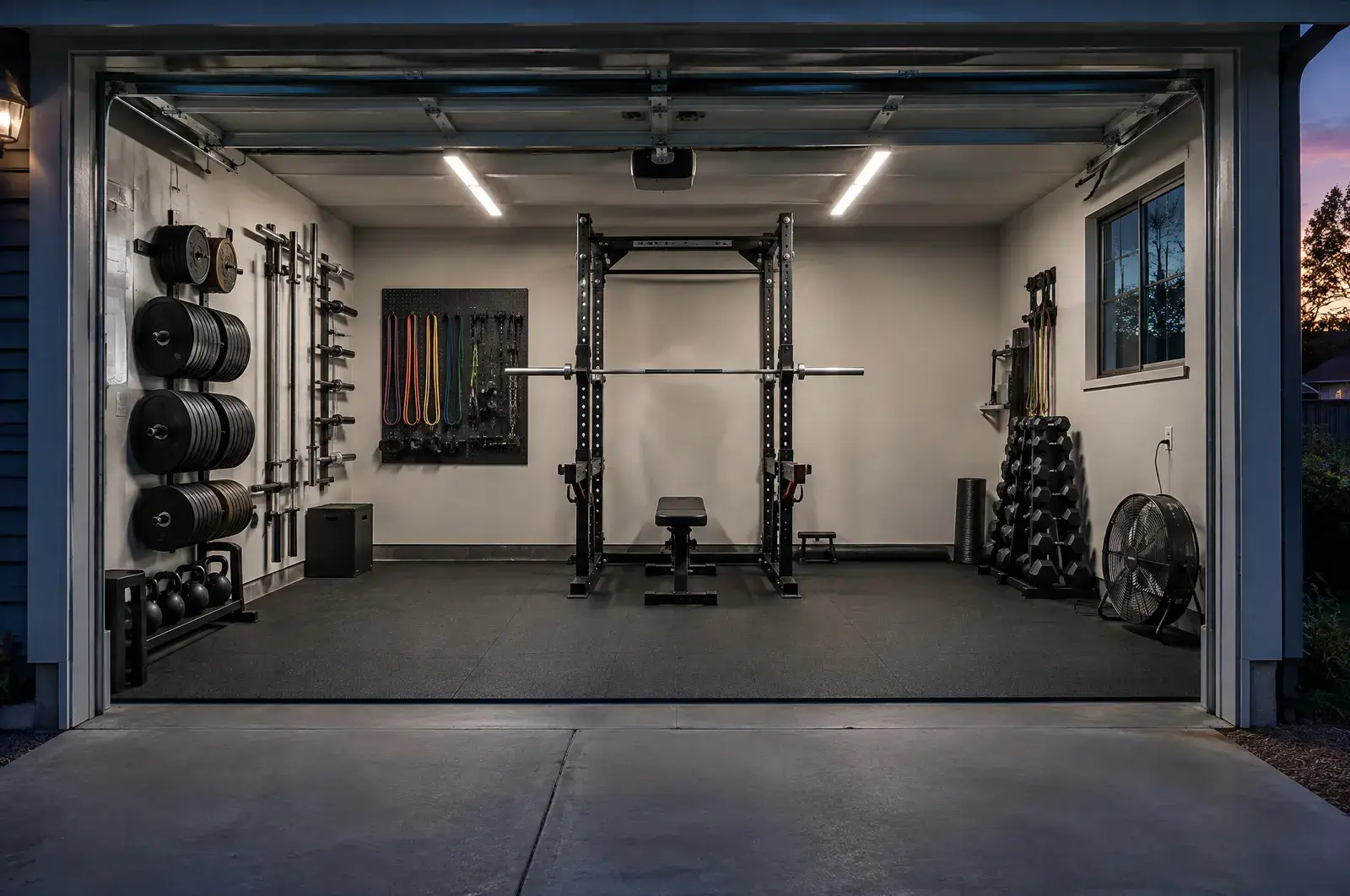
A garage gym works when you fit real equipment footprints into your real garage. A power rack needs about 4×4 ft, a flat bench about 4×2 ft, and a standard 86.75-inch barbell needs a clear path to load. Start from a one-car (roughly 12×20 ft) or two-car (roughly 24×24 ft) garage, place the rack and bar path first, then add flooring, wall storage, lighting and heat around them.
On this page 13 sections
- The short answer
- What’s the best garage gym layout?
- How much garage space do you actually need?
- Three dimensioned garage gym layouts
- How do you store weights and bars without clutter?
- What flooring works best for a garage gym?
- How do you light a garage gym?
- Do you need heating, cooling or ventilation in a garage gym?
- Should garage gym equipment be mobile or fixed?
- What does a garage gym setup cost?
- How we researched this guide
- Questions
- Sources
What’s the best garage gym layout?
Start from the equipment footprint, not the room. A power rack needs roughly 4 ft by 4 ft of floor, a flat bench needs about 4 ft by 2 ft, and a standard barbell is 86.75 in (about 7.2 ft) long end to end, which sets how much clear lane you need to load and unload plates. Fit those three numbers into your garage first, then build storage, flooring, lighting and climate control around them.
Most garages fall into one of three working sizes: a one-car bay around 12×20 ft, a two-car bay around 24×24 ft, or a two-car bay you still have to share with a vehicle. Each one supports a different layout, covered with dimensions below. For other planning basics like budgeting and setup order, see our planning hub.
How much garage space do you actually need?
Before sketching a layout, know the footprint of what you’re actually buying. These numbers come from current maker product pages, not averages.
| Component | Example product | Footprint (W × D) | Height |
|---|---|---|---|
| Power rack (fixed depth) | Rogue RML-390F | 49 in × 48 in (about 4’1” × 4’0”) | 92.25 in (about 7’8”) |
| Power rack (adjustable depth) | REP PR-4000 | 50.8 in wide; depth options of 16, 24, 30 or 41 in | 80 or 93 in (6’8” or 7’9”) |
| Flat bench | Titan Series Single Post Flat Bench | 50 in × 26 in (about 4’2” × 2’2”) | 17 in |
| Standard barbell | Titan Series Power Bar | 86.75 in long (about 7’3”) | — |
| Lifting platform | Rogue 8’ x 8’ Oly Platform | 8’4” × 8’4” outer frame; 8’ × 8’ usable interior | — |
Two things this table doesn’t cover: you need room to walk the full length of a loaded bar to slide plates on from both ends, and you need turning room to carry plates from wall storage to the rack. Neither of those has a fixed number — it depends on your equipment and how you move through the space — so budget more clearance than the bare footprints above, not less.
Three dimensioned garage gym layouts
One-car garage (about 12 × 20 ft)
A single-car garage bay is commonly 12 ft wide by 20 ft deep, or 240 sq ft. Set the rack against the back wall, centered on the 12 ft width, with the bench stored on end or wall-mounted next to it rather than left out. That leaves roughly a 12×14 ft open zone in front of the rack — enough for a lifting platform (8×8 ft) plus a walking lane down one side to the garage door. Wall-mounted plate and bar storage on the side walls keeps the floor clear for the bar path.
Two-car garage, dedicated to training (about 24 × 24 ft)
A modern two-car garage commonly runs 24 ft by 24 ft, or about 581 sq ft — enough to give the rack and platform their own zone and still fit a cardio machine or a second rack-and-bench station. A common split: rack and platform along the back wall (roughly a 12 ft wide zone), a second 8–10 ft zone for cardio or conditioning work, and the remaining width for a storage wall and a stretching or warm-up mat area. This layout doesn’t need to double as parking, so equipment can stay bolted down and out rather than on casters.
Two-car garage, shared with a vehicle
If the car still needs to fit, treat the gym as an L-shaped zone that leaves a clear rectangle for the vehicle (most passenger cars need roughly 6 ft of width plus door clearance). Mount the rack on a folding wall-mounted model instead of a fixed floor rack, use interlocking flooring tiles you can pull up around the car’s tire path, and keep the bench, plates and bar on wall or corner storage so nothing sits in the car’s path. For a full dimensioned walkthrough of this setup, see our half-garage gym layout guide; for the fold-flat rack itself, see our folding wall-mounted power rack picks.
How do you store weights and bars without clutter?
Wall-mounted storage is what makes a shared or small garage workable, because it gets plates, bars and accessories off the floor entirely. A single-horn wall-mounted plate rack, like the REP Fitness Wall Mounted Plate Storage, lists for $45.99, mounts on standard 16 in stud spacing, and holds full-sized plates on an 8.25 in horn. Bar holders and multi-plate “stringers” mount the same way and can go on any open wall, not just the wall behind the rack.
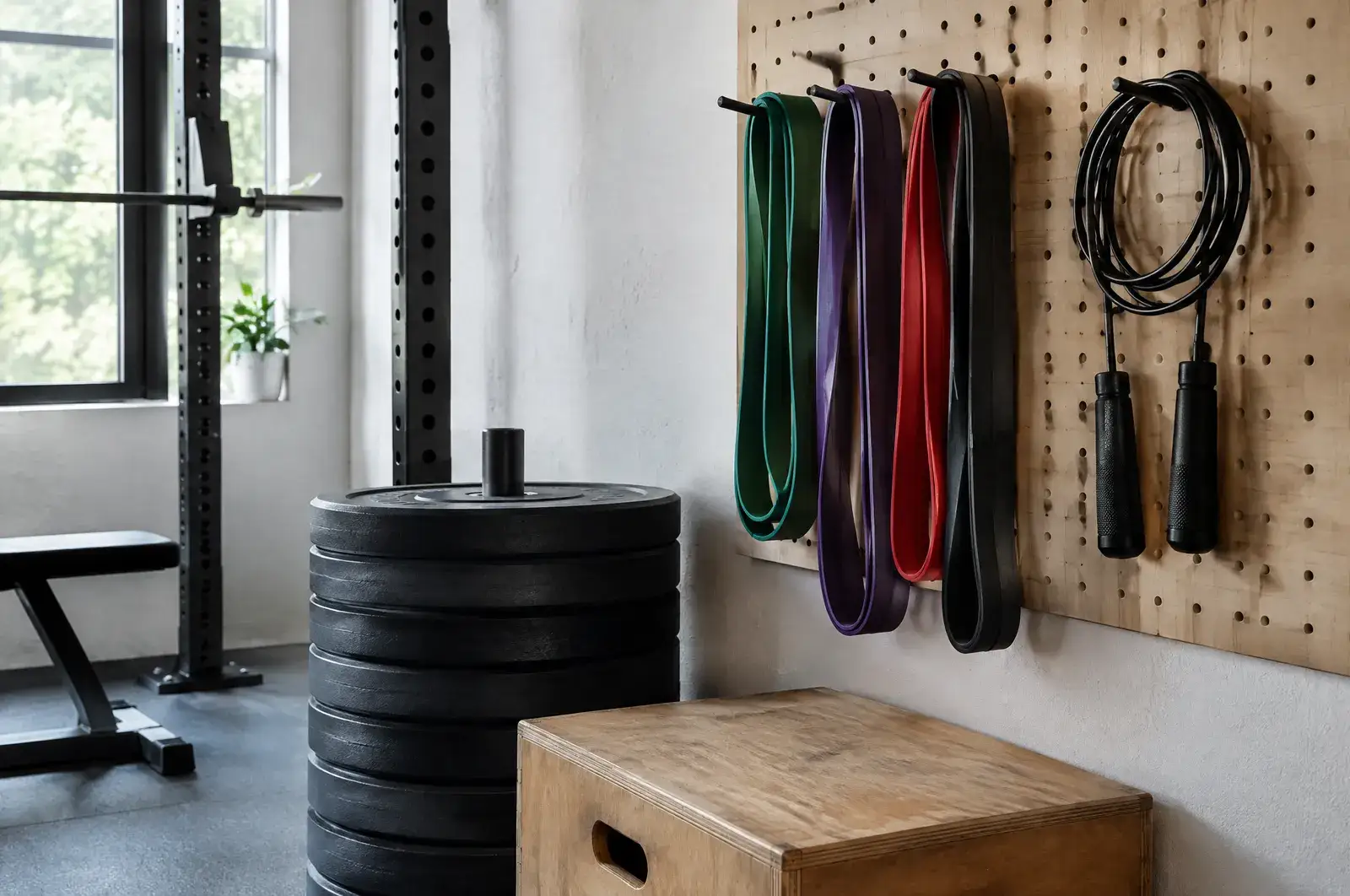
A practical storage wall usually combines three things: a horizontal or vertical bar holder near the rack, one or two plate horns sized to your heaviest plates, and a shelf or pegboard section for bands, collars and chalk. None of it needs floor space, which matters most in a one-car or shared bay.
What flooring works best for a garage gym?
Garage slabs are harder and colder than a finished basement floor, and many sweat with humidity, so flooring needs to handle moisture and impact, not just look finished. Horse stall mats — thick recycled rubber originally made for barns — are a common budget choice for this reason: a 3/4 in thick 4×6 ft mat runs roughly $45 to $75, and full interlocking stall mat kits run about $3 to $5 per square foot, according to Greatmats’ own pricing guide.
Zone your flooring by use rather than matting the whole bay the same way: heavier rubber (3/4 in or more) under the rack and platform where plates get dropped, thinner interlocking tile in cardio or stretching zones, and a hard-wearing runner or none at all in a walking lane you’ll also drive over if the bay is shared with a car. For the full breakdown by thickness and use case, see our garage gym flooring guide.
How do you light a garage gym?
Stock garage lighting — usually a single bare bulb or a small fixture near the door — isn’t enough to see form in a mirror or read plate numbers at the far end of the bay. A single 4 ft integrated LED shop light, like the Feit Electric 4 ft 4000-lumen fixture, outputs 4,000 lumens at 52 watts and mounts directly to the ceiling with a 5-foot cord, according to Feit’s own product page. Two of those fixtures, run the length of the bay, cover most one- or two-car garage gyms without an electrician, since they plug into an existing outlet rather than needing hardwired power.
A mirror helps too, mostly for checking bar path and depth on squats and deadlifts when training alone. See our garage gym mirror guide for sizing a mirror to a rack wall.
Do you need heating, cooling or ventilation in a garage gym?
An unheated, uninsulated garage swings further in temperature than the rest of the house, since the door and often the walls aren’t insulated the way living space is. Most owners insulate the walls and garage door first, then size a heater to the space rather than the other way around. As one example, the Mr. Heater Big Maxx MHU50 is rated at 50,000 BTU and heats up to 1,667 sq ft, per the maker’s product page — well beyond a typical one- or two-car bay, so a smaller unit is often enough for a garage gym alone.
Gas heaters need proper venting and, in most areas, a permit and licensed installation — this isn’t a DIY electrical or gas job, and specific code requirements vary by city and county, so confirm with your local building department and a licensed contractor before installing one. For a broader look at options including electric and ductless choices, see our garage gym heating guide.
Ventilation matters year-round, not just in summer. A closed garage bay traps heat, humidity and exhaled air fast once you’re breathing hard, so plan for cross-airflow even if you never add a dedicated heater or AC unit: a door cracked open opposite a box fan, a garage door screen for warmer months, or a ceiling or wall-mounted exhaust fan vented outside. Humidity control matters too, separate from temperature — a damp garage rusts steel bars and rack uprights faster than a dry one, so a standalone dehumidifier is worth running in humid climates even in a heated or cooled bay, and it’s cheaper to run than most heating or cooling equipment.
Should garage gym equipment be mobile or fixed?
If the bay doubles as parking, mobile and foldable equipment matters more than anything else on this list. Casters on a bench, a fold-flat wall-mounted rack instead of a floor rack, and interlocking flooring tiles you can lift in sections all make it possible to clear the bay for a car in a few minutes. If the garage is dedicated to training full time, fixed and bolted-down equipment is more stable for heavy lifts and doesn’t need to be re-set each session. Renting some equipment short-term is also worth weighing against buying, especially for machines you’ll use rarely — see our renting vs. buying home gym equipment guide for the trade-offs.
What does a garage gym setup cost?
Costs vary widely by brand and how much you already own, but here’s one example build using current listed prices for a rack, bench, barbell, wall storage and heat — a mid-range starting point, not a floor or a ceiling.
| Item | Example product | Price | Checked |
|---|---|---|---|
| Power rack | Rogue RML-390F | $935.00 | Rogue Fitness, 2026-09-23 |
| Flat bench | Titan Series Single Post Flat Bench | $249.97 | Titan Fitness, 2026-09-23 |
| Barbell | Titan Series Power Bar | $384.99 | Titan Fitness, 2026-09-23 |
| Wall-mounted plate storage | REP Wall Mounted Plate Storage | $45.99 | REP Fitness, 2026-09-23 |
| Flooring, interlocking kit | Greatmats stall mat kit | $3–$5 per sq ft | Greatmats, 2026-09-23 |
| Garage heater, 50,000 BTU | Mr. Heater Big Maxx MHU50 | $913.87 | Mr. Heater, 2026-09-23 |
Adding just the rack, bench, barbell and wall storage above comes to about $1,616 (our calculation, based on the listed prices in the table). Flooring a 10×10 ft rack-and-platform zone at $3 to $5 per square foot adds roughly $300 to $500 (our calculation). A heater is optional and depends on climate — skip it in a mild climate, add it if the garage needs to be usable year-round. For a full breakdown across more equipment tiers, see our garage gym conversion cost guide and our general home gym setup guide.
Prices change and vary by region and promotion — always check the current price on the maker’s page before buying.
How we researched this guide
Every price, dimension and spec in this guide was pulled from the maker’s own product page or a named retailer’s listing on the date shown, not from memory or estimation. Garage size figures come from published building guides, not measured averages. No product mentioned here was physically tested for this article; where we describe what a product is good for, that’s based on its published specs and the layout math above, not hands-on use. Costs are examples from one product per category, not price guarantees — always confirm the current price before buying. For more on how we compare and rank products across this site, see how we research.
Questions
How much does a basic garage gym cost to set up?
A rack, bench, barbell and wall-mounted plate storage from mid-range brands run roughly $1,600 combined, based on current listed prices for one example of each (see the cost table). Flooring adds $3 to $5 per square foot for an interlocking stall mat kit, and heating or cooling is a separate line item. Prices change, so check the maker's page before buying.
Do I need a permit to convert my garage into a gym?
Usually not if you're not changing electrical, gas or structural elements, but rules vary by city and county. Adding a gas heater, a dedicated circuit or removing a wall does typically require a permit and a licensed contractor. Check with your local building department before any electrical or structural work.
Can I still park my car if I put a gym in my garage?
Yes, if you plan for it. Mobile equipment on casters, a rack that folds flat to the wall, and flooring in an L-shape around a car-sized rectangle let you share the bay. See our half-garage layout guide for a dimensioned example.
What size garage do I need for a power rack and a lifting platform?
A rack alone needs about 4×4 ft, but you also need room to walk around it and load plates from both ends of the bar. An 8×8 ft platform plus a rack against one wall fits into most two-car garages (commonly 24×24 ft) with room left over for a bench and storage.
How do I stop a garage gym from getting too hot or too cold?
Uninsulated garages swing further than the rest of the house, so most owners add rigid foam or batt insulation to the walls and door first, then a heater sized to the space. A 50,000 BTU forced-air unit is rated to heat up to about 1,667 sq ft, well beyond a typical garage bay, so a smaller unit is often enough. Any gas or electrical heater installation should go through a licensed contractor.
Is bolting a power rack to the garage floor necessary?
Most rack makers recommend bolting to concrete for stability during heavy lifts, especially with a bar-and-plate weight that can tip an unanchored rack. Flat-foot racks add stability without bolting and work on rented or shared floors. Check your specific rack's manual for its anchoring recommendation.
What flooring keeps a garage gym from getting slippery?
Rubber flooring, including horse stall mats, keeps traction even when a garage floor sweats with humidity, which bare concrete or foam tiles don't handle as well. Interlocking or glue-down rubber also resists the oil and moisture residue common on a garage slab. See our flooring thickness guide for how much you need under different equipment.
Do I need a mirror in a garage gym?
A mirror is optional but helps check form on squats, presses and deadlifts, especially training alone. It also visually opens up a small garage bay. See our garage gym mirror guide for size and mounting options.
Sources
Every fact on this page comes from the sources below. We did not test these products by hand.
- RML-390F Flat Foot Monster Lite Rack — Rogue Fitness, accessed
- PR-4000 Power Rack (Pre-Selected) — REP Fitness, accessed
- TITAN Series Single Post Flat Bench — Titan Fitness, accessed
- TITAN Series Power Bar — Titan Fitness, accessed
- Rogue 8' x 8' Oly Platform — Rogue Fitness, accessed
- Pricing and Costs of Horse Stall Mats — Greatmats, accessed
- Wall Mounted Plate Storage — REP Fitness, accessed
- MHU50 Big Maxx Natural Gas Unit Heater — Mr. Heater, accessed
- 4 ft. 4000 Lumens LED Shop Light — Feit Electric, accessed
- Standard Garage Dimensions & Sizes (1, 2, 3 & 4 Car Guide) — Renuity Home, accessed
- 2-Car Garage Dimensions: A Complete Guide to Standard Sizes — Angi, accessed