
The short answer
Sweep or vacuum gym floor mats daily, then damp-mop weekly with a pH-neutral cleaner and warm water — never bleach, ammonia, alcohol or solvent-based cleaners, which maker guides warn can crack or discolor rubber. Rinse away residue, then air-dry fully before use. Foam mats need less water: wipe with a damp cloth instead of mopping, since liquid can seep into the seams and get trapped underneath.
On this page 12 sections
- The short answer
- Step by step
- How often should you clean gym floor mats?
- Rubber vs. foam gym mats: does the same routine work for both?
- Which cleaners are safe for gym floor mats?
- How do you get the smell out of new rubber gym mats?
- How do you remove sweat odor and stains without damaging the mats?
- Can you pressure-wash or steam-clean gym mats?
- How do you keep cleaned mats from sliding, curling or trapping moisture?
- How we researched this
- Questions
- Sources
Step by step
Sweep or vacuum before you clean
Dry debris grinds into rubber and foam under foot traffic, so clear it first. Rogue Fitness's cleaning guide for plastic and rubber gym surfaces says to remove chalk with a dry, lint-free cloth before applying any liquid, since chalk holds moisture and bacteria. On rubber flooring, Greatmats recommends a power brush-style vacuum for routine cleaning; on foam tiles, use a gentle vacuum setting or a broom instead of a spinning-brush attachment, which can chew up the surface.
Mix a pH-neutral cleaning solution
Skip anything harsh and mix a neutral cleaner (a pH of about 7 — pH-neutral means neither acidic nor alkaline) with warm water. A solution of mild soap or detergent works, or a cleaner sold specifically for rubber gym floors. Greatmats and REP Fitness both point to a mild, pH-neutral detergent solution as the standard wash for rubber mats, tiles and rolls, because a neutral pH doesn't attack the rubber compound the way acidic or alkaline cleaners can over repeated cleanings.
Spot-treat stains and heavy soil first
Work a soft-bristle brush and your cleaning solution into sweat stains, chalk residue and grime around tile seams before you mop the whole floor. Consolidated Flooring's care guide notes seams are where sweat and grime accumulate fastest. Let the solution sit briefly, then agitate gently — skip stiff or metal brushes, which can scuff the surface.
Damp-mop rubber flooring with the two-bucket method
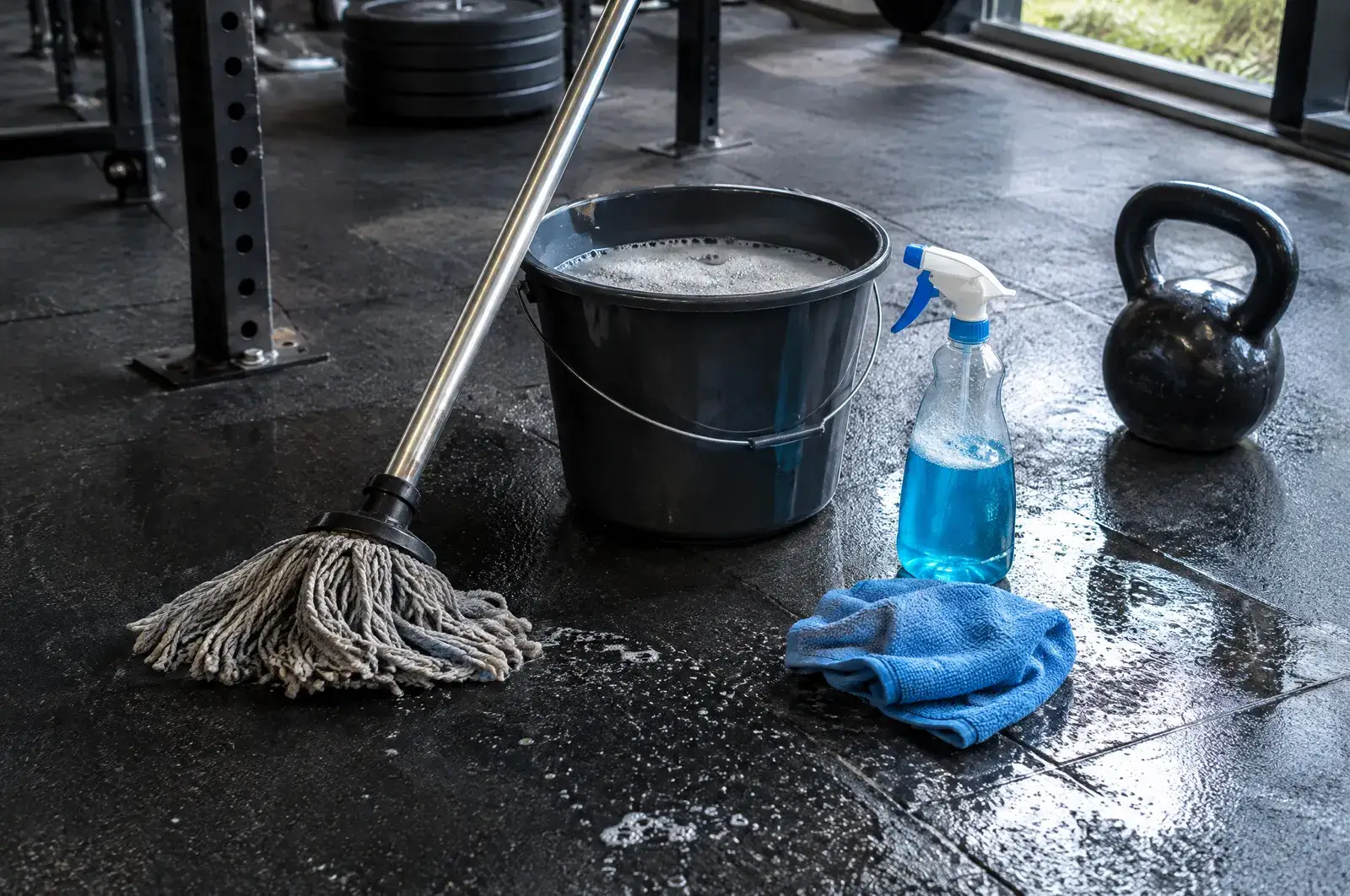
Use one bucket for cleaning solution and a second for rinse water, wringing the mop out before it touches the floor so you're mopping, not flooding. A nylon or microfiber mop works best; a cotton string mop sheds lint. Change the wash-bucket water once it looks dirty, or you're just smearing soil back across the floor.
Clean foam mats and interlocking tiles differently
Foam mats need less water than rubber. Greatmats' care guide for EVA foam tiles says to apply cleaner to a damp cloth rather than spraying or pouring it directly on the mat, and to avoid soaking the surface, because liquid that reaches the seams can get trapped underneath. For vinyl-topped foam mats, the same guide suggests wiping with a disposable antibacterial wipe after workouts instead of mopping.
Disinfect high-touch spots the right way
For an actual disinfecting pass — not just a wash — Rogue Fitness's plastic/rubber and vinyl cleaning guides both call for an EPA-registered disinfectant that's alcohol-free, phenol-free, bleach-free and ammonia-free, applied after the surface is already clean. Leave it in place for at least 15 seconds, and ideally 4 minutes or until it air-dries, before wiping off any residue with a clean, lint-free cloth. This step matters most for shared or multi-user spaces; a single-user home gym can usually skip it except after illness or before selling used mats.
Rinse and air-dry completely before walking on it
Go back over mopped rubber flooring with clean water to lift leftover cleaner residue, then let it air-dry fully. Consolidated Flooring's cleaning guide says never to reopen the space while the floor is still wet — air-drying is preferred, and fans can speed it up, but the room should stay closed off until the floor is dry. Foam mats should also dry completely before you reinstall or restack them — trapped moisture under foam is a common cause of mold and odor.
Handle new-mat odor separately from cleaning
A strong rubber smell in a brand-new mat is off-gassing (volatile organic compounds releasing as the rubber cures), not dirt, and no amount of scrubbing removes it faster. GrytFit's guide to rubber-flooring odor says the smell is usually strongest in the first 48–72 hours and fades substantially within 3–7 days with good ventilation, though a tight, poorly ventilated room can take a couple of weeks. Greatmats suggests airing new mats outdoors in sunlight before installing them, rotating them so both sides are exposed, and never stacking them while they're off-gassing, since stacked mats trap the smell against each other.
How often should you clean gym floor mats?
A working home-gym schedule has four layers: daily, weekly, monthly and as-needed. Daily upkeep is a quick sweep or vacuum plus a wipe of anything you actually sweated on. Weekly is a real damp-mop with a pH-neutral cleaner. Monthly (or every few weeks, if you train daily) is a scrub of high-traffic zones — seams, equipment footprints, the spot under the rack where chalk and dust collect. Deep-clean cadence varies by source: REP Fitness’s flooring guide says to sweep or vacuum regularly and mop with mild detergent as needed, while Consolidated Flooring’s guide describes a quarterly deep clean for lower-traffic settings, done more often in high-traffic ones. A home gym used by one or two people sits closer to REP’s “every few weeks” than a commercial floor’s quarterly schedule, since fewer feet means less grit working its way into the surface.
| Task | Frequency | Time needed |
|---|---|---|
| Sweep or vacuum | Daily, after training | 3–5 min |
| Wipe sweat spots | Daily, on the spots you used | 1–2 min |
| Spot-clean stains and chalk buildup | As needed | 2–5 min per spot |
| Damp-mop with pH-neutral cleaner | Weekly | 15–30 min |
| Scrub high-traffic zones and seams | Monthly (or every few weeks if trained daily) | 20–30 min |
| Full rinse and air-dry before reuse | After every wet clean | Until fully dry — don’t reopen while wet |
This table reflects the cadence described across the maker and retailer guides sourced for this article, adjusted for home-gym traffic rather than commercial-facility traffic. Treat it as a starting point, not a fixed rule — mats under a squat rack that sees daily heavy lifting need attention more often than a stretching mat in a spare room.
Rubber vs. foam gym mats: does the same routine work for both?
Not exactly, and mixing them up is the fastest way to damage a mat. Rubber flooring — stall mats, rolls, interlocking rubber tiles — tolerates a real damp-mop because it’s a solid, largely non-porous material. Greatmats’ rubber-flooring guide describes vacuuming for routine cleaning and a nylon-mop-plus-neutral-cleaner pass for deeper cleaning, with the floor able to handle a proper wash.
Foam mats and interlocking foam tiles are a different structure: a closed-cell foam core, sometimes with a vinyl skin on top, assembled from separate tiles with seams between them. Greatmats’ foam-mat care guide is explicit that foam shouldn’t be soaked — apply cleaner to a cloth rather than spraying or pouring it onto the mat, because liquid that reaches a seam can work its way underneath and get trapped, where it can’t evaporate. The foam itself is non-absorbent once it’s fully dried, but water sitting between the foam and the subfloor is what actually causes problems, not the foam material itself.
The practical rule: mop rubber, wipe foam. If your gym mixes both — rubber stall mats under a rack, foam tiles in a stretching corner — clean them as two separate zones rather than running one mop over everything.
Which cleaners are safe for gym floor mats?
This is where the most damage happens, because “clean” household products aren’t automatically rubber-safe. Multiple guides converge on the same short list of what to avoid, with one notable disagreement.
| Cleaner or method | Verdict | Why |
|---|---|---|
| A solution of mild soap or detergent | Do | Rogue Fitness’s plastic/rubber guide names this exact combination for the first cleaning pass, before any disinfectant |
| pH-neutral commercial rubber-floor cleaner | Do | Greatmats and REP Fitness both specify neutral pH as the standard for rubber flooring |
| EPA-registered disinfectant, alcohol/phenol/bleach/ammonia-free | Do, for disinfecting only | Rogue Fitness’s plastic/rubber and vinyl guides both spell out this exact combination and a 15-second-to-4-minute dwell time |
| Bleach | Don’t (disputed) | Consolidated Flooring excludes it outright; Garage Gym Reviews allows it only heavily diluted, spot-tested and ventilated |
| Ammonia | Don’t | Excluded by Rogue Fitness’s cleaning guides and Consolidated Flooring’s rubber-flooring guide |
| Pine-Sol and other pine-oil cleaners | Disputed | Greatmats lists Pine-Sol as an option for cutting rubber odor; Garage Gym Reviews and Consolidated Flooring both list it as a solvent-style cleaner that damages rubber over time |
| Murphy’s Oil Soap and other oil-based cleaners | Don’t | Flagged by Garage Gym Reviews and Consolidated Flooring |
| Acetone and other solvents | Don’t | Consolidated Flooring warns solvents break down the rubber compound and cause cracking |
| Vinegar | Disputed | Consolidated Flooring warns it can break down rubber and cause discoloration; no maker page in this research confirmed it as safe |
| Steam cleaners | Don’t | Excluded by Consolidated Flooring’s rubber-flooring guide |
| Steel wool or abrasive scouring pads | Don’t | Flagged by both Garage Gym Reviews and Consolidated Flooring |
Two products show up on both sides — Pine-Sol and vinegar. Rather than pick a winner between conflicting retailer guides, the safer call is to skip both unless the specific mat’s own manufacturer care page names it safe, and to reach for a plain pH-neutral cleaner instead, which every source agrees on.
If in doubt about a product you already own, test it on a hidden corner or offcut first, and rinse thoroughly afterward. Discoloration, softening or a tacky residue means stop using it.
How do you get the smell out of new rubber gym mats?
New rubber flooring almost always smells strong out of the box, and that smell is off-gassing — the release of volatile organic compounds (VOCs) left over from how the rubber was manufactured and bound together, not a sign the mat is dirty or defective. According to GrytFit’s guide to rubber-flooring odor, the smell is typically strongest in the first 48–72 hours and fades substantially within 3–7 days given decent ventilation; a tighter room with the windows shut and the heat running can stretch that out to a couple of weeks.
Two things speed it up. First, ventilation: open windows and run fans to create airflow across the mats rather than letting the smell sit in a closed room. Second, sunlight before installation: Greatmats’ guide to reducing rubber-mat smell suggests laying new mats outdoors in direct sun, positioning them so air can circulate underneath, and rotating them so both sides get exposure — heat speeds up how fast the VOCs release. That same guide warns against stacking mats while they’re off-gassing, since stacked mats trap the smell against each other instead of letting it disperse.
What doesn’t help: extra scrubbing or stronger cleaners. Off-gassing is a property of the material curing, not surface soil, so no cleaning product removes it faster than ventilation and time do.
How do you remove sweat odor and stains without damaging the mats?
Sweat odor is a different problem from new-mat odor, and it responds to plain cleaning rather than airing out. Consolidated Flooring’s care guide points to tile seams as the spots where sweat and grime accumulate fastest, which is why the spot-treatment step matters more than an occasional full mop: hitting those specific areas on a tighter schedule than the rest of the floor keeps odor from building up between deep cleans.
For a stain that’s already set, work the pH-neutral solution into it with a soft-bristle brush, let it sit for a minute or two, then wipe and rinse. Avoid pressing the same wet cloth back and forth without rinsing it — that just redistributes the stain over a wider area. Chalk residue responds better to a dry, lint-free cloth first (per Rogue Fitness’s guide) than to going straight in with a wet mop, since wet chalk can smear into a paste.
If a mat has absorbed enough sweat to develop a persistent musty smell rather than a fresh-sweat smell, that usually points to moisture trapped underneath rather than on top — see the section below on keeping mats dry.
Can you pressure-wash or steam-clean gym mats?
None of the maker or retailer guides referenced for this article recommend it, and Consolidated Flooring’s rubber-flooring guide specifically excludes steam cleaners: high heat degrades rubber and compromises the adhesive layer beneath it. A soft-bristle brush, a pH-neutral cleaner and a wrung-out mop clean a home gym floor without that risk, and they’re also what every source in this research actually recommends.
How do you keep cleaned mats from sliding, curling or trapping moisture?
Cleaning creates a moisture-management problem if you don’t finish the job. Let mats and tiles air-dry completely before walking on them or restacking them — Consolidated Flooring says not to reopen the space while the floor is still wet, and to run fans if you want it to dry faster than plain air-drying. REP Fitness’s flooring-maintenance guide flags basements specifically as spots where a dehumidifier or a sealed subfloor matters, since damp concrete under flooring is a common cause of curling, mold and odor that has nothing to do with how often you clean the surface.
For interlocking tiles, check the underside occasionally, especially in a basement or garage with humidity swings. If tiles are curling at the edges or you can feel dampness when you lift a corner, pull them up, dry the subfloor fully, and let the tiles air-dry before relaying them — cleaning the top surface more often won’t fix moisture coming from below.
Handle equipment carefully on cleaned mats, too. REP Fitness’s guide recommends lifting and moving equipment rather than dragging it across rubber flooring, since dragging causes scuffs and tears that no cleaning routine reverses, and avoiding dropped weights directly onto rubber tiles specifically, which can dent or damage them.
How we researched this
This guide compiles care instructions published by rubber and foam flooring makers and specialist flooring retailers — Rogue Fitness’s own cleaning guides, Greatmats’ rubber and foam care pages, and REP Fitness’s flooring blog — plus supporting detail from flooring-focused retailers and installers where maker guidance didn’t cover a specific question, such as odor timelines. Every cleaner recommendation, dwell time and odor timeframe in this article comes from one of the pages listed in Sources below, accessed the day this article was published. Where two sources gave conflicting advice — Pine-Sol and vinegar, specifically — this article says so rather than picking a side, and defaults to the cleaner every source agreed on: a plain pH-neutral solution. No product on this page was tested by Home Gym Journal; see how we research for the full method.
Before buying flooring in the first place, our flooring hub rounds up every guide on this topic, including the best gym flooring and best gym mats for current picks, and how thick gym flooring should be and rubber gym flooring for material and thickness choices that affect how a floor holds up to cleaning over time. If you’re installing interlocking tiles for the first time, how to install interlocking gym tiles covers the setup that makes cleaning easier later, since gaps and poor seams are what let moisture in under the mats in the first place.
Questions
Can you use a pressure washer on gym mats?
Maker guides for rubber flooring in this brief don't recommend pressure washers, and Consolidated Flooring's care guide specifically excludes steam cleaners because high heat degrades rubber and compromises the adhesive layer beneath it. A soft-bristle brush with a pH-neutral cleaner handles most buildup without that risk.
Is it safe to clean gym mats with diluted bleach?
Sources disagree. Garage Gym Reviews says bleach can be used if heavily diluted (about 1/3 cup per gallon of water), tested on a hidden spot first, and used with ventilation and gloves. Consolidated Flooring lists bleach as a cleaner to avoid outright, saying it degrades rubber over time and causes cracks, discoloration and surface breakdown. Given the conflict, a pH-neutral cleaner is the safer default, and bleach is worth reserving for situations that genuinely need disinfection.
How do you get sweat smell out of rubber mats?
Regular cleaning is the main fix: Consolidated Flooring notes that tile seams are where sweat and grime accumulate fastest, so scrubbing those spots with a pH-neutral cleaner on a normal schedule prevents odor from building up in the first place. If the smell is from a new mat rather than sweat, that's off-gassing — see the step above on airing new mats out.
Can you mop rubber gym flooring, or should you only wipe it?
You can mop it, as long as you don't soak it. Every rubber-flooring guide referenced here calls for a damp mop wrung out before it touches the floor, not a saturated one. Standing water that seeps between tiles or into seams is the main risk, not mopping itself.
How long does new rubber flooring need to air out before you use it?
GrytFit's guide puts the strongest odor window at 48–72 hours, with most of it fading within 3–7 days if the room is well ventilated. You can use the floor while it airs out; ventilation just speeds up how fast the smell drops off.
Do interlocking foam tiles need to come apart to clean underneath?
Only if moisture or debris has gotten under them. Greatmats' foam-mat care guide focuses on cleaning the top surface with a damp cloth rather than soaking, specifically to avoid liquid working its way under the tiles in the first place. If you notice a musty smell or dampness underneath, lift the tiles, dry the subfloor completely, and let the tiles air-dry before relaying them.
What's the fastest way to clean gym mats after every workout?
Wipe down sweat with a damp cloth or an antibacterial wipe on the spots you actually touched, and sweep or vacuum loose chalk and dust. That covers the daily maintenance pass; save the full mop-and-rinse routine for weekly cleaning.
Can you use vinegar to clean rubber gym flooring?
Treat this as unresolved rather than a clear yes. Consolidated Flooring's rubber-flooring guide lists vinegar among the products to avoid, warning it can break down the rubber compound and cause discoloration over time. If a cleaner isn't confirmed safe on your specific mat maker's own care page, the lower-risk choice is a plain pH-neutral cleaner instead.
Sources
Every fact on this page comes from the sources below. We did not test these products by hand.
- Plastic/Rubber Cleaning Guide — Rogue Fitness, accessed
- Vinyl Surface Cleaning Guide — Rogue Fitness, accessed
- How to Clean Rubber Floor Mats, Tiles & Rolls — Greatmats, accessed
- How to Clean EVA Foam Tiles & Vinyl-Covered Gym Mats — Greatmats, accessed
- What to Use on Rubber Mats to Take the Smell Out — Greatmats, accessed
- How to Clean Your Rubber Gym Floor: Mats and Tiles — REP Fitness, accessed
- How to Install and Maintain Gym Flooring — REP Fitness, accessed
- How to Clean Rubber Gym Flooring and Keep it Spotless — Garage Gym Reviews, accessed
- How To Clean a Rubber Gym Floor: Your Expert Guide — Consolidated Flooring, accessed
- Rubber Smell in New Gym Flooring: Off-Gassing, VOCs, and How to Clear — GrytFit, accessed