
The short answer
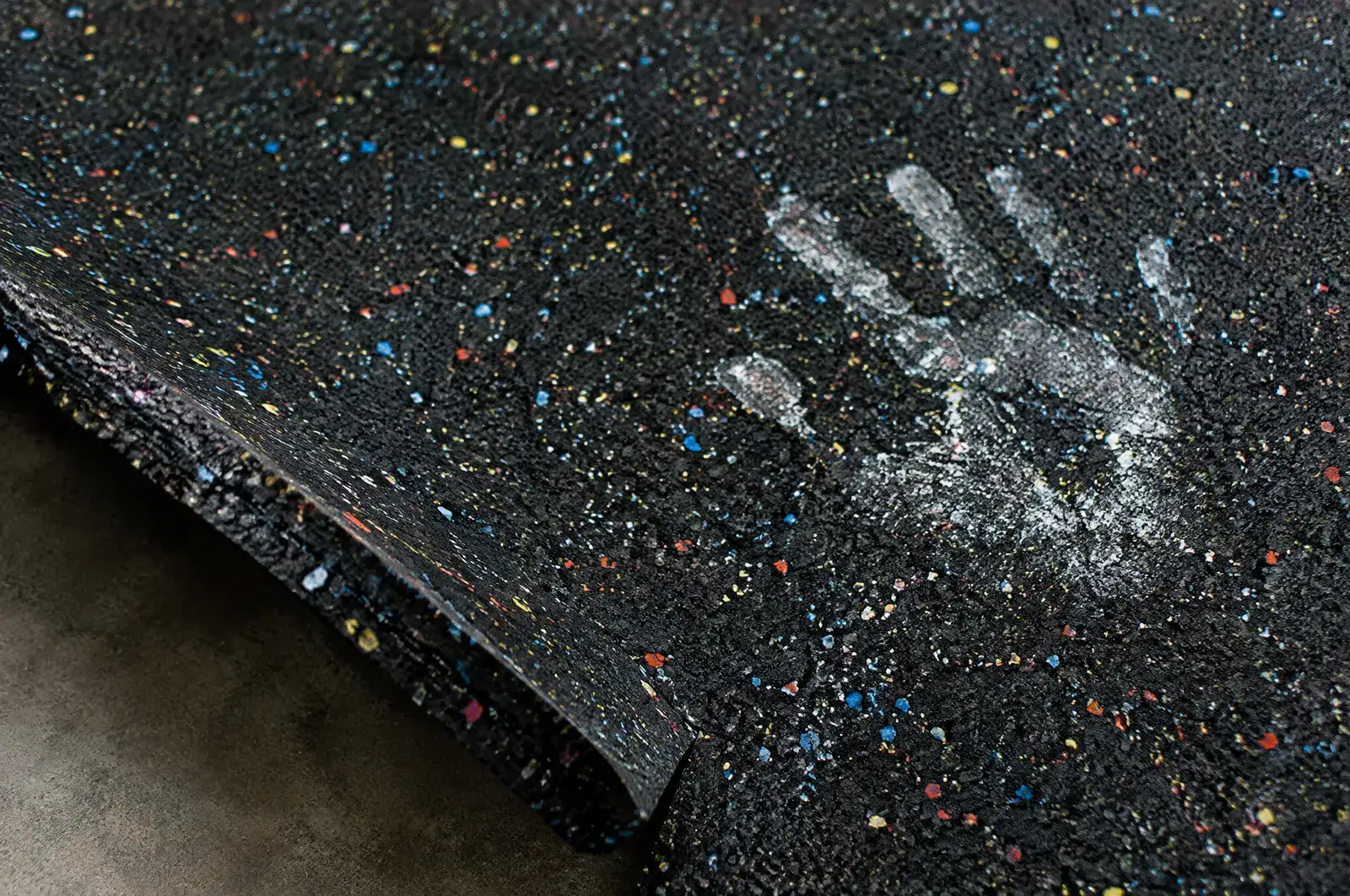
Rubberized flooring for a gym is rubber sold as rolls, interlocking tiles, or stall mats, made from recycled SBR tire rubber, virgin rubber with EPDM color flecks, or vulcanized rubber. Recycled SBR, usually 3/8 in to 1/2 in thick and roughly $2-$4 per sq ft, covers most home gyms; it has the strongest new-rubber smell, which fades over one to three weeks. EPDM-fleck and vulcanized rubber cost more but off-gas less.
On this page 11 sections
- The short answer
- What does “rubberized flooring for gym” actually mean?
- Recycled SBR vs virgin/EPDM-fleck vs vulcanized: what’s the difference?
- Does rubber density matter for a home gym floor?
- Why does new rubber flooring smell, and how long does it last?
- What formats does rubberized gym flooring come in?
- How much does rubberized gym flooring cost?
- How do you clean and maintain rubber gym flooring?
- How we researched this
- Questions
- Sources
What does “rubberized flooring for gym” actually mean?
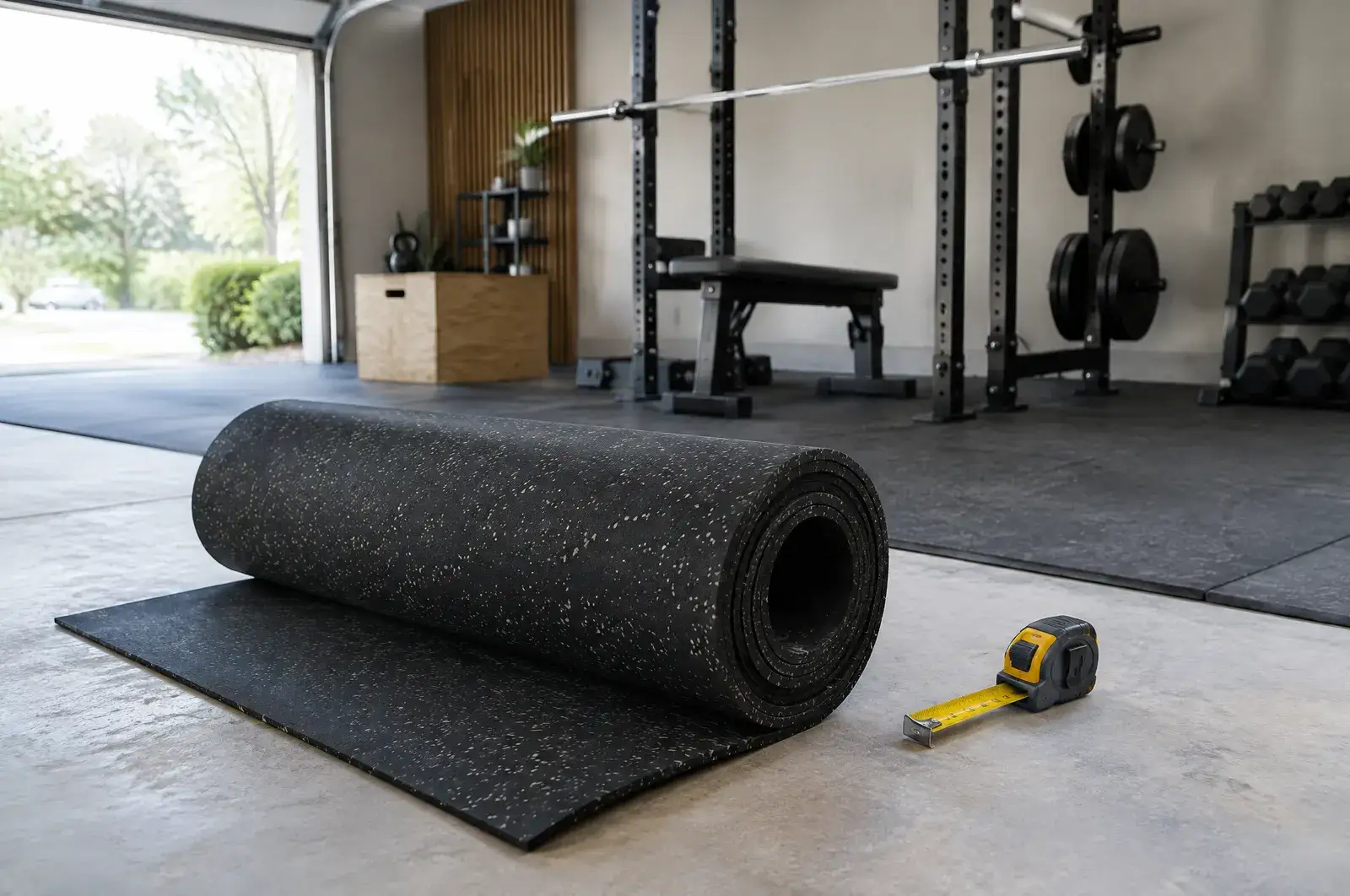
“Rubberized flooring” is a catch-all term for any gym floor made mostly of rubber, sold as rolls, interlocking tiles, or thick stall-style mats. Nearly all of it starts as either recycled tire rubber, virgin (newly made) rubber, or a vulcanized rubber that’s been cured under heat and pressure. The label doesn’t tell you the thickness, the smell, or the price on its own — those depend on which rubber type and format you pick, which is what the rest of this guide breaks down.
Rubberized flooring protects a concrete or wood subfloor from dropped weights, dampens noise, and gives lifters a non-slip surface. It’s the standard choice for home gym floors in the /flooring/ category, ahead of foam tiles or carpet, because it holds up to barbells and plates.
Recycled SBR vs virgin/EPDM-fleck vs vulcanized: what’s the difference?
Three rubber types cover almost everything sold as gym flooring. Gym-Flooring.com describes SBR as rubber “made from recycled rubber granules — primarily reclaimed from truck and car tyres — bonded together with polyurethane,” while EPDM is “a synthetic rubber manufactured from raw materials rather than recycled sources.” IndigoFitness adds that EPDM is prized for weather and UV resistance and is usually the material behind the colored flecks scattered through a black floor, not a full-color floor on its own.
Vulcanized rubber is a separate manufacturing process rather than a raw material. American Floor Mats describes its vulcanized rolls as “virtually pure rubber (with less than 1% binder)” that has gone through “heat, pressure and safe, simple elements to make the rubber stronger, tougher and longer lasting” than standard bonded rubber. Campus Rec Magazine describes the vulcanization step as what “permanently amalgamates individual layers, using high heat and pressure,” and credits the result with strong shock absorption and resistance to tearing under cleats or heavy footwear.
| Rubber type | What it’s made from | Typical use in a home gym | Smell notes | Cost range (sourced listings) |
|---|---|---|---|---|
| Recycled SBR | Reclaimed tire rubber granules bonded with polyurethane | Rolls and tiles for general strength and cardio floors | Noticeable new-rubber smell out of the box; Gym-Flooring.com says it “typically fades within two to four weeks” | ~$1.72-$3.93/sq ft (American Floor Mats rolls, by thickness and color) |
| Virgin/EPDM-fleck | New-made rubber, often EPDM flecks mixed into a recycled-rubber base for color | Rolls and tiles where a lighter smell or a non-black look matters | “Significantly less odour out of the box” than plain SBR, per Gym-Flooring.com | Roughly 30-50% above equivalent SBR, per Gym-Flooring.com |
| Vulcanized | Rubber cured under heat and pressure, minimal binder | Heavy-use rolls and stall-style mats under racks and platforms | American Floor Mats reports “no documented off-gassing issues across decades of” use for its vulcanized line | ~$1.38-$8.45/sq ft (American Floor Mats vulcanized rolls, by thickness and color) |
Durability is the one place all three sourced comparisons agree: Gym-Flooring.com states plainly that “there is no meaningful difference in lifespan — a well-made SBR tile will perform just as long as an EPDM tile under the same conditions.” Picking a rubber type is mostly a smell, color, and budget decision, not a longevity one.
Does rubber density matter for a home gym floor?
Manufacturers rarely print a density figure in pounds per cubic foot on a home-gym product page, but weight per square foot is a workable stand-in, and it’s what American Floor Mats actually publishes for its recycled rubber rolls: about 1.3 lb/sq ft at 1/4 in thick, 2 lb/sq ft at 3/8 in, and 3 lb/sq ft at 1/2 in. Dividing that weight by the thickness (our calculation) works out to roughly 62-72 lb per cubic foot across those three thicknesses — denser than it looks, which is why a 4x6 ft mat can weigh 80+ pounds.
That weight matters two ways. First, a denser, heavier mat sits flatter and resists curling at the edges, which is why REP Fitness’s 4x6 floor mat — 47 in x 71 in x 3/4 in and 88 lb per mat — stays put without tape in most home setups. Second, weight is a rough proxy for how much rubber (versus air or filler) is actually in the product, so two mats of the same thickness aren’t always the same floor.
Thickness still does most of the practical work for impact protection: go thin (1/4 in-3/8 in) under cardio equipment or a yoga area, and thick (1/2 in-3/4 in, or stacked layers) under a rack or platform where plates get dropped. See /how-thick-should-gym-flooring-be/ for a full breakdown by use case.
Why does new rubber flooring smell, and how long does it last?
The smell is off-gassing: volatile organic compounds (VOCs) escaping the rubber as it settles after manufacturing. GymCrafter’s guide lists the compounds involved as “xylene, toluene, formaldehyde, acetaldehyde, ethylbenzene, and butylated hydroxytoluene,” and warns that lower-quality products can carry benzene and carbon disulfide “in amounts that are considered above the ‘health threshold.’” This article isn’t offering a health verdict on any specific product — it’s reporting what these sourced guides say, and none of them frame typical home-gym rubber as a long-term hazard once it’s aired out.
On timing, GrytFit’s guide puts it plainly: “The first 48–72 hours are the strongest, then the odor drops off as the surface compounds dissipate,” and “most of the rubber smell fades substantially within 3–7 days with decent ventilation.” Cold weather with the windows shut can stretch that to a couple of weeks, and the same guide says that if odor, headaches, or eye irritation are still present after three to four weeks of active ventilation, it’s worth investigating further or contacting the seller.
Material quality changes the timeline more than anything else. GymCrafter contrasts “high-quality recycled rubber,” which can be “almost odorless after a couple days of sun exposure,” against “low-quality rubber (stall mats),” which may need “months” outdoors and might never fully lose the smell. That tracks with what retailers say about their own products: REP Fitness notes its urethane-bound 4x6 mats have “less odor” and still recommends airing them out for several days, while its 3x4 vulcanized mats will have “a small odor when they first arrive,” with one buyer describing that odor as “very very very low” once aired out.
To cut the smell faster, sourced guides suggest:
- Air out before or after installing. GrytFit recommends airing new mats in a ventilated area for at least 24-72 hours before bringing them indoors.
- Ventilate the room. GymCrafter and GrytFit both recommend cross-ventilation — open windows on opposite sides of the room, with a box fan pushing air out and another pulling fresh air in.
- Use sun and heat, carefully. GymCrafter notes that sun exposure helps “the pores of the rubber expand and open up,” speeding VOC release, but caps safe outdoor exposure at “1-2 weeks max” to avoid drying out or cracking the rubber.
- Wash both sides with a pH-neutral cleaner or diluted vinegar before the first use, per GymCrafter, then let the mats air-dry fully.
What formats does rubberized gym flooring come in?
Greatmats groups gym rubber into three formats, and each fits a different install:
- Rolls. Sold by the linear foot off a roll typically 4 ft wide, in thicknesses from about 1/4 in to 3/4 in. Rolls give the fewest seams across a large room and are usually the lowest cost per square foot, but need a straight cut and a bit of a learning curve to lay flat. Rubber Flooring Direct sells rolls from about $1.32/sq ft in solid black, with color-fleck versions costing more.
- Interlocking tiles. Usually 24 in x 24 in squares that connect edge-to-edge without adhesive — Rogue’s Regupol AktivLok and Econ tiles are built this way, at 3/8 in and 5/16 in thick respectively. Tiles are the easiest DIY format for an odd-shaped room or a floor you might want to take with you, but have more seams than a roll.
- Mats (stall-style). Thick, pre-cut rectangles, commonly 3x4 ft or 4x6 ft, originally designed as livestock stall mats and widely adopted for home gyms because they’re heavy, cheap per mat, and need no cutting. REP Fitness’s 4x6 mat is 3/4 in thick and weighs 88 lb; its 3x4 mat is thinner, at 3/8 in and 22 lb.
Greatmats also notes that “virgin rubber is not typically used for whole gym flooring tiles” because of cost — it shows up mainly as the fleck material in an otherwise recycled floor, not as full sheets.
How much does rubberized gym flooring cost?
Cost tracks thickness, format, and how much (if any) EPDM color fleck is mixed in. HomeAdvisor’s national range for materials alone is $1 to $16 per square foot, with rolled mats at the low end ($1-$5/sq ft), tiles in the middle ($3-$8/sq ft), and poured-in-place rubber (a commercial gym method, not a DIY home option) at the top ($9-$16/sq ft). Add $1-$4/sq ft for professional installation if you’re not laying it yourself; HomeAdvisor notes some flooring brands require pro installation to keep a warranty valid.
| Product (thickness) | Format | Price | Cost per sq ft |
|---|---|---|---|
| Rubber Flooring Direct roll, solid black (1/4 in) | Roll | Starting $1.32/sq ft | $1.32/sq ft (listed) |
| American Floor Mats recycled roll, solid black (1/2 in) | Roll | $2.81/sq ft | $2.81/sq ft (listed) |
| Rogue Regupol Econ tile (5/16 in) | Interlocking tile | $10.38/tile, 24”x24” | ~$2.60/sq ft (our calculation) |
| Rogue Regupol AktivLok tile (3/8 in) | Interlocking tile | $11.37/tile, 24”x24” | ~$2.84/sq ft (our calculation) |
| REP Fitness rubber floor tile (3/8 in) | Interlocking tile | $69.99 per set of 4 tiles (16 sq ft) | ~$4.37/sq ft (our calculation) |
| REP Fitness 4x6 mat (3/4 in) | Stall-style mat | $76.99/mat, 47”x71” (~23.2 sq ft) | ~$3.32/sq ft (our calculation) |
| Rogue rubber tile, waffled base (1.5 in) | Square tile (non-interlocking) | $85 per pair, 24”x24” each | ~$10.63/sq ft (our calculation) |
Greatmats’ own pricing guide lines up with that spread: about $2/sq ft for 1/4 in recycled “regrind” tiles, $4.50/sq ft for standard 3/8 in recycled tiles, and $10-$18/sq ft for thicker weight-room or high-performance tiles built for noise reduction. Prices change and shipping (rubber is heavy) can add meaningfully to a delivered total, so treat every figure above as a starting point, checked on the date shown, not a quote. See /gym-flooring-installation-cost/ for a full room-by-room cost breakdown.
How do you clean and maintain rubber gym flooring?
REP Fitness’s cleaning guide keeps it simple: sweep or vacuum regularly to keep grit from grinding into the surface, wipe spills with “a damp cloth with a mild detergent,” and every few weeks mop with “a pH-neutral cleaner diluted in water,” rinsing with clean water afterward. The same guide warns to “avoid harsh chemicals that could damage the rubber” and to avoid soaking the floor, since standing moisture can work into seams between tiles or mats. Let rubber air-dry rather than wiping it with a towel for a streak-free finish. Full steps, including what to use on odors and stains, are at /how-to-clean-gym-floor-mats/.
How we researched this
This guide was compiled from maker and retailer product pages, published pricing, and owner comments found on those pages and in retailer blog posts — not from hands-on testing of any flooring product. Every price, thickness, weight, and quote above came from a page fetched on the access date shown in Sources; figures we calculated ourselves (like cost per square foot from a listed price and size) are labeled “our calculation.” We could not independently verify manufacturer VOC or off-gassing lab data for any specific product; the smell and off-gassing information here reflects what retailer and buying-guide sites report, not a lab test HomeGymJournal ran. See /how-we-research/ for our full method.
If you’re choosing between actual products rather than just the flooring type, our roundups compare current picks by thickness, price, and format: /best-gym-flooring/ for an overall list, /best-rubber-gym-flooring-rolls/ for rolls specifically, and /best-interlocking-gym-flooring-tiles/ for tiles.
Questions
Is rubberized gym flooring toxic?
Sourced guides describe the new-rubber smell as volatile organic compounds (VOCs) such as xylene, toluene and formaldehyde releasing from the rubber, which can irritate eyes, nose or throat at close range but is described as temporary, not a chronic hazard, once it airs out. This isn't medical advice; if breathing problems or headaches continue for more than three to four weeks of active ventilation, stop using the space and look into the product or get medical advice.
How long does rubber gym flooring smell last?
Owner reports and retailer guides put the strongest smell in the first 48-72 hours after installation, fading substantially within 3-7 days with good ventilation. Cooler weather or a closed room can stretch that to a couple of weeks. Lower-grade rubber, like basic stall mats, can take months outdoors and may never go fully odorless.
What thickness of rubber flooring do I need for a home gym?
Common home gym choices run 3/8 in for general strength training and cardio, and 1/2 in to 3/4 in under a squat rack or platform where barbells or plates get dropped. Thinner 1/4 in rolls work for a treadmill or yoga area but offer less impact protection.
Is EPDM rubber flooring worth the extra cost over SBR?
Sourced comparisons say EPDM costs roughly 30-50% more than plain recycled SBR and has noticeably less odor out of the box, plus UV-stable color. Performance and lifespan are reported as equal to SBR, so the extra cost buys smell and looks, not durability.
Can I put rubber gym flooring over carpet or concrete?
Rolls and mats lie directly on concrete, plywood subfloor, or low-pile carpet without adhesive in most home setups; retailers recommend double-sided tape or adhesive only for high-traffic commercial floors. Uneven or damaged concrete should be leveled first so seams don't rock or curl.
Do rubber gym floor tiles need adhesive?
Interlocking rubber tiles like Regupol AktivLok and Econ are made to connect edge to edge without glue, which is why retailers market them as easy DIY installs. Loose-lay rolls and stall mats also skip adhesive for a home gym; glue-down is mainly for commercial floors with rolling equipment or heavy foot traffic.
What's the cheapest way to floor a garage gym with rubber?
Based on sourced pricing, thin 1/4 in solid-black recycled rubber rolls are the least expensive option, starting around $1.32-$1.72 per sq ft before shipping. Stall mats bought locally can undercut that per square foot but are heavier and harder to handle alone.
Sources
Every fact on this page comes from the sources below. We did not test these products by hand.
- Rubber Flooring Rolls — Rubber Flooring Direct, accessed
- Vulcanized Rubber Flooring Rolls — American Floor Mats, accessed
- Rubber Roll Matting — American Floor Mats, accessed
- Rubber Gym Flooring - Mats, Rolls & Tiles — Greatmats, accessed
- Pricing Of Rubber Floor Tile Products — Greatmats, accessed
- SBR vs EPDM Gym Flooring: Which Should You Choose? — Gym-Flooring.com, accessed
- What is rubber gym flooring actually made from? SBR, EPDM and virgin rubber explained — IndigoFitness, accessed
- 4'x6' Floor Mats — REP Fitness, accessed
- 3'x4' Floor Mats — REP Fitness, accessed
- Rubber Floor Tiles — REP Fitness, accessed
- How to Clean Your Rubber Gym Floor: Mats and Tiles — REP Fitness, accessed
- Rubber Tile 24"x24"x1.5" — Rogue Fitness, accessed
- Regupol Econ Interlocking Tiles — Rogue Fitness, accessed
- Regupol AktivLok Interlocking Tiles — Rogue Fitness, accessed
- 2026 Rubber Flooring Cost: How Much Is Rubber Flooring for Your Home? — HomeAdvisor, accessed
- Getting the Smell Out of Your Rubber Gym Floor — GymCrafter, accessed
- Rubber Smell in New Gym Flooring: Off-Gassing, VOCs, and How to Clear — GrytFit, accessed
- Vulcanized Rubber Flooring: The Multi-sport Solution — Campus Rec Magazine, accessed