
The short answer
Vertical climber cardio uses a machine where you push and pull handlebars while pedaling in a climbing motion, working arms, legs, and core at once. Home units run from roughly $2,300 to over $20,000, with most compact vertical climbers priced near $2,700–$2,800 and needing at least 7.5 to 8.5 feet of ceiling clearance.
On this page 15 sections
- The short answer
- What is vertical climber cardio?
- How does a vertical climber compare to a stair climber?
- What muscles does a vertical climber train?
- What does the Xebex Vertical Climber 3.0 actually offer?
- What workout programs come loaded on a vertical climber?
- Can you attach accessories to a vertical climber?
- How much space and ceiling height do you need?
- How much does vertical climber cardio equipment cost overall?
- Who should choose vertical climber cardio over other machines?
- Safety notes before you start
- Where does vertical climber cardio fit in a home gym?
- Bottom line
- Questions
- Sources
What is vertical climber cardio?
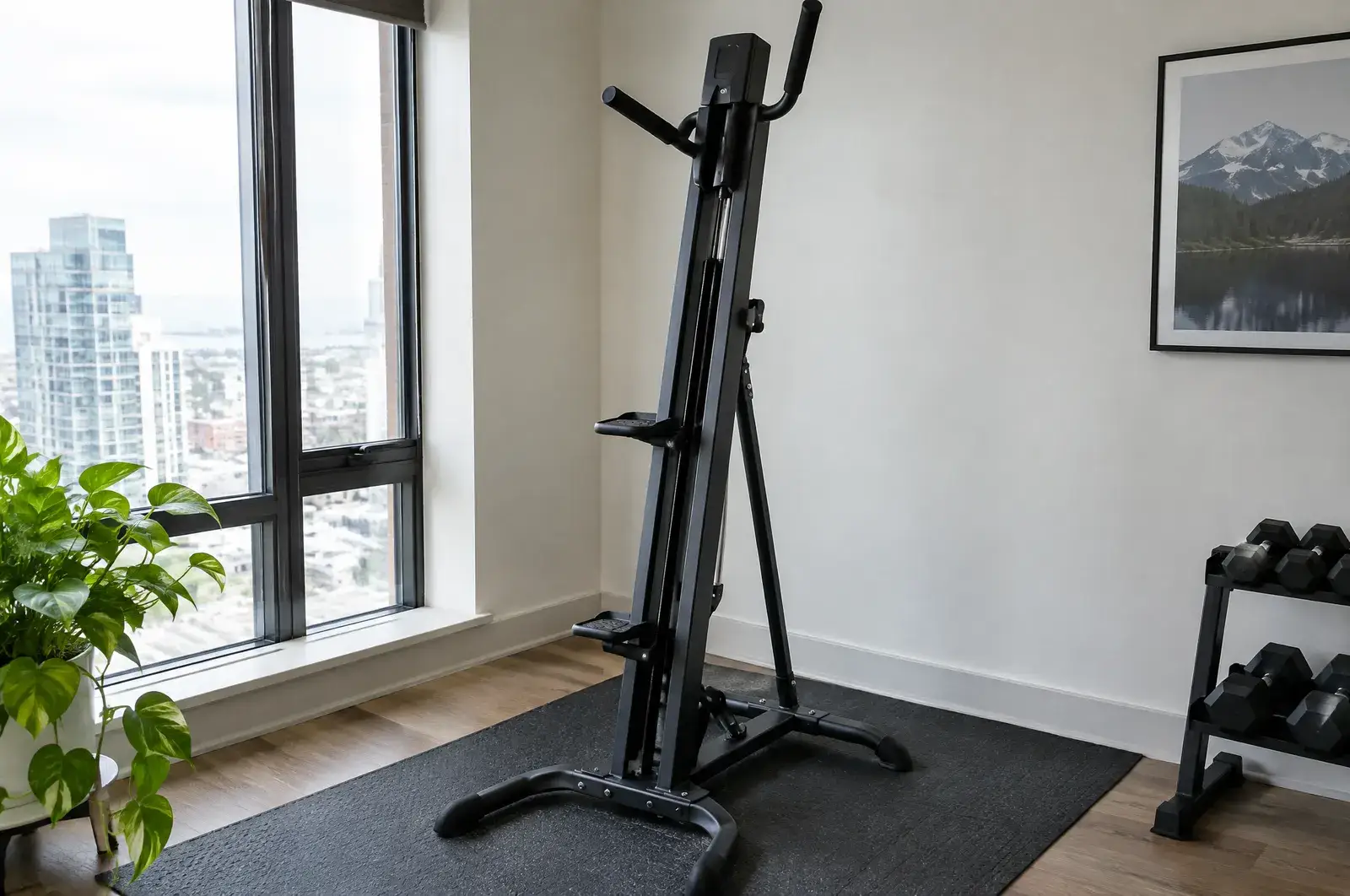
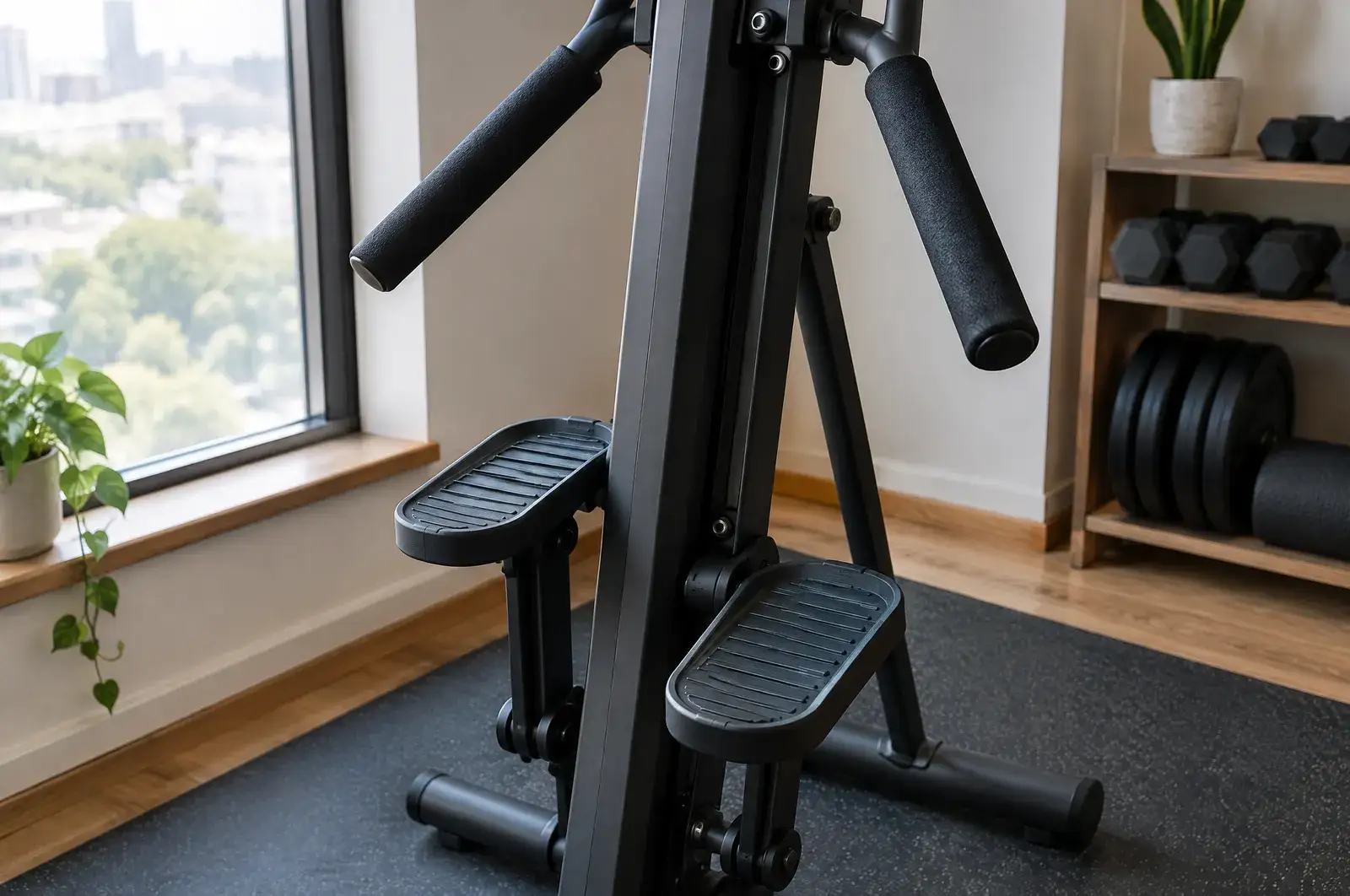
Vertical climber cardio means using a standing machine where you push and pull handlebars while your feet move on angled pedals, mimicking a climbing motion. On the Xebex Fitness Vertical Climber 3.0 Smart Connect, that motion has a 20-inch pedal stride and a 20-inch handlebar stride, giving a full-body range of motion instead of the lower-body-only work of an elliptical or bike.
It’s a different category from stair climbers and incline treadmills, even though people often lump them together. A vertical climber has a compact, fixed footprint and moves all four limbs at once. A stair climber like the Sisyphean Stepper or STEPR moves your legs through a stepping pattern, and an incline treadmill like the Blitz Mountain Climber lets you walk or jog up a graded deck. All three fall under the broader ellipticals and stair climber categories on cardio equipment, but they load the body differently.
How does a vertical climber compare to a stair climber?
The core difference is arm involvement and footprint. A vertical climber engages arms and legs together in one continuous pattern; a stair climber is leg-driven, with your arms mostly used for balance on rails or handles.
This table lines up the machines from our product research by category, so you can see where vertical climbing sits next to stepping and incline-walking options.
| Machine | Category | Price | Ceiling need |
|---|---|---|---|
| Xebex Fitness Vertical Climber 3.0 | Vertical climber | $2,799.00 | Not listed |
| Sisyphean Stepper | Manual stair climber | $2,362.97 | 102 in (8.5 ft) minimum |
| Blitz Mountain Climber Treadmill | Incline treadmill | $2,726.97 | 7.5 ft minimum |
| STEPR / Classic LED | Stair climber | $3,999.99 | Not listed |
| STEPR / HD Touchscreen | Stair climber | $4,999.99 | Not listed |
| STEPR Pro / Classic LED | Stair climber | $6,999.00 | Not listed |
| STEPR Pro / HD Touchscreen | Stair climber | $7,999.00 | Not listed |
| STEPR XL / Classic LED | Stair climber | $8,999.00 | Not listed |
| STEPR XL / HD Touchscreen | Stair climber | $9,999.00 | Not listed |
| Intenza 450 i2S Escalate | Commercial stairclimber | $15,000.00 | Not listed |
| Intenza 550 e2+ Escalate | Commercial stairclimber | $22,095.00 | Not listed |
Prices are maker-listed and change; check the source site before buying. Notice the spread: a vertical climber and the cheapest stair or incline options sit near $2,400–$2,800, while STEPR’s larger XL touchscreen models and the Intenza commercial units run into five figures.
What muscles does a vertical climber train?
Arms, shoulders, back, legs, and core all get worked because the handlebar-and-pedal motion moves the whole body at once. The pulling and pushing action on the handlebars loads the upper body while the pedal stride drives the legs, and staying upright through the movement recruits the core for stability.
Our product research doesn’t include a muscle-activation study or percentage breakdown, so treat that description as how the movement pattern works, not a lab-tested claim. If you want lower-body-dominant cardio instead, a stair climber or the ellipticals category will lean more on legs and glutes with less arm demand.
What does the Xebex Vertical Climber 3.0 actually offer?
It’s the only vertical climber in our product research, and it comes with a console that tracks nine metrics and runs multiple built-in program types. The base weighs 202 lbs and sits on wheels, which matters for a machine you may want to move for cleaning or space reasons.
| Spec | Value |
|---|---|
| Price | $2,799.00 |
| Net weight | 202 lbs (91.5 kg) |
| Ship weight | 232 lbs (105 kg) |
| Ship dimensions | 91 in x 30 in x 13 in |
| Resistance levels | 16 (console-controlled) |
| Pedal stride | 20 in |
| Handlebar stride | 20 in |
| Handlebar positions | 4 adjustable |
| Console read-outs | 9 (time, speed, workout time, step length, distance, pulse, calories, interval, resistance level) |
| Built-in programs | 7+ Race/Opponent, 4+ Interval, 4 Target/Goal |
| Heart-rate compatibility | 5kHz chest belts |
Sixteen resistance levels, shown on a large console read-out, is what lets one machine cover a walk-paced warmup and a high-effort interval. The 4 adjustable handlebar positions matter for households where more than one person, of different heights, will use the climber.
What workout programs come loaded on a vertical climber?
The Xebex console ships with race, interval, and target-based programs so you’re not stuck doing the same steady-state session every time. There are 7 or more Race/Opponent programs, 4 or more Interval programs built around time, distance, calories, or step count, and 4 Target/Goal programs, plus the option to switch between metric and imperial units.
Race/Opponent modes work well for short, motivating sessions where you’re pushing against a pace target. Interval programs suit HIIT-style cardio, since you can structure work-rest cycles by distance or step count instead of a fixed clock. Target/Goal programs are the better pick if you want a fixed calorie or distance goal and don’t want to watch the timer.
Can you attach accessories to a vertical climber?
Yes, at least on the Xebex model. Get RX’d sells a Cross Crawl Attachment for $195.00 that changes the movement from a standard pattern (elbow and knee on the same side stay equal distance apart) to a cross-crawl pattern (elbow and knee on the same side move toward each other). There are also Climber Extender Arms, also $195.00, for added reach.
Both attachments only fit Xebex climbers with serial number XC-CBR-1902 or higher; they are explicitly not compatible with serial number XC-CBR-1901. If you already own an older unit, check your serial number before ordering either accessory, since the maker’s warning is direct about the cutoff.
How much space and ceiling height do you need?
This is where vertical climbers and their stair-climbing, incline-walking cousins differ the most. Our product research does not list a ceiling requirement for the Xebex Vertical Climber, but its ship dimensions (91 x 30 x 13 inches) give a sense of footprint for planning a spot in a garage or spare room.
Related machines do list minimums, and they’re worth knowing if you’re weighing a climber against a stair or incline option for the same room:
- Blitz Mountain Climber Treadmill: minimum 7.5-foot ceiling for the average user, and it ships partially assembled.
- Sisyphean Stepper: minimum 102 inches (8.5 feet) for the average user, also ships partially assembled.
If your gym space is a converted garage with a low header or ductwork, measure clearance at the exact spot the machine will stand, not just the room’s average height. A stepper or incline treadmill that needs 8.5 feet of clearance won’t fit in a space with a 7-foot beam, even if the rest of the room is taller.
How much does vertical climber cardio equipment cost overall?
Budget for the machine itself plus flooring underneath it. The Xebex Vertical Climber lists at $2,799.00, which puts it close to entry-level stair climbers and incline treadmills in our product research, but well under STEPR’s higher-end XL touchscreen models ($8,999–$9,999) or the Intenza commercial stairclimbers ($15,000–$22,095).
For most home users, spending at the low end of this range ($2,300–$2,800) gets a console with resistance control, built-in programs, and a mobile freestanding base. The jump to $4,000+ machines like STEPR’s Classic LED and HD Touchscreen tiers buys a different category of build aimed at commercial or serious home-gym use, and the Intenza units are priced for club settings, not typical home budgets.
Under a rolling 202-lb machine with 16 resistance levels of vibration and repeated foot strikes, a stable, non-slip surface protects both your subfloor and the equipment’s footing. See best gym flooring for mat options sized for cardio machines.
Who should choose vertical climber cardio over other machines?
Pick a vertical climber if you want full-body cardio in a smaller footprint than a stair climber, and you don’t have the 7.5–8.5 feet of ceiling clearance that incline treadmills and steppers in our product research require. It also suits anyone who wants adjustable resistance and structured programs rather than a single fixed-intensity stepping motion.
Choose a stair climber instead if you want a leg-dominant workout that more closely mimics stepping, and you have the ceiling height to spare. Choose an incline treadmill if you want to walk or jog rather than climb, since the Blitz Mountain Climber ranges from a -5% decline to a 50% incline and lets you set a specific speed between roughly 0.5 and 8 km/hr, though the maker notes it isn’t built for running due to a shorter deck.
Safety notes before you start
Vertical climbers, stair climbers, and incline treadmills all involve repeated stepping or pedaling near a moving deck or pedal — check footing every session and keep the area around the machine clear. The Sisyphean Stepper’s maker specifically warns to place your foot fully onto each step, a rule that applies to any stepping-pattern machine to avoid a slipped step.
If you have joint issues, a heart condition, or you’re returning from injury, talk to a doctor before starting any high-intensity interval program, including the interval and race modes built into these consoles. None of this equipment is a substitute for medical guidance, and heart-rate chest belt compatibility (5kHz, on the Xebex console) is a tool for monitoring effort, not a diagnostic device.
Any assembly involving bolted frames or electrical console hookups should follow the maker’s manual closely; for anything beyond plug-in assembly, use a licensed professional. Ships-partially-assembled machines like the Blitz Mountain Climber and Sisyphean Stepper will need basic tools and a second person to handle heavier frame sections safely.
Where does vertical climber cardio fit in a home gym?
It works well as a standalone cardio station next to strength equipment, since its 202-lb wheeled base moves out of the way when you need floor space for other training. If you’re building out a full setup, see best home gym equipment for how cardio machines pair with racks and benches, and best home gyms for full-room planning.
This guide draws only on maker specs, prices, and published product pages; see how we research for how Home Gym Journal checks facts before publishing.
Bottom line
Vertical climber cardio gives you a full-body, arm-and-leg workout in a smaller footprint than most stair climbers, with the Xebex Fitness Vertical Climber 3.0 priced at $2,799.00 and offering 16 resistance levels plus built-in race, interval, and goal programs. If ceiling height or floor space is tight, a vertical climber is worth comparing directly against stair climbers and incline treadmills before you commit, since those categories can demand 7.5 to 8.5 feet of clearance and, in commercial-grade cases, five-figure budgets.
Questions
What is a vertical climber exactly?
A vertical climber is a cardio machine where you stand upright and move pedals and handlebars in a climbing pattern, similar to scaling a ladder. The Xebex Fitness Vertical Climber 3.0, for example, gives a 20-inch pedal stride and 20-inch handlebar stride for the movement.
How is vertical climber cardio different from a stair climber?
A vertical climber moves your arms and legs together in a climbing pattern with a fixed footprint, while stair climbers like the Sisyphean Stepper or STEPR use stepping motion, sometimes with continuous rotating steps. Stair climbers listed here also tend to need more ceiling height and, in some cases, cost more.
What muscles does vertical climber cardio work?
The pushing and pulling handlebar motion engages arms, shoulders, and back, while the pedal stride works legs and glutes, and the standing, twisting posture engages the core. Our product research does not list a specific muscle-activation study, so treat this as a description of the movement pattern, not a lab claim.
How much ceiling height does a vertical climber need?
The Xebex Fitness Vertical Climber 3.0 does not list a required ceiling height on its spec sheet. Related incline machines do: the Blitz Mountain Climber Treadmill needs a minimum 7.5-foot ceiling, and the Sisyphean Stepper needs a minimum 102 inches (8.5 feet) for the average user.
How much does a vertical climber cost?
The Xebex Fitness Vertical Climber 3.0 Smart Connect lists at $2,799.00 direct from Get RX'd. Related stair and incline machines range from $2,362.97 (Sisyphean Stepper) up to $22,095.00 for a commercial-grade Intenza stairclimber, so price depends heavily on category and build.
Can I add attachments to a vertical climber?
Xebex sells a Cross Crawl Attachment ($195.00) that changes the movement pattern so the same-side elbow and knee move toward each other, and Climber Extender Arms ($195.00) for added reach. Both only fit Xebex climbers with serial number XC-CBR-1902 or higher, not the earlier XC-CBR-1901.
Does a vertical climber tell you how many calories you burned?
The Xebex console displays Calories/Hr or Total Calories as one of nine standard read-outs, along with time, speed, distance, pulse, and resistance level. Our product research does not give sample calorie numbers for a workout, so actual output will vary by user and effort.
Is a vertical climber good for small home gyms?
The Xebex Vertical Climber 3.0 has a 202-lb freestanding base with wheels for moving it, and its footprint is smaller than a full stair-stepping machine. Ship dimensions are listed at 91 x 30 x 13 inches, which is a useful reference for floor space planning before delivery.
Sources
Every fact on this page comes from the sources below. We did not test these products by hand.
- Xebex Fitness Vertical Climber 3.0 Smart Connect — Get RX'd, accessed
- Xebex Climber Cross Crawl Attachment — Get RX'd, accessed
- Xebex Climber Extender Arms — Get RX'd, accessed
- Blitz Mountain Climber Treadmill — Bells of Steel, accessed
- Sisyphean Stepper - Manual Stair Climber — Bells of Steel, accessed
- STEPR Stair Climber — REP Fitness, accessed
- Intenza 550 e2+ Escalate Stairclimber — REP Fitness, accessed