
The short answer
The Bowflex C6 lists at $999 with no built-in screen and pairs with your own phone or tablet through the JRNY app. The VeloCore 22 lists at $2,199, adds a 22-inch HD touchscreen and a leaning core-engagement mode. Both have 100 magnetic resistance levels and ship with SPD cleats and 3 lb dumbbells.
On this page 13 sections
- The short answer
- Bowflex C6 vs bowflex VeloCore 22
- What’s the core difference between the C6 and VeloCore?
- How do price and included accessories compare?
- Does the screen difference change how you’ll actually train?
- What about workout apps and subscriptions?
- How does the leaning core mode change the ride?
- What do warranty and protection plans look like?
- Which bike fits a small home gym budget better?
- Where should each bike go in a home gym layout?
- Bottom line
- Questions
- Sources
Bowflex C6 vs bowflex VeloCore 22
| Attribute | Bowflex C6 | Bowflex VeloCore 22 |
|---|---|---|
| Price (maker listing) | $999.00 | $2,199.00 |
| Resistance levels | 100 magnetic | 100 magnetic |
| Built-in screen | None; uses your phone/tablet with JRNY app | 22 in HD touchscreen (Wi-Fi required) |
| Third-party apps | Connects to Peloton or Zwift app | Stream entertainment apps on touchscreen, no extra subscription |
| Included accessories | SPD cleats, pair of 3 lb dumbbells | SPD cleats, pair of 3 lb dumbbells |
| Handlebars | Not listed on sheet | 4-way adjustable |
| Dimensions | Not listed on sheet | 59.8 in L x 24.1 in W x 55.3 in H |
| Standard warranty | Not listed on sheet | 2 yrs mechanical parts, 1 yr electronics/touchscreen |
Choose bowflex C6 if
- Want the lowest entry price at $999
- Already own a tablet or phone for workout apps
- Want Peloton or Zwift compatibility without paying for a built-in screen
Choose bowflex VeloCore 22 if
- Want a built-in 22 in touchscreen with no extra device
- Want the leaning core-engagement design
- Want a longer maker-listed mechanical warranty spelled out up front
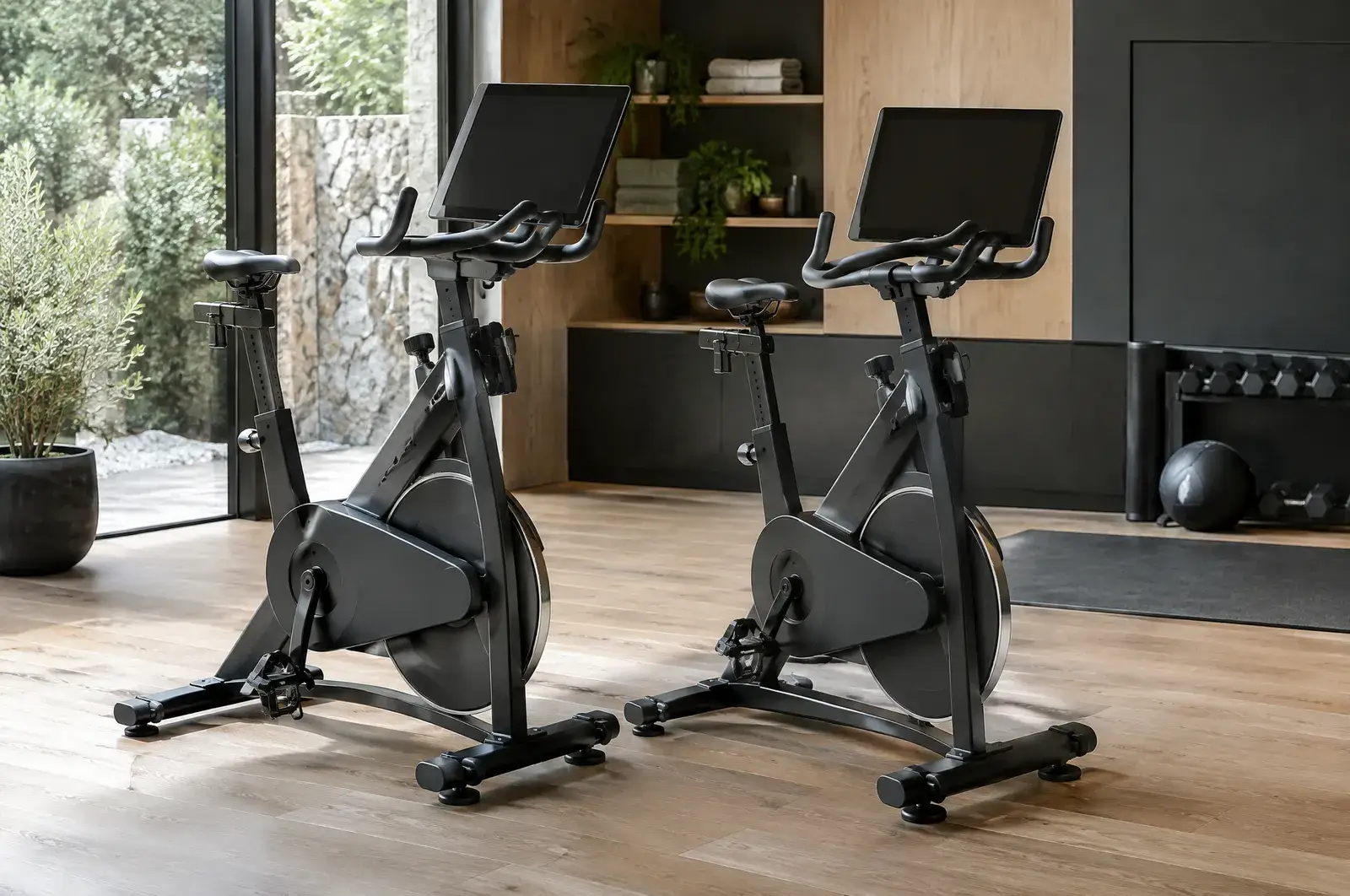
Bowflex sells two magnetic resistance bikes that share the same resistance hardware but split hard on price and screen. The C6 lists at $999 and skips the built-in display, leaning on your own phone or tablet. The VeloCore 22 lists at $2,199 and bundles a 22-inch HD touchscreen plus a leaning core mode the C6 doesn’t have.
What’s the core difference between the C6 and VeloCore?
The biggest gap is the screen and the price tag that comes with it. The C6 has no built-in display and pairs with a phone, tablet, or the Peloton and Zwift apps. The VeloCore 22 has its own 22-inch HD touchscreen built into the frame, and the maker’s price sheet puts it at $2,199 versus $999 for the C6 — a $1,200 difference (our calculation).
Both bikes share the same resistance system: 100 magnetic resistance levels, according to each product page. So the core pedaling feel and adjustability should track closely between the two, at least on paper. The difference in experience comes from what’s mounted to the handlebars, not what’s inside the flywheel housing.
How do price and included accessories compare?
Both bikes list the same starter accessory kit despite the price gap. Each one ships with a pair of SPD cleats for compatible cycling shoes and a pair of 3 lb dumbbells, per the maker’s listings.
| Item | Bowflex C6 | Bowflex VeloCore 22 |
|---|---|---|
| Price (maker listing) | $999.00 | $2,199.00 |
| Resistance levels | 100 magnetic | 100 magnetic |
| Cleats included | Yes, SPD | Yes, SPD |
| Dumbbells included | Pair of 3 lb | Pair of 3 lb |
| Built-in screen | None | 22 in HD touchscreen |
That means the $1,200 price gap buys the touchscreen, the leaning core-engagement feature, and whatever the internal frame and console upgrades cost to build — not extra workout gear. If you already own a tablet stand and don’t mind mounting your own device, the C6’s accessory kit matches the VeloCore’s.
Does the screen difference change how you’ll actually train?
Yes, it changes how you access workouts day to day. The C6 depends on an external phone or tablet running the JRNY app, or a connection to Peloton or Zwift, meaning you supply and mount your own screen. The VeloCore 22 has the screen already built in — a 22-inch HD touchscreen that needs a Wi-Fi connection to work, per the maker’s spec sheet.
For someone who already streams workouts on a tablet propped on a nearby shelf, the C6’s setup may feel familiar and saves $1,200. For someone who wants one integrated unit with no separate device to charge, mount, or misplace, the VeloCore’s built-in screen removes that extra step. The maker’s page also notes the VeloCore can stream entertainment apps directly through the touchscreen with no extra subscription required, which the C6 can’t do since it has no screen of its own.
What about workout apps and subscriptions?
Neither bike forces a required subscription for basic use. The C6 offers free access to essential JRNY workouts with no subscription needed, and it also connects to the Peloton app or Zwift app if you already pay for those separately. The VeloCore 22 offers JRNY access directly from its touchscreen, and the maker lists no extra subscription required to stream entertainment apps through that screen.
If your household already has Zwift or Peloton accounts, the C6’s app flexibility may matter more than a built-in screen. If you want one device that handles workouts and entertainment without juggling a tablet, the VeloCore’s on-board access covers both from a single touchscreen.
How does the leaning core mode change the ride?
The VeloCore’s page lists a leaning design as part of its core-engagement feature, along with 4-way adjustable handlebars — specs not listed on the C6’s sheet. That leaning mechanism is the VeloCore’s signature mechanical difference from the C6, beyond the screen. The C6’s product page doesn’t list a leaning frame or adjustable handlebar spec, so our product research suggests it’s a more traditional fixed-frame stationary bike.
If core engagement during cardio is a priority, that’s a VeloCore-only feature based on what’s listed. If you just want steady, fixed-position pedaling without extra frame movement, the C6’s simpler frame may suit that better — though our product research doesn’t list handlebar specs for the C6 to confirm adjustability.
What do warranty and protection plans look like?
Only the VeloCore’s page lists a detailed standard warranty: 2 years on mechanical parts and 1 year on electronics and the HD touchscreen. Bowflex also lists optional paid protection plans for the VeloCore — $159 for 3-year coverage and $219 for 5-year coverage. The C6’s sheet doesn’t list a specific warranty term, so that comparison can’t be made directly from the available facts.
Bowflex’s VeloCore page also lists a 30-day return window from delivery for a full product refund minus shipping and handling, and separate delivery tiers: Standard delivery at $199, Room of Choice at $249, and White Glove at $349. These delivery and return terms are listed specifically on the VeloCore page in our product research; the C6 page in our product research doesn’t repeat them, so buyers should check current terms directly with the maker before ordering either bike.
Which bike fits a small home gym budget better?
For most buyers watching total spend, the C6 at $999 covers the core cardio need — 100 resistance levels, JRNY access, and app compatibility — without the touchscreen premium. Pair the savings with your own tablet mount and you get a similar workout experience for roughly less than half the VeloCore’s list price (our calculation based on the $999 vs $2,199 figures on our product research).
The VeloCore makes sense if a built-in screen and the leaning core feature are must-haves, or if you want the bike to double as an entertainment display without separately mounting a tablet. Either way, check current pricing directly with Bowflex before buying, since retail prices change and the VeloCore page in our product research also references a sale price alongside the $2,199 regular price, meaning the page itself lists two different price points.
Where should each bike go in a home gym layout?
Both bikes need firm, level flooring and enough clearance around the front wheel for pedaling stability. A rubber mat under either model protects flooring from sweat and vibration; see our guide to best gym flooring for mat options sized for cardio equipment. If you’re building out a broader space that includes strength gear, our best home gym equipment and best home gyms roundups cover how a bike fits alongside racks and other stations.
Buyers comparing bike types beyond Bowflex’s magnetic resistance models can also read our explainers on what a recumbent bike is and what an air bike is for a wider view of the category, plus our bikes hub for more model comparisons. This article is based on maker specs, prices and published information as noted in our product research; see how we research for our sourcing approach.
Bottom line
The Bowflex C6 and VeloCore 22 share the same 100-level magnetic resistance system, SPD cleats, and 3 lb dumbbell set, but split sharply on price and screen. At $999, the C6 is the budget pick for anyone willing to supply their own tablet or phone. At $2,199, the VeloCore 22 adds a built-in 22-inch touchscreen, a leaning core mode, and a maker-listed warranty structure the C6’s sheet doesn’t spell out — a real upgrade if the integrated screen and core feature justify the $1,200 gap for your training space and budget.
Questions
Is the VeloCore worth $1,200 more than the C6?
The maker page lists the VeloCore 22 at $2,199 versus $999 for the C6, a $1,200 gap. That extra cost buys a built-in 22-inch HD touchscreen and the VeloCore's leaning core mode; the C6 has neither and relies on your own phone or tablet for the JRNY app.
Do both bikes need a screen or tablet to work?
The C6 has no built-in display, so it needs a phone or tablet running the JRNY app, or a connection to Peloton or Zwift. The VeloCore 22 has its own 22-inch HD touchscreen built in, though the maker notes it needs a Wi-Fi connection.
Do the C6 and VeloCore use the same resistance system?
Yes. Both bikes list 100 magnetic resistance levels on the maker's product pages, so the resistance hardware itself is not a differentiator between the two.
What accessories come with each bike?
Both the C6 and VeloCore 22 ship with a pair of SPD cleats for compatible cycling shoes and a pair of 3 lb dumbbells, according to the maker's product listings.
Does either bike require a subscription to use?
The C6 offers free access to essential JRNY workouts with no subscription required. The VeloCore 22 also lists no extra subscription needed to stream entertainment apps through its touchscreen, and offers JRNY access from the touchscreen as well.
What warranty protection does Bowflex list for the VeloCore?
The maker's VeloCore page lists a standard warranty of 2 years on mechanical parts and 1 year on electronics and the HD touchscreen. Optional paid protection plans extend that to 3 years for $159 or 5 years for $219.
Can I connect the C6 to Peloton or Zwift?
The maker's C6 product page lists connection to the Peloton app or Zwift app as a feature, alongside JRNY app compatibility for phones and tablets.
Sources
Every fact on this page comes from the sources below. We did not test these products by hand.
- C6 Bike product page — Bowflex, accessed
- C6 Bike pricing and resistance specs — Bowflex, accessed
- C6 Bike JRNY app and connectivity details — Bowflex, accessed
- VeloCore Bike - 22 product page — Bowflex, accessed
- VeloCore Bike - 22 pricing and warranty details — Bowflex, accessed
- VeloCore Bike - 22 dimensions and touchscreen specs — Bowflex, accessed